

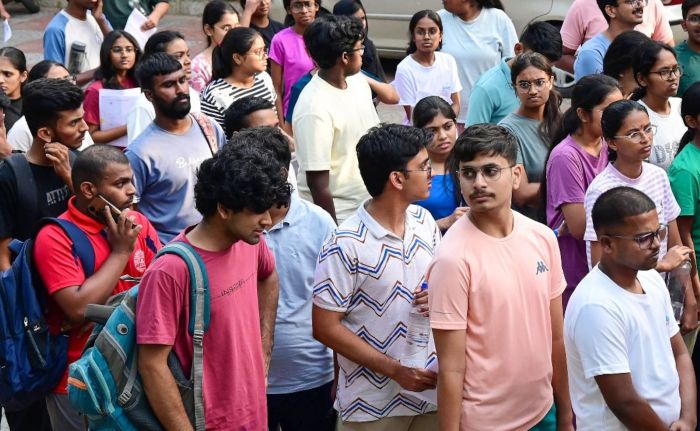
The alleged NEET UG 2026 paper leak controversy has triggered nationwide outrage, with initial investigations by the Central Bureau of Investigation (CBI) reportedly detaining five individuals so far. The now-scrapped examination—India’s largest single-shift entrance test for MBBS admissions—is at the centre of a deepening credibility crisis that has left over 22.8 lakh aspirants awaiting a fresh exam date.
NEET UG 2026 was conducted on May 3 across more than 5,400 centres nationwide, with nearly every registered candidate appearing for the examination after years of preparation, intense coaching, and immense personal sacrifice. The exam was meant to fill approximately 1.29 lakh MBBS seats across 780 medical colleges.
However, on May 13, the National Testing Agency (NTA) announced the cancellation of the examination following confirmed compromises arising from a suspected paper leak—turning months of preparation into uncertainty for lakhs of students.
The controversy escalated rapidly. Only two years after the widely criticised 2024 NEET cycle, the latest disruption has reignited concerns over systemic vulnerabilities in India’s high-stakes testing framework. Despite earlier assurances of reform, critics say structural weaknesses remain unaddressed. For many aspirants, the cancellation felt like a collective punishment—despite no fault of their own—fueling anger across social media platforms.
A widely circulated post by Dr. Nishant Singh, an orthopaedic surgeon, captured the intensity of public sentiment:
“This ‘broken trust’ isn’t a simple hairline fracture that can be fixed with a cast. As a surgeon, I see a system in septic shock. When 70% of a paper matches a ‘guess paper’ on WhatsApp, the infection has reached the marrow. Twenty-two lakh futures are on a ventilator while the NTA offers nothing but political anesthesia. We need a radical amputation of this corrupt nexus, not just words.”
Another user highlighted perceived institutional inertia:
“Remember the high-level committee led by the ISRO Chairman formed after the NEET paper leak issue? We excel at optics, announcements, and committees—outcomes are another matter.”
Financial concerns have also surfaced prominently. One user estimated that families collectively spend anywhere between ₹20,000 and ₹3 lakh per aspirant on coaching, accommodation, travel, and test series. Multiplied across more than 22 lakh candidates, the ecosystem cost runs into tens of thousands of crores—excluding the emotional toll and repeated financial strain caused by prolonged uncertainty.
Meanwhile, the investigation has widened. Authorities reportedly traced part of the leak network to Nashik in Maharashtra, where a 30-year-old BAMS student, Shubham Khairnar, allegedly purchased the leaked question paper for ₹10 lakh and resold it for ₹15 lakh. Officials believe the paper circulated nearly 45 hours before the examination through encrypted messaging platforms, suggesting a coordinated and pre-planned operation involving multiple intermediaries.
The probe has since expanded across several states, including Haryana, Rajasthan, Bihar, Kerala, and Jammu and Kashmir. Cities such as Gurugram, Jaipur, and Sikar have emerged as key nodes in the alleged network. Investigators suspect the involvement of organised “solver gangs” and middlemen who facilitated access to leaked papers for sums reportedly ranging from ₹2 lakh to ₹25 lakh, depending on timing and authenticity.
Several individuals have been detained from locations including Nashik, Gurugram, and Jaipur. However, officials are still working to establish how the paper was initially leaked and who had direct access to confidential examination material.
This latest controversy comes in the shadow of the 2024 NEET crisis, which saw allegations of paper leaks, grace marks disputes, Supreme Court hearings, and widespread protests over rank inflation. Following that episode, NEET was restored to its pre-COVID format, with all 180 questions made compulsory—Physics (45), Chemistry (45), and Biology (90)—and a total duration of 180 minutes.
The unrest prompted the government to constitute a seven-member high-level committee headed by former ISRO chairman Dr. K. Radhakrishnan on June 22, 2024. The panel recommended sweeping reforms, noting that the NTA had become overstretched while handling multiple large-scale examinations such as NEET, JEE, CUET, and UGC-NET.
Among its key recommendations were restructuring the agency, creating specialised teams for different exams, hiring permanent technical experts instead of outsourcing critical functions, and strengthening cybersecurity and encryption systems. The committee also suggested shifting NEET to an online mode—though the proposal was not implemented, citing infrastructural constraints.
As investigations continue and aspirants await clarity on a re-examination schedule, the controversy has already taken on political dimensions. Calls for accountability have intensified, with demands emerging for the resignation not only of senior NTA officials but also the Union Education Minister, Dharmendra Pradhan.
Critics argue that repeated exam security failures point to systemic negligence and a nexus between exam administrators and coaching networks. Bhim Kumar, Member of the Delhi State Committee, KYS, said:
“It is shameful that once again more than 22 lakh students have fallen prey to the apathy, incompetence and nexus of the NTA with the coaching mafia. This is not an isolated incident but a repetition of numerous paper leak cases. In the last ten years, more than 80 such incidents have come to light across the country. Despite repeated failures, instead of strict action and accountability, the Union Education Ministry continues to cover up the issue.”
—Autar Nehru