

The State of Working India (SWI) 2026 report identifies graduate employability and youth unemployment as a deepening structural crisis, based on a four-decade analysis of the official labour market data.
At the heart of the problem lies the massification of higher education. Rapid expansion of higher education institutions (HEIs)—driven by post-liberalization private sector growth and reinforced by the 11th Five-Year Plan—has not been matched by proportional increases in public funding or job creation. The result is a widening gap between degrees and decent work, even as India seeks to position itself as a key supplier to the global workforce.
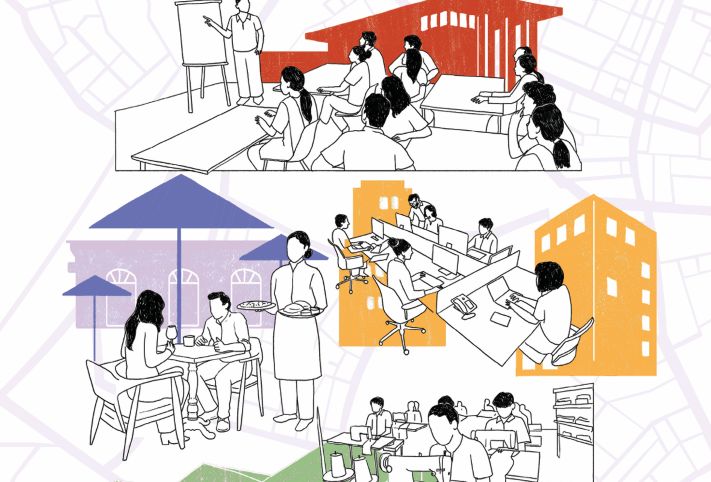
Against this backdrop, the fifth edition of SWI, released by Azim Premji University’s Centre for Sustainable Employment in March, examines ‘Youth in the Labour Market: Pathways from Learning to Earning’. Drawing on government datasets, administrative records, and surveys spanning 1983–2023, the report situates today’s employment crisis within long-term economic and educational transformations.
With a median age of 28 and nearly 367 million people in the 15–29 age group, India’s demographic advantage is undeniable. Yet the transition from education to employment remains fraught. Graduate unemployment as per this report among youth hovers near 40%, raising serious questions about the direction and effectiveness of higher education and identifies the education-to-employment transition as a critical bottleneck. For many young Indians, securing a job takes a year or more, often involving prolonged spells of open unemployment. While such friction is common globally, its scale and persistence in India point to deeper structural constraints—particularly weak labour demand.
SWI 2026 shows that the school-to-work transition is both delayed and uncertain. Nearly 40% of individuals aged 15–25 and about 20% of those aged 25–29 are unemployed, while only a small fraction secure stable salaried jobs soon after graduation.
This is occurring alongside an unprecedented expansion in higher education. The number of HEIs has grown from 1,644 to over 69,000, with the sharpest rise between 2000 and 2010. College density has improved, and nearly 80% of institutions are now privately managed. Technical education has followed a similar trajectory, with a surge in privately run ITIs.
However, job creation has not kept pace. Between 2004–05 and 2023, around 5 million graduates entered the labour market annually, but only 2.8 million found employment—and just 1.7 million secured salaried positions. This mismatch has led to a persistent surplus of graduates and stagnating earnings.
The report notes that the 11th Five-Year Plan (2007-2012)—once described as an “Education Plan” by the then Prime Minster Dr Manmohan Singh—spurred expansion in institutions and enrolment. But fiscal constraints later slowed public investment, while deregulation enabled rapid private growth. This led to regional clustering, the proliferation of low-cost colleges, and growing mismatches between enrolment and faculty capacity.
Inequalities have also widened. Rising costs of professional education have made high-return degrees inaccessible to poorer households, concentrating them in lower-return streams such as humanities and commerce. Faculty shortages further compound the issue, with student-teacher ratios far exceeding recommended norms in many institutions.
Regional disparities add another layer of complexity. In states like Bihar, Jharkhand, and West Bengal, limited access to quality education and weak local economies have made migration a necessity rather than a choice for many young people.
Importantly, the report challenges the binary framing of a “skills deficit” versus a “jobs deficit.” While skill gaps exist, the more binding constraint is the shortage of productive, formal, and well-paying jobs. Education and skilling investments alone cannot deliver outcomes without parallel expansion in labour demand.
Policy responses such as the National Education Policy (2020), the National Credit Framework (NCrF), and Apprenticeship Embedded Degree Programmes (AEDP) aim to bridge the gap between learning and earning. However, experts caution that these are only initial steps.
“Our experience while hiring suggests that youth unemployability is the biggest constraint due to lack of experiential learning that helps build both cognitive skills and domain knowledge. Inspite of having technical/ domain knowledge, graduates lack key horizontal skills – critical thing, solution mindset, decision making etc, which are required to unlock the human potential and for this academia needs to aligned is with industry as skills can’t be taught, it has to be acquired. The introduction of AEDP solves this problem, bit this needs a tripartite arrangement between student, industry and academia. Academia should build a bank of industrial connect to curate industry relevant programs and also for implementing them. Hands on learning is key to address the employability which smoothly transition from education to employment. University also has to focus on upgrading the skills through re skilling of existing workforce. As the shelf life of skills is shortening, continuous upgrading is non-negotiable. Hence, the role of academia which traditionally ended post student exit, which now has to co-exist as employability lifeline for life long,” reasons Sumit Kumar, Chief Strategy Officer, TeamLease Services Limited, a leading staffing solutions and recruitment company.
Ultimately, the school-to-work transition is a key barometer of labour market health. A smooth transition reflects a robust system; prolonged unemployment signals structural inefficiencies. SWI 2026 does not offer easy solutions, but it provides a vital evidence base for rethinking how India can align education, employment, and economic growth to truly realize its demographic dividend.