

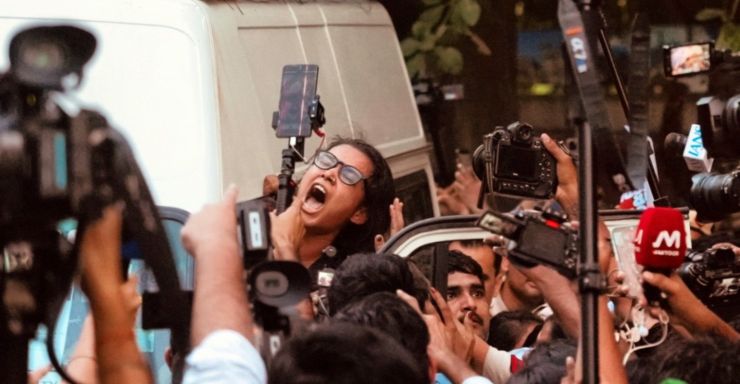
Neha Bora, national president of the All India Students’ Association (AISA), the student wing associated with the Communist Party of India (Marxist–Leninist) Liberation, has found herself at the centre of a political controversy following her October 14 remarks about Bangladesh’s student-led uprising. A PhD scholar at Jawaharlal Nehru University (JNU), Bora said that the Gen Z movement in India had drawn inspiration from Bangladesh and congratulated its student activists for having “shown us the way”. Her comments triggered a sharp reaction from the BJP and renewed allegations that ostensibly issue-based protests in India could be part of a larger project of political destabilisation.
Bora subsequently offered an explanation, arguing that her reference was to progressive Bangladeshi activists who championed communal harmony and opposed fundamentalism. Her clarification raises a legitimate question: when an activist invokes an international protest movement, is the intention to borrow its democratic aspirations, endorse its methods, or signal a broader political alignment?
The distinction matters, particularly in the case of Bangladesh. The uprising that forced Sheikh Hasina from power in August 2024 began with student opposition to government job quotas and expanded amid a deadly crackdown and wider public anger. Its aftermath, however, has also been marked by political instability and serious concerns over attacks on Hindus. For many Indians, these developments complicate any straightforward celebration of the uprising as a democratic template.
Bora’s remarks, therefore, deserve scrutiny. But scrutiny should not automatically become proof of a conspiracy. A political activist can draw inspiration from a foreign movement without being part of an externally directed operation. Conversely, the language of democracy and popular resistance does not exempt any movement from questions about its objectives, methods, leadership or accountability.
From a campus activist to a national political voice
Bora’s rise illustrates how rapidly the political landscape can change when a local grievance finds a wider audience. During the protests against the NEET examination paper leak and alleged irregularities in the examination system, she emerged as one of the prominent faces of the agitation. Her participation in a prolonged hunger strike at Jantar Mantar, her criticism of the government’s handling of examination failures, and her ability to communicate political arguments in an accessible language brought her considerable visibility.
The agitation also demonstrated that established student organisations retain organisational resources that loosely connected protest groups may lack. Left student bodies, including AISA and the Students’ Federation of India (SFI), contributed activists, campaign experience, slogans, cultural programmes and mobilisation networks. The Cockroach Janata Party (CJP), meanwhile, became a recognisable platform around which anger over examination irregularities and wider grievances could gather.
Was the emergence of CJP merely coincidental? It would be premature to infer either a spontaneous, entirely leaderless movement or a centrally orchestrated political project without examining the evidence. The more useful question is how different groups came together, what each contributed, and whether their cooperation was limited to a particular cause or extended into a continuing political arrangement.
AISA’s involvement was hardly inexplicable. Student organisations affiliated with political parties have historically participated in campaigns beyond university campuses, especially when issues such as examinations, recruitment, unemployment and government accountability affect young people directly. Bora herself has described the Jantar Mantar agitation as the culmination of years of activism rather than an overnight revival of the Left. That account should be examined alongside the roles played by independent organisers and participants who may not share AISA’s ideology.
What is clear is that Bora has moved beyond the conventional profile of a campus activist. Whether she eventually enters electoral politics is her decision, and there is little value in speculating about it. Her immediate significance lies in her ability to connect established political traditions with a younger audience that often distrusts traditional party structures.
The international connection: influence is not proof of control
Student politics has never existed in an ideological vacuum. Indian movements have long drawn on international ideas about socialism, anti-colonialism, civil liberties, labour rights, feminism and democracy. The Russian Revolution influenced Indian communists; European socialist thought informed sections of the nationalist movement; and international debates over race, caste, gender, environmental justice and human rights continue to find their way into campus discussions.
These exchanges are neither new nor inherently suspicious. Indian student organisations may draw inspiration from movements abroad, just as activists in different countries borrow slogans, symbols, digital tactics and forms of protest from one another. Social media has accelerated this process, allowing a campaign in one country to become a reference point for young people elsewhere within hours.
But four different relationships must be distinguished: ideological influence, organisational links, financial connections and operational coordination. The first is commonplace in political life. The others require progressively more specific evidence before claims about their significance can be established. Similar slogans, shared political positions, contacts between activists or protests occurring at around the same time may demonstrate influence or solidarity; on their own, they do not prove central direction or a coordinated plan for regime change.
At the same time, international inspiration should not be treated as a substitute for political judgment. The question for Indian student activists is therefore not whether they should learn from movements abroad, but whether they assess those movements critically, including their failures and unintended consequences.
Why the old Left has struggled—and why it may not disappear
The present moment also invites a broader examination of the Left’s place in Indian student politics. Before the economic reforms of 1991, trade unions, civil-liberties campaigns and socialist organisations often occupied a more prominent place in public debate. Their appeal rested on a combination of ideological commitment, mass organisation and identifiable collective interests, including those of workers, peasants and students.
The political economy has since changed. Liberalisation, the expansion of private education, the growth of the service sector, digital communication and increasingly competitive employment markets have altered the aspirations of young Indians. Students face intense pressure to secure qualifications and jobs in an uncertain economy. They may be deeply concerned about examination failures, unemployment, rising costs and unfair recruitment without necessarily subscribing to a comprehensive political ideology.
This helps explain why issue-based mobilisation can attract participants who would never join a political party or become lifelong members of a student organisation. A student may join a protest against a paper leak because it threatens years of preparation and family investment. Another may participate because of anger over police action or the denial of civil liberties. Both can share a platform without agreeing on the larger political order they want.
Such movements can produce powerful moments of collective action, but sustaining them is more difficult. Once the immediate grievance is addressed, participants return to their studies, employment searches and personal lives. A political organisation, by contrast, seeks continuity, ideological commitment and a durable support base. This difference may help explain why visibility during a major agitation does not always translate into sustained electoral strength for the organisations involved.
Yet it would be a mistake to declare the Left irrelevant. Questions of inequality, access to education, workers’ rights, social discrimination and the concentration of economic power remain unresolved. Left organisations possess traditions of collective mobilisation and political argument that can still resonate when they connect with the lived experiences of young people.
Campus politics is changing, not disappearing
Does all this substantially change campus life? Not necessarily. A high-profile protest can dominate the national conversation without transforming everyday political participation across universities. The intensity of a particular agitation should not be mistaken for a permanent shift in student loyalties.
Universities also contain political traditions that do not fit neatly into a Left-versus-Right framework. Students mobilise around regional identity, caste, gender, language, fees, hostel conditions, representation and administrative accountability. Some favour ideological organisations; others prefer independent platforms. Many remain politically disengaged until an issue affects them directly.
Digital platforms have made it easier to communicate grievances and build a public profile, but they have also encouraged politics centred on personalities, viral clips and sharply defined ideological labels. An effective communicator can bring an overlooked issue to national attention, yet online popularity is a poor substitute for an organisation capable of listening to students, negotiating with administrations and sustaining campaigns after public attention moves elsewhere.
Bora’s growing profile may inspire young activists, including those who do not agree with her politics, to communicate more effectively and take public issues seriously. That is a contribution in itself. But a charismatic leader’s success does not automatically signal the revival of an ideology, just as an ideological organisation’s participation in a protest does not mean it controls every participant.
The danger lies in two opposite temptations: dismissing every student protest as a conspiracy, or treating every protest as an uncomplicated expression of popular will. Both positions evade the harder task of examining grievances, leadership, methods, evidence and outcomes.
The ultimate test of student politics is not how loudly a movement challenges those in power, how quickly its slogans spread, or how many followers its leading figures acquire. It is whether the movement advances students’ interests, respects democratic freedoms, remains accountable to its participants and offers credible answers to the problems that brought people onto the streets in the first place.
India’s campus politics may indeed be entering a new phase—one in which established ideological organisations, independent campaigners and digital-first activists work together on some issues while competing on others. Whether this produces a durable political realignment remains uncertain. What is already evident is that student activism is adapting to a different social and technological environment.