

India’s largest and first-ever competency-based student assessment, the PARAKH Rashtriya Sarvekshan 2024, under the National Education Policy (NEP) 2020, has raised serious concerns about learning outcomes in key subjects. The recently released report reveals a sharp decline in students’ understanding of mathematics and science as they progress from primary to secondary school.
While a fair percentage of Class 3 students demonstrated foundational skills in reading and arithmetic, those same competencies drop by nearly 20–30% in Class 6 and plummet further in Class 9. Basic number sense, conceptual clarity in fractions and percentages, or even the ability to reason through scientific principles—these are skills that should grow stronger with time. Instead, they are eroding.
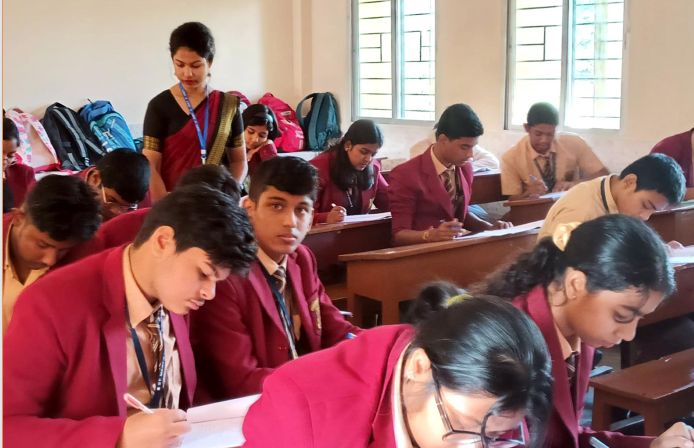
The PARAKH Rashtriya Sarvekshan 2024 conducted in December 2024 engaged over 22,94,377 students in Grade 3, Grade 6, and Grade 9 from 75,565 schools nationally to assess their competencies in critical subjects like Language, Mathematics, Science, Social Science and The World Around Us, with the aim to provide comprehensive insights into the educational journey of learners. The findings are clear: as students move up the grades, particularly in maths and science, their competencies decline sharply.
- Only 38% of Class 6 students could solve real-life arithmetic problems.
- Less than 30% of Class 9 students could apply concepts like percentages and fractions accurately.
- In science, fewer than 35% of Class 9 students could explain everyday phenomena or understand basic principles like electric circuits and states of matter.
- The survey found significant regional gaps in performance, with students from Punjab, Kerala, and Himachal Pradesh performing better across grades, while districts in Jharkhand, Meghalaya, and Arunachal Pradesh lagged behind.
- Interestingly, in states like Rajasthan, rural students in Class 3 outperformed their urban counterparts, highlighting that infrastructure alone may not be the defining factor—classroom practices and community involvement matter just as much.
This points to a system where learning is not being reinforced, tracked, or strengthened over time. A student may clear one grade without mastering the concepts needed for the next—and by the time they reach higher classes, they are left unprepared and demotivated. Maths and science are not just subjects—they are gateways to critical thinking, problem-solving, and innovation. A student who gives up on fractions in Class 6 is less likely to pursue engineering or science in Class 11. These learning gaps are not mere academic failures; they are missed opportunities in the making of a knowledge economy.
India stands at a crossroads. It can continue to churn out millions of underprepared youth with paper qualifications—or it can invest deeply in the kind of foundational learning that transforms lives, economies, and futures.
This trend should set off loud alarm bells in both policy and pedagogical circles. In a country aspiring to be a global hub for technology, innovation, and scientific research, the foundational skills that fuel such ambitions are withering far too early.
The declining competencies suggest two interlinked failures: retention and reinforcement.
First, the lack of conceptual retention points to a pedagogy that may favour rote learning over real understanding. If students can perform operations in Class 3 but not apply the same knowledge in Class 9, it shows that learning is not cumulative—it is mechanical and brittle.
Second, the absence of reinforcement stems from curriculum design and classroom delivery that do not build progressively on earlier foundations. Maths and science, by their nature, require scaffolding—concepts must be layered over time. But current teaching methods often treat topics as isolated units, not as parts of a larger, coherent journey.
The PARAKH report also found that a significant number of teachers are under-resourced and under-trained. In many cases, subject-specific teaching is missing altogether in upper primary classes. Without well-prepared, well-supported teachers, maths and science cannot be taught with the clarity and confidence they demand. This shortage is especially acute in rural and underdeveloped districts, compounding inequality and regional disparity in learning outcomes.

This sharp decline in learning outcomes reflects deep-rooted problems in how we teach, learn, and evaluate. Classrooms continue to rely heavily on rote memorisation rather than conceptual understanding. Textbooks move on, but comprehension does not follow. The curriculum is not structured to revisit and reinforce earlier concepts. By the time students reach secondary school, many are left with shaky foundations and no support structure to rebuild them.
What is equally troubling is the loss of confidence in students. Struggling with abstract concepts without adequate guidance, they disengage. Maths and science soon become subjects to fear or avoid—cutting off pathways to careers in STEM fields where India hopes to lead globally.
A key reason behind this learning loss is the shortage of well-trained, subject-specific teachers, especially in rural areas. Teachers are often overburdened, under-resourced, and sometimes teaching subjects outside their area of expertise. In such conditions, even the best curriculum or the most ambitious policy will fail to deliver.
As the PARAKH report does not just diagnose a problem—it points to a path forward by building upon the foundations laid by the National Achievement Survey (NAS). The Rashtriya Sarvekshan 2024 was designed to assess schools as comprehensive entities, focusing on the overall health of the education system in each district. This includes State Government, Government-Aided, Central Government and Private Recognised Institutions alike. “This initiative is not just an assessment; it’s a cornerstone for driving educational reforms aligned with the National Education Policy (NEP) 2020. By gathering rich data and insights, we are committed to paving the way for a brighter, more equitable educational future for every child in India,” says the report.
The need of the hour is a multi-pronged response:
- Radically overhaul curriculum sequencing to ensure continuity and deepening of concepts across grades. Strengthen conceptual learning in primary and middle school, especially in maths and science. Topics must build on each other, not exist in silos.
- Retrain and upskill teachers, ensuring subject mastery and modern pedagogy reach every classroom. Invest in teacher training, especially in content mastery for maths and science.
- Introduce targeted remedial programs in middle and secondary school—not just early grades.
- Use real-life contexts in teaching to make abstract concepts relatable and retainable.
- Make assessments competency-based, not memory-based, throughout the school journey.
- Invest in rural and underperforming districts where the learning crisis is most severe.
India does not lack ambition when it comes to education reform. The NEP 2020, NIPUN Bharat, and the creation of PARAKH itself are testament to a policy ecosystem that understands the urgency of the learning crisis. But execution remains the Achilles’ heel.