

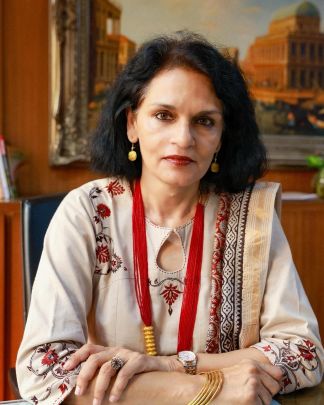
By Rima Singh, Head of DPS International, Gurgaon
 The children who will solve tomorrow’s most complex challenges are already sitting in today’s classrooms. Their ability to address these problems will depend largely on how well they can think critically, build on ideas, and navigate uncertainty. Skills such as curiosity, innovation, and confidence will be essential—and the earlier these are nurtured, the more profound and lasting their impact.
Over the past three decades of evolving pedagogical practices, one insight stands out: starting early is not about accelerating content delivery, but about cultivating the capacity to question, explore, and create. Two globally recognized educational frameworks—the International Baccalaureate (IB) and Cambridge International Education (CIE)—exemplify this philosophy. Both systems recognize that curiosity, creativity, and self-confidence are innate to every child. Their goal is not merely academic achievement, but the development of lifelong learners who can adapt to a rapidly changing world.
The IB: Inquiry-Driven Learning
The IB Continuum includes the Primary Years Programme (ages 3 to 12), Middle Years Programme (ages 11 to 16) and Diploma Programme (ages 16 to 19), demonstrating this methodology. The learner profile is a framework of ten attributes (inquirer, thinker, risk-taker, and communicator) and is a guide for each relationship. Transdisciplinary inquiry allows students to solve real life problems using the attributes of their learner profile, facilitating the development of innovation.
Consider a PYP unit on “Sharing the Planet,” where young learners investigate sustainable water use. Instead of focusing solely on memorization, they create prototypes of systems for harvesting rainwater, making changes to their prototypes according to the opinions of their peers and the data collected from the environment.
The resulting questions encourage curiosity and exploration through inquiry into issues such as “Why does abundance sometimes create scarcity?” and “What if common everyday materials can offer solutions that are hidden?” As children have opportunities to see their ideas develop into a real-world impact, they build confidence over time and begin to express their own unique and creative perspectives.
The Cambridge Approach: Structure with Flexibility
The Cambridge Schools, as outlined by their Programmes, including Primary and Lower Secondary through IGSCE & A Level, provide Structure and Flexibility within a Framework that supports Active Learning as well as Projects, Debates, Interdisciplinary Thematic Studies (like the IB’s Inquiry Based Learning Model), and a series of composed assessments that are Rigorous and Shift the focus from rote memorisation to comprehensive depth of comprehension.
In Cambridge’s “Global Perspectives” course, for instance, students aged 14 and above dissect issues like climate migration, synthesizing evidence from diverse sources to propose evidence-based arguments. This cultivates curiosity by demanding engagement with multifaceted viewpoints, challenging learners to pivot from certainty to informed exploration.
Beyond the Classroom: Building Resilience and Agency
These two programs share the commonality of rejecting the separation of emotional/social development from intellectual growth. The two models place a high value on international-mindedness and encourage students to question cultural biases and make ethical choices. In IB’s Middle Years Programme (MYP), learners must complete a community project addressing a cause of their choosing (e.g., urban biodiversity loss).
Students create their project through independent research and action; thus, students balance their autonomy with guidance, which helps develop learners’ metacognition and ability to navigate the increasing number of future jobs with AI augmentations. The Extended Essay and reflective portfolio in A Level/IGCSE similar emphasize consistent investigation. The students learn to be comfortable with uncertainty and develop the skills required and the necessary mindset to embrace it.
From Fleeting Wonder to Enduring Exploration
This nurturing process can be interpreted in a new way: it is not simply through teaching skills that we have facilitated this learning opportunity; it is by rewiring the neural pathways that provide the building blocks for curiosity through exploration of open-ended problems (specifically). This work, through neuroeducational research, shows that when children are given access to opportunities to explore possibilities through open-ended problems very early on; they begin developing habits of exploration spurred by dopamine as opposed to experiencing wonderment as a temporary feeling.
When applying these changes made in the field of education, there are many programs that have been developed to improve the situation of learners, both in schools and out of the classroom. For example, a service-learning model allows students to merge their academic goals with their material contributions to the local community by providing them with the opportunity to create student-lead task forces to deal with sustainability issues. The model prepares students to confidently lead in times of uncertainty and encourages creative solutions to existing challenges.
Preparing for an Exponential Future
The true strength of IB and Cambridge lies in their forward-looking vision. As automation increasingly replaces routine tasks, uniquely human capabilities—creative problem-solving, adaptability, and ethical reasoning—become critical.
These frameworks proactively embed future-oriented literacies: computational thinking in early robotics challenges, ethical discussions around artificial intelligence, and data analysis skills in advanced coursework. Students graduate not just with knowledge, but with the versatility to innovate in unfamiliar domains—from biotechnology to social reform.
As educators refine the models established by these frameworks the promise remains that if you nurture the young mind today, the major breakthroughs of tomorrow will follow.