

The Panchkula school assault is not an ordinary incident of violence caught on a school’s CCTV cameras. The footage, reportedly showing an eight-year-old student brutally assaulting a six-year-old girl inside an empty classroom, is disturbing beyond words. The sheer ferocity and sequence of the attack raise questions that go far beyond the immediate circumstances of the incident. How could such violence unfold inside a school, involving children so young, without anyone intervening?
The October 28 incident at Shaheed Major Anuj Rajput Government Model Sanskriti Senior Secondary School in Sector 20, Panchkula, has brought into sharp focus the safety of children within school premises, the adequacy of classroom supervision and the accountability of school authorities. It also raises a disturbing question about the possible influence of violent digital content on young and impressionable minds. The victim’s family has alleged that the boy was exposed to violent online games. While this cannot be accepted as an established explanation for his behaviour, the possibility that children are absorbing and imitating violent imagery warrants serious examination.
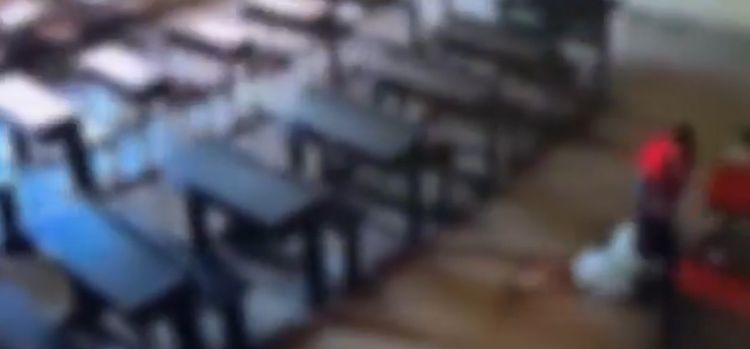
According to reports, the eight-year-old Class 3 student allegedly lured the six-year-old kindergarten girl to an empty classroom on the first floor by telling her that her father had arrived. He then attacked her with a brick, flowerpot and other objects, banged her head against a desk and kicked her after she fell. CCTV footage reportedly captured not only the initial assault but also a second attack after the little girl had lost consciousness.
The child sustained serious head and facial injuries, including a nasal fracture, and is undergoing treatment at PGIMER, Chandigarh. The Haryana government has suspended the school principal and two teachers, registered a case against the school authorities and constituted a five-member committee to investigate the incident. The principal’s suspension has been ordered under the Haryana Civil Services (Punishment and Appeal) Rules, 2016. The eight-year-old boy has undergone a psychological assessment and was sent to an observation home in Ambala on November 2, pending further proceedings.
The constitution of the inquiry committee and the decision to undertake a safety audit of schools across Haryana are welcome steps. But these must not become another administrative exercise that ends with a report and a few suspensions. All state governments should undertake a comprehensive school safety audit, covering staffing, classroom supervision, CCTV monitoring, access control, emergency response and child protection mechanisms. Safety cannot be reduced to installing cameras or locking school gates. It requires vigilant adults, clearly defined responsibilities and systems that work when children are most vulnerable.
What makes the Panchkula incident even more disturbing is that it cannot be viewed in isolation. Another shocking attack, this time by an adult intruder, was reported from a Zilla Parishad school in Raptadu, Anantapur district of Andhra Pradesh. On October 31, a 21-year-old man allegedly entered a classroom around 10.30 am, while 31 girl students were attending a mathematics lesson, and attacked a Class 10 student with a mechanised chainsaw. Another girl, who attempted to intervene, was also seriously injured.
The principal victim suffered deep cuts to her neck, abdomen and face, and her right hand was nearly severed. She was shifted for advanced treatment and placed under the care of a multidisciplinary medical team. The second injured student was also hospitalised. The accused, reportedly a relative of the girl, was subsequently apprehended by police after a manhunt.
The two incidents are different in nature and involve very different circumstances. One concerns alleged violence by a child against another child; the other, an alleged attack by an adult who entered a school carrying a dangerous weapon. Yet both expose a common vulnerability: the failure of school environments to guarantee the physical safety of children entrusted to their care. In Panchkula, the alleged assault took place inside the school, apparently without timely intervention. In Raptadu, an outsider was able to enter a classroom and carry out a potentially fatal attack.
India needs to move beyond fragmented responses to such incidents and establish a comprehensive, enforceable school safety framework. This should include mandatory visitor verification, monitored entry and exit points, functional CCTV systems, adequate deployment of teachers and support staff, designated child-protection officers, emergency response protocols and periodic independent safety audits. Schools must also have mechanisms for identifying bullying, aggression, abuse and behavioural distress before they escalate into violence.
There is another dimension that deserves urgent attention: the digital environment in which children are growing up. Violent games, graphic videos, online challenges and algorithm-driven content can expose young minds to material they may not have the maturity to process. It would be simplistic to attribute an act of violence to video games alone. Nor should children displaying disturbing behaviour automatically be labelled dangerous. But parents, teachers, counsellors, technology companies and policymakers can no longer afford to treat children’s digital exposure as a private matter beyond the reach of child protection.
The Supreme Court’s October 15, 2026 observations on children’s internet access and online safety also deserve renewed attention in this context. The Court recognised that children have rights to internet access and expression, and that a blanket prohibition is not necessarily an effective answer to online dangers. Its emphasis on safer, age-appropriate access, parental oversight and protective mechanisms should now be translated into a more concrete national framework. The government must examine solutions being attempted in other countries, including age-appropriate account settings, meaningful age verification, restrictions on harmful content and stronger parental controls, while protecting children’s legitimate access to education and information.
The larger question is whether we are adequately preparing children to navigate an increasingly violent and unregulated information environment. Schools cannot be expected to shoulder this responsibility alone. Parents must be more attentive to what children watch and play; teachers need training to recognise behavioural warning signs; counsellors must be accessible; and digital platforms must be held accountable for exposing minors to harmful content.
The Panchkula and Raptadu attacks should not be dismissed as isolated aberrations. Neither should they become an excuse for panic, indiscriminate restrictions or criminalising children. These incidents may be warning signs of a deeper crisis in the way society safeguards its children. If we fail to understand the conditions that allow such violence to occur, we risk confronting more serious consequences later. A school is supposed to be a sanctuary of learning, trust and childhood. When that sanctuary is breached, the responsibility to restore it belongs not merely to the school administration but to the entire system of education, governance and child protection.
The question is no longer whether our schools need stronger safety measures. It is how many more children must suffer before we make their safety an uncompromising priority.