

It is hardly a secret anymore that the Rashtriya Swayamsevak Sangh (RSS) has always taken a special interest in who heads the Ministry of Education whenever the Bharatiya Janata Party (BJP) is in power. The ministry has rarely been left to function without someone perceived to enjoy the confidence of the RSS. Critics point to an obvious conflict of interest, while supporters see it as a legitimate ideological alignment. Either way, the pattern is difficult to ignore.
The obvious explanation is that education shapes future generations and, therefore, offers an opportunity to influence national thought and cultural identity. But if ideas are strong enough to stand on their own, they should spread through scholarship, successful models, public debate and popular appeal. Why, then, is it considered so important to have a trusted individual occupying Shastri Bhavan?
The answer perhaps lies in the Ministry’s central role in educational governance. It determines policies, oversees institutions, regulates standards, influences curriculum frameworks and shapes the direction of educational reform. Control over the ministry, therefore, carries significance far beyond routine administration.
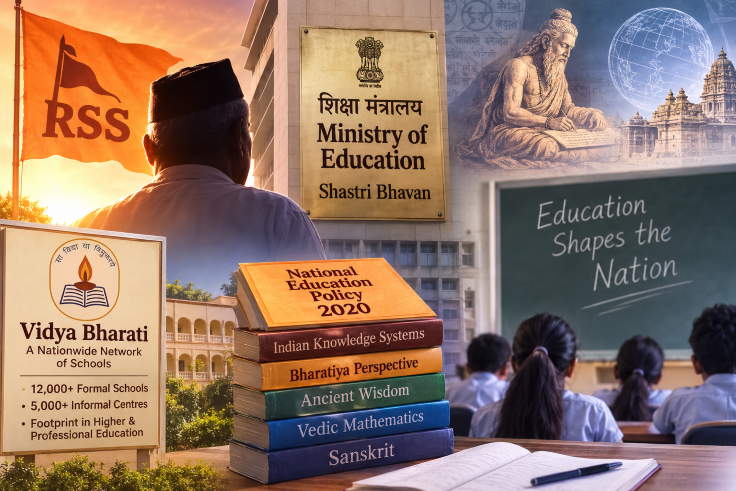
The RSS itself has a substantial educational presence through Vidya Bharati, which administers more than 12,000 formal schools and around 5,000 informal education centres across the country. It also has a growing footprint in higher and professional education. Protecting and expanding this network naturally requires a policy environment that is, at the very least, sympathetic to its objectives.
Beyond institutional interests, the RSS has long advocated what it describes as a “Bharatiya” perspective on education. Its think tank, Bharatiya Shikshan Mandal, has consistently argued for an education system rooted in India’s civilisational traditions. While critics often dismiss these efforts as the “saffronisation” of education, the RSS argues that India’s ancient systems of learning were inquiry-driven, intellectually rigorous and founded on enduring scientific and philosophical principles. In its view, these traditions can be adapted to modern needs without sacrificing their essential character.
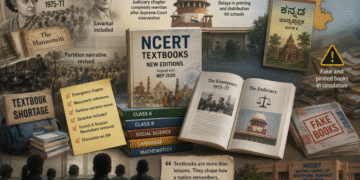
These competing narratives have become increasingly visible with every appointment of an education minister, every textbook revision, every committee formation and every institutional appointment. Social media has amplified the debate, making education one of the principal arenas of India’s larger ideological contest. The BJP and the RSS appear determined to use the opportunity provided by political power to institutionalise their vision, while opponents challenge these efforts on constitutional, academic and procedural grounds. The result is an ongoing struggle over the direction of Indian education.
This is not a new phenomenon. The Vajpayee government pursued a similar course after 1999. However, there is an important distinction. Dr. Murli Manohar Joshi was not merely an RSS-backed minister; he was an accomplished academic and one of the BJP’s foremost intellectual leaders. He confronted an educational establishment that was widely perceived as dominated by Left-liberal thought and whose influence extended across universities, research institutions and academic bodies. His decisions were vigorously debated and often challenged, but they were part of a contest between competing intellectual traditions. Whether one agreed with him or not, Dr. Joshi commanded respect as an educationist and policymaker.
His tenure also witnessed significant reforms. The Constitution (Eighty-sixth Amendment) Act, 2002 strengthened the foundation for free and compulsory education for every child, and the expansion of the Mid-Day Meal Scheme gave fresh momentum to school enrolment and retention.
The period after 2014 presents a different picture. India has had four education ministers during the Modi years, yet none has matched Dr. Joshi’s academic stature or emerged as an independent intellectual voice on education. The architecture of governance appears to have changed. Rather than appointing influential policymakers with their own educational vision, the preference seems to have shifted towards ministers who faithfully execute decisions formulated elsewhere while remaining politically loyal.
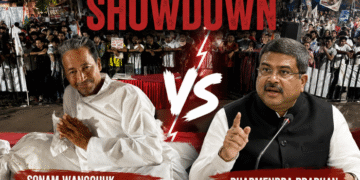
Dharmendra Pradhan’s tenure illustrates this perception. A capable political organiser who rose steadily through the BJP ranks, he was once viewed as a potential national president and even a contender for Odisha’s chief ministership. Yet, as Education Minister, his public image became more closely associated with political messaging than with educational leadership. Critics argue that he failed to articulate an independent vision for India’s education system, even though his supporters credit him with implementing important reforms under the National Education Policy.
Whether this perception is entirely fair is open to debate. What is beyond dispute is that the Ministry of Education increasingly appears to be viewed as an institution whose leadership is expected to align closely with the broader ideological priorities of the ruling establishment.
If that indeed is the long-term strategy, it may now be worth reconsidering. A growing number of Indians take genuine pride in the country’s civilisational heritage, its philosophical traditions, indigenous knowledge systems and intellectual legacy. Promoting these traditions need not depend upon administrative direction or political patronage. They can gain wider acceptance through rigorous scholarship, academic inquiry and evidence-based research.
In today’s information-rich world, scholars have unprecedented access to historical sources, comparative research and global academic discourse. There is also a wider societal awakening about preserving indigenous knowledge and strengthening national identity. These aspirations are both legitimate and increasingly mainstream. But they are more likely to succeed when academic institutions enjoy intellectual freedom, institutional autonomy and credible leadership rather than when they are perceived to be instruments of political power.
If the objective is to restore confidence in India’s educational institutions while simultaneously reclaiming the country’s intellectual heritage, the process must begin at the top. The Ministry of Education should be seen not merely as an extension of political authority but as the guardian of academic excellence, institutional independence and public trust. That, ultimately, would do more to strengthen India’s civilisational confidence than any amount of administrative control.