

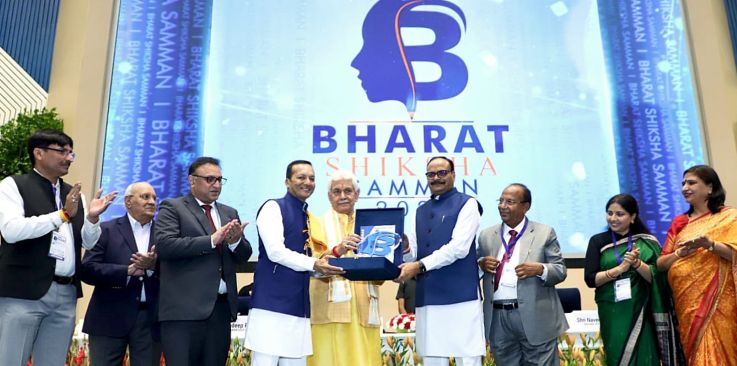
At the Bharat Shiksha Summit held in New Delhi on April 3, Jammu & Kashmir Lieutenant Governor Manoj Sinha offered a visionary outlook on the future of education in India. Delivering the keynote address, Sinha emphasized that India’s education system should be rooted in the scientific intellect of Albert Einstein and the compassionate wisdom of Gautam Buddha—an integration essential to shaping the nation’s youth.
Speaking in the context of the ongoing decolonization of education post the National Education Policy (NEP) 2020, Sinha criticized the current system that prioritizes marks, frequent testing, and rote learning. “Education has become a process of downloading information,” he said, noting that teachers are often confined to syllabi while institutions function more like storage units than centers of inspiration. This shift in the “center of gravity” of education, he argued, has resulted in a growing disconnect from society and the real world.
Addressing issues such as bias in AI models, Sinha pointed to a deeper problem in the foundational structure of education—its lack of focus on character development, empathy, ethical values, and real-world challenges. “Today’s campuses do not prioritize value-based education,” he said.
Citing ancient Sanskrit texts, Sinha reminded the audience of India’s rich legacy in knowledge, science, and innovation—much of which, he claimed, remains unrecognized. He referenced historian William Dalrymple’s book The Golden Road: How Ancient India Transformed the World, which underscores the global impact of India’s intellectual contributions and how many of these ideas traveled through the Muslim world to Europe. Ironically, he said, “the European domination of India was made possible by mathematical advancements that originated in India.”
An alumnus of IIT-BHU, Sinha stressed that education should be seen as a journey of self-discovery—a path toward finding one’s passion. He cited examples like mystic poet Kabir, who was illiterate yet has inspired over a thousand doctoral theses; Alex Thorne, a child math prodigy who pursued a PhD at Oxford after only completing 11th grade; and Bharat Ratna awardee Sachin Tendulkar, who turned his passion into excellence.
Quoting the Maitri Upanishad, Sinha said that tapa—deep reflection and perseverance—leads to knowledge, emphasizing the importance of lifelong learning. “Consciousness is what cultivates values for life,” he said, adding that knowledge received from a guru is considered uttam (supreme) in Indian culture.
Sinha also touched upon the concept of nationhood, stating that the idea of a nation is timeless and finds mention even in the Rig Veda. He urged educational institutions to instill in students a sense of responsibility towards the continuity of the nation. “Good intentions must be backed by inventions and meaningful interventions,” he asserted.
In conclusion, Sinha praised the NEP 2020 for introducing flexibility into India’s rigid education system. He called upon teachers to prioritize dialogue and discussion in classrooms to spark curiosity and critical thinking. “Education must reconnect with the real world, address societal needs, and drive innovation in technology and industry,” he said.