

Education, we are told, exists to produce employability, economic growth and competitive advantage. Schools prepare children for colleges. Colleges prepare them for jobs. Jobs prepare them for consumption. The machine keeps moving. But this machine was not designed accidentally.
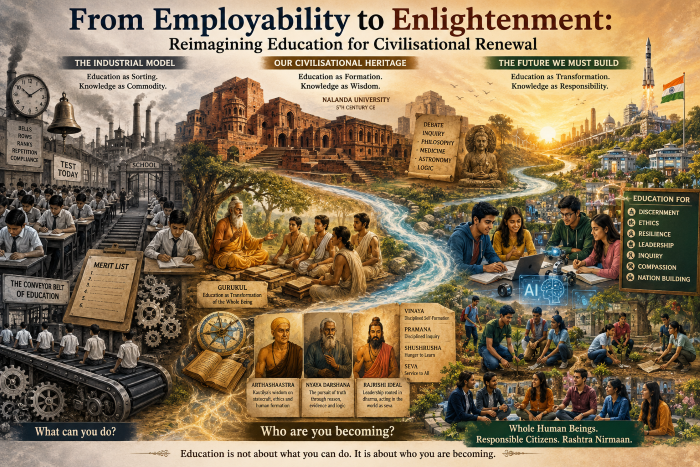
The modern school, as most of the world inherited it, emerged during the Industrial Revolution. Factories needed punctuality, compliance, repetition and ranking. Schools slowly adopted the same architecture: bells, rows, standardised testing, rigid hierarchies, age-batching and performance sorting. The child became a unit moving along a conveyor belt.
Colonialism exported this model everywhere, including India. Instead of taking the best of western civilization – its scientific curiosity, philosophical inquiry or democratic imagination embodied by Plato’s Academy in Athens – independent India inherited the industrial version of education: education as sorting mechanism, knowledge as commodity, and success measured through the ability to reproduce information under pressure.
Meanwhile, India’s own educational traditions had evolved around a very different question. The Gurukul was not merely a place of instruction but a place of formation. The student — the Shishya — lived with the Guru to be formed intellectually, emotionally, morally, and spiritually. Education was not transactional. It was transformational.
In this context talking about Nalanda University is necessary. Nalanda, – a civilizational statement of a university, at its height drew students from across Asia into an ecosystem of debate, inquiry, philosophy, medicine, astronomy and logic, producing thinkers and lifelong learners in the 5th Century CE. All this has become desirous again in the debate of education.
Modern Education vs Indic Education
That distinction suddenly feels very relevant again. And that is the deepest divergence between the two educational rivers:
Modern education asks: What can you do?
The Indic tradition asks: Who are you becoming?
Because the age we are entering will not reward human beings merely for storing information. Artificial Intelligence is already making information cheap. Memory is becoming cheap. Even technical skill, increasingly, will become cheap.
What will remain valuable are qualities far more difficult to automate: discernment, resilience, ethical judgment, disciplined inquiry, leadership, and the ability to work through ambiguity without collapsing into anxiety or noise.
Ancient Indian thinkers had a word for this capacity: Chakshushmanah — Insight. The capacity to observe reality without distortion, to perceive patterns beneath appearances, to anticipate consequences before they unfold. It prevents the learner from being manipulated by trends, outrage or propaganda, enabling him to step back, examine context, test assumptions, and respond with steadiness rather than reaction. In many ways, this is precisely the quality our times are starving for.
And strangely enough, India’s older knowledge traditions spent centuries trying to cultivate exactly these capacities.
The Arthashaastra, for instance, is often misunderstood as a book about politics or statecraft. In reality it is a remarkably sophisticated manual on human formation. Kautilya understood something modern systems often forget: a society built only on artha — wealth, ambition and self-advancement — eventually begins to decay from within. Wealth without dharma produces instability.
At the heart of the Arthashaastra lies Vinaya — disciplined self-formation. A person who cannot govern himself cannot govern institutions, communities or nations. From this emerges one of the most powerful ideas in the Indic imagination: the Rajrishi – the leader who acts fully in the world while remaining internally anchored in dharma and seva. The Rajrishi leads not to dominate, but because responsibility itself is a form of Seva.
And in a democracy, every citizen is a potential Rajrishi. This is why education cannot merely be treated as an economic project. It is a civilisational one.
Alongside the Arthashaastra, the Nyaya Darshana contributed something equally important: Pramana — the disciplined pursuit of valid knowledge. Long before modern scientific temper became fashionable, Nyaya trained students to test assumptions, examine evidence, question flawed reasoning and pursue truth through inquiry rather than authority.
Hybridization and adaptation—the Arjun Sampat framework
Not what to think. But how to think. In an age of misinformation, algorithmic manipulation and outrage-driven discourse, this may be one of the most urgent educational capacities of all.
And underpinning both traditions was Shushrusha — the deep hunger to learn. Not the hunger to score or to outperform, but the hunger to genuinely understand.
These are not abstract spiritual ideas. They are nation-building competencies. This is the foundation from which the Arjun Sampat framework emerges — an attempt to translate these civilisational principles into a modern grammar of leadership and human development. To cultivate whole human beings: curious yet disciplined, analytical yet ethical, ambitious yet rooted in service.
Across India, there are still educators quietly carrying this work forward. Teachers who care more about a child’s character than his rank. Institutions that still believe trust matters more than surveillance. Mentors who understand that their real legacy is not personal success, but the human beings they leave behind. These are the living rishis of our time.
And perhaps this is the deeper shift now unfolding globally. The world is slowly realising that education designed only to produce efficient workers and anxious achievers is not enough. Emotional grounding, ethical clarity, disciplined inquiry and social responsibility are no longer “soft skills.” They are the foundations of civilisation itself.
India does not need to rediscover these ideas from elsewhere. It already possesses them in its own civilisational memory. The river is returning. And Rashtra Nirmaan begins with the formation of whole human beings.
*The Arjun Sampat framework of twelve excellences is aligned with India’s National Education Policy 2020 and draws on the Indian Knowledge System traditions of the Arthashastra, Nyaya Darshana, and the Gurukul model of holistic formation. *