

Riding on the wave of nationwide student protests over examination irregularities and paper leaks May this year, the Congress has launched an ambitious campaign to transform student discontent into a sustained national conversation on education reforms.
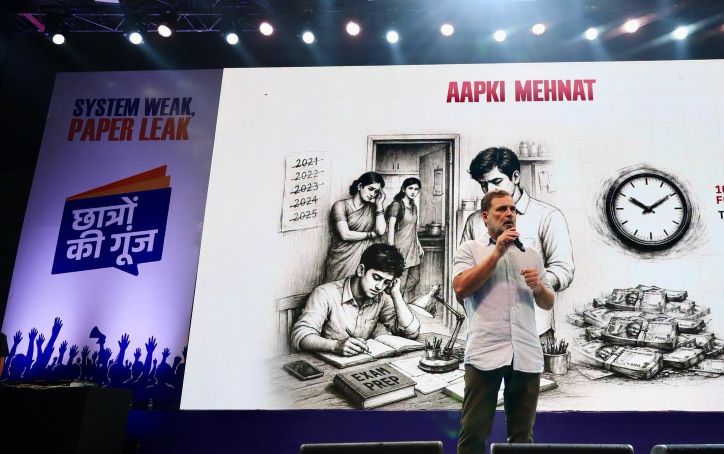
At the centre of this effort is “Chhatron Ki Goonj” (Voice of Students), a nationwide outreach programme spearheaded by Congress leader and Leader of Opposition Rahul Gandhi. The campaign, launched in Kota, Rajasthan, on June 17, is being positioned not as a conventional political rally but as a series of dialogues with students, competitive examination aspirants, teachers and parents affected by what the party describes as a deepening crisis in India’s education and recruitment systems.
The initiative has since travelled to Dehradun, where Rahul Gandhi interacted with students preparing for government recruitment examinations, and is now headed to Prayagraj on August 8, a city that has long been synonymous with civil services preparation and student activism. The Congress says the campaign will eventually cover several states as it seeks to build a nationwide platform for student grievances.
From protest to political campaign
The timing of the campaign is significant. It follows months of unprecedented student unrest triggered by recurring examination paper leaks, cancellations of recruitment tests, allegations of irregularities in competitive examinations and widespread frustration over shrinking employment opportunities. These developments culminated in large-scale protests that placed education at the centre of national political discourse.
Sensing an opportunity to connect with first-time voters and aspirants, Rahul Gandhi has attempted to frame education not merely as a sectoral issue but as a question of justice, equality and democratic accountability.
At the Kota launch, he argued that the country’s examination system had reached a point where honest students were paying the price for institutional failures. According to the Congress, the objective of “Chhatron Ki Goonj” is to collect first-hand accounts from students and incorporate them into a broader agenda for examination and education reforms.
“This isn’t a paper leak—it’s theft”
The campaign has been anchored around a powerful political message. Ahead of the Dehradun programme in July, Rahul Gandhi described recurring examination leaks as “theft” rather than mere administrative lapses, arguing that they rob young people of years of preparation, opportunity and trust in public institutions.
At Dehradun, he claimed that paper leaks had become “the norm” over the past decade and alleged that 7.5 crore students had been affected by examination irregularities. While the figure has become a central talking point in the Congress campaign, it has also sparked political debate over the scale of the problem and the need for comprehensive reforms.
Beyond paper leaks, the campaign has broadened its focus to include delayed recruitments, vacant government posts, the rising cost of higher education, dependence on expensive coaching centres and growing mental stress among students.
Why Kota and why Prayagraj?
The choice of venues reflects careful political symbolism.
Kota, often described as India’s coaching capital, represents both the aspirations and anxieties of millions of students preparing for engineering, medical and civil services examinations. It has also become a national symbol of the intense academic pressures associated with competitive examinations.
Prayagraj, meanwhile, occupies a unique place in India’s educational landscape. For decades it has attracted lakhs of aspirants preparing for UPSC, PCS, SSC, banking and railway examinations. The city has witnessed repeated student protests over recruitment delays and examination irregularities, making it a natural venue for the next phase of the campaign.
Building a movement beyond speeches
Unlike traditional political rallies, Congress leaders say “Chhatron Ki Goonj” is intended to function as an ongoing dialogue. Party workers have been instructed to organise interactions, collect student testimonies and hold simultaneous press conferences across states to amplify local education-related concerns.
On social media, the campaign has been aggressively promoted through the Congress’ official X, Instagram and Facebook platforms with the slogan “After Kota and Dehradun, Chhatron Ki Goonj is now coming to Prayagraj.” Promotional videos invite students to “raise your voice” and participate in discussions on education, employment and the future of India’s examination system.
State Congress leaders have increasingly described the initiative as a “national movement” rather than a series of isolated events, claiming it resonates with students frustrated by recurring examination controversies.
The politics of education
The campaign also marks a strategic shift in Rahul Gandhi’s political messaging. While previous Congress campaigns centred on issues such as social justice, economic inequality and constitutional values, “Chhatron Ki Goonj” places education and employment at the heart of the opposition’s outreach to young voters.
Rather than limiting the conversation to university campuses, the Congress is attempting to connect with the vast ecosystem of coaching institutes, competitive examination aspirants and unemployed graduates—constituencies that have grown in size and political significance over the past decade.
Whether this student-focused mobilisation translates into electoral gains remains uncertain. However, the campaign has succeeded in placing examination integrity, recruitment transparency and educational accountability firmly on the national political agenda.
As Rahul Gandhi prepares to address thousands of students in Prayagraj on August 8, the Congress hopes that “Chhatron Ki Goonj” evolves from a campaign slogan into a sustained youth movement. For a generation increasingly defined by competitive examinations, uncertain job prospects and recurring recruitment controversies, the party is betting that education can become not merely a policy issue but a decisive political narrative.