

Over the past two months, the National Council of Educational Research and Training (NCERT) has found itself at the centre of one of the most intense debates on school education in recent years. What began as the rollout of revised textbooks aligned with the National Education Policy (NEP) 2020 has evolved into a broader national conversation on history, ideology, constitutional values, institutional autonomy, and even the logistics of textbook delivery.
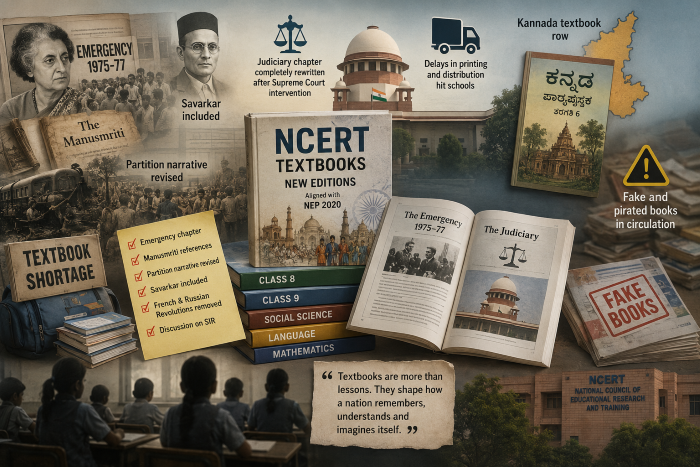
The most contentious changes have appeared in the new Social Science textbooks for the middle and secondary classes. The revised Class 9 volume marks a noticeable shift towards a more India-centric narrative. It introduces an expanded discussion on the Emergency of 1975–77, revisits the political circumstances surrounding Partition, incorporates references to Vinayak Damodar Savarkar, and includes discussions on traditional social structures through references to the Manusmriti. At the same time, familiar chapters on the French and Russian Revolutions have either been removed or significantly curtailed in favour of themes considered more relevant to India’s own historical experience.
These revisions have reignited a long-running ideological contest over school curricula. Supporters argue that NCERT is finally correcting a colonial and Eurocentric bias that dominated Indian school education for decades. They contend that textbooks should reflect India’s civilisational heritage and political evolution rather than disproportionately focusing on European historical developments. Critics, however, see the changes as part of a larger project to reshape historical narratives through a particular ideological lens. The debate is no longer confined to what students should study; it increasingly concerns who decides the nation’s historical memory.
If the controversy over history was expected, the developments surrounding the judiciary chapter were not. Following sharp observations by the Supreme Court on an earlier Class 8 textbook that referred to corruption within the judiciary, NCERT withdrew the chapter and issued a substantially revised version. The new text adopts a far more conventional approach, explaining constitutional courts, Public Interest Litigation, tribunals, constitutional remedies and the role of the judiciary in safeguarding citizens’ rights, while omitting contentious references that had drawn judicial criticism.
The episode was unprecedented. Rarely has a school textbook been rewritten after direct intervention by the country’s highest court. While the revision may have resolved an immediate institutional dispute, it has also reopened larger questions about academic freedom, editorial independence and the extent to which judicial institutions should influence curriculum design.
As these debates unfolded, another challenge emerged on the ground. Thousands of students across several states began the new academic session without the revised textbooks. Delays in printing and distribution left schools struggling to secure copies, particularly of newly introduced Class 9 books. NCERT attributed the shortages to the scale of curriculum revisions and assured that digital editions were available while printing continued. Yet for teachers and students, especially in schools that rely heavily on printed texts, the delay disrupted classroom teaching during the crucial opening months of the academic year.
The shortage also fuelled the circulation of pirated editions in several markets, prompting NCERT to caution schools and parents against purchasing unauthorised textbooks. The episode exposed the vulnerabilities of India’s textbook supply chain whenever large-scale curriculum revisions are introduced simultaneously across classes.
Meanwhile, objections surfaced from different quarters over language and regional representation. The revised Kannada textbook for Class 6 drew criticism from cultural organisations that alleged inadequate representation of Karnataka’s linguistic and cultural traditions. Although smaller in scale than the national controversies, the episode underscored the continuing challenge of balancing national curricular objectives with India’s regional diversity.
Taken together, these developments reveal that textbook revision is no longer a purely academic exercise. School textbooks today occupy the intersection of politics, public policy, constitutional institutions and identity. Every chapter, omission and illustration is scrutinised not only by educators but also by political parties, courts, civil society organisations and the media.
For NCERT, the challenge extends beyond producing revised content. As the country’s premier curriculum body, it must maintain public confidence in the academic integrity of its textbooks while responding to changing educational priorities under NEP 2020. Frequent revisions, public controversies, judicial interventions and logistical shortcomings risk creating uncertainty for teachers, students and examination systems alike.
Curriculum reform is both necessary and inevitable in a rapidly changing society. However, its success depends not merely on what is added or removed from textbooks but on whether the process inspires confidence among educators, scholars and the wider public. As the latest controversies demonstrate, the debate over NCERT textbooks is ultimately about much more than school lessons. It reflects the larger national conversation on how India chooses to understand its past, educate its young and define its future.