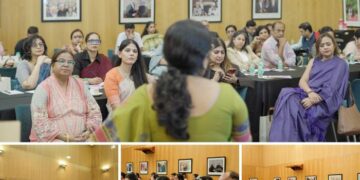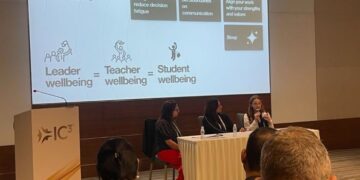


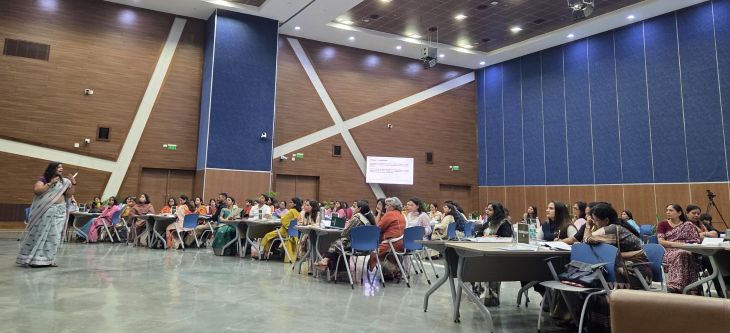
The Australian Council for Educational Research (India), ACER India, announced conclusion of a series of professional development workshops for teachers of grades 6-8 conducted by the Delhi Public School Society. Aimed to strengthen teaching practices in English by enhancing pedagogical approaches and assessment strategies aligned with contemporary educational reforms, about 100 educators benefited from it.
The programme comprised a series of onsite and online workshops, covering key areas: Reading with Purpose: Strategies for Deep Understanding, Developing Effective Writing Skills, and Competency-Based Assessment in English. The workshops were conducted at the DPS HRD centre in Delhi (DPS HRDC), a state-of-the-art residential facility for the training and development of DPS teachers. These wrokshops for DPS school teachers was as part of the society’s ongoing efforts to empower the teaching and student community through knowledge sharing and capacity building.
‘Reading is a foundational skill that drives learning in every subject. Competency-based assessments, which focus on students’ ability to apply their learning in real-world contexts, have become a global educational priority and are increasingly being adopted in India,” said Ashtamurthy Killimanglam, Senior Research Fellow at ACER India.
The sessions were designed to be highly interactive and practice-oriented, providing teachers with practical, classroom-ready strategies. The reading workshop focused on developing purposeful reading skills, including identifying key ideas, making inferences, and promoting critical thinking. The writing workshop emphasised effective techniques for idea development, organisation, drafting, revision, and feedback.
The competency-based assessment workshop supported teachers in aligning their assessment practices with the National Education Policy (NEP) 2020 and National Curriculum Framework for School Education (NCFSE) 2023, focusing on designing high-quality assessment tasks and implementing robust quality assurance processes.
Participants actively engaged in hands-on activities, collaborative tasks, and reflective discussions, enabling them to connect workshop learnings with their classroom practices. The sessions also highlighted inclusive teaching approaches and differentiated instruction to support diverse learners.