

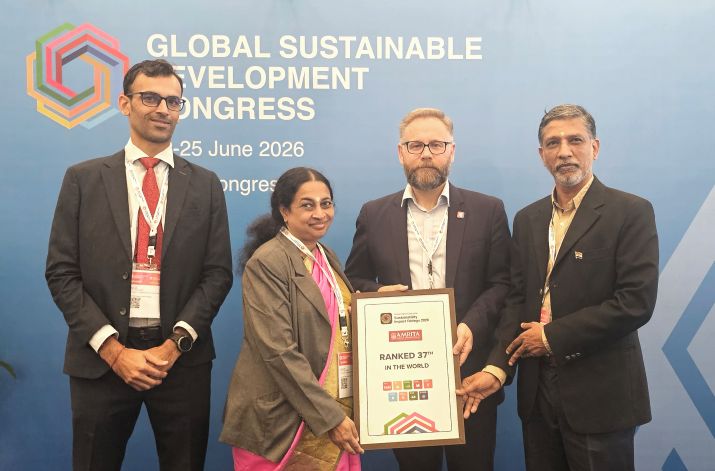
Amrita Vishwa Vidyapeetham, a 10-campus, multi-disciplinary research University, founded under the inspiration of Sri Mata Amritanandamayi Devi and recognized among India’s leading institutions, has added another milestone to its achievements. In the Times Higher Education (THE) Sustainability Impact Ratings 2026 released on June 24, it has secured an overall global rank of 37, propping it into Top 50 as well as Top 100 universities globally. After LPU, it is second overall top university in India where 110 universities have made it to the list this year.
Amrita Vishwa Vidyapeetham has achieved the No. 1 position in India for Industry, Innovation and Infrastructure in the Times Higher Education (THE) Sustainability Impact Ratings 2026. This recognition is based upon the University’s contribution to the United Nations’ 9th Sustainable Development Goal (SDG), which focuses on building resilient infrastructure, promoting inclusive and sustainable industrialization, and fostering innovation.
These results have placed Amrita globally in the Top 25 Worldwide for five SDGs—Quality Education (SDG 4), Gender Equality (SDG 5), No Poverty (SDG 1), Clean Water & Sanitation (SDG 6), and Affordable & Clean Energy (SDG 7).
Amrita is also among the Top 50 Worldwide for two more SDGs with the rating for Industry, Innovation and Infrastructure (SDG 9), alongside its contribution to Climate Action (SDG 13). As well, the University achieved a Top 100 placement for Good Health and Well-being (SDG 3), and in yet another milestone, was featured for the first time in No Poverty (SDG 1), Zero Hunger (SDG 2), and Affordable & Clean Energy (SDG 7).
Chancellor Amma, Sri Mata Amritanandamayi Devi, expressed gratitude to the THE Sustainability Impact Ratings for going beyond measuring universities and researchers via funding, publications, and intellectual caliber. Her vision for Amrita is compassion-driven research—a vision that has resulted in concrete humanitarian initiatives across rural India.
Amma said: “We should also consider how much we have been able to use research to serve the lowest and most vulnerable strata of society. This will make our impact more comprehensive and meaningful. In our approach to sustainable development, we should not forget that it is by strengthening the people at the base of the pyramid that the entire edifice of society becomes healthy and strong.”
Dr. Maneesha V. Ramesh, Pro Vice-Chancellor and Dean, School for Sustainable Futures, Amrita Vishwa Vidyapeetham, emphasized the alignment between the university’s values and these achievements. “Being ranked first in India for Industry, Innovation and Infrastructure affirms a conviction that has guided our work for years: technology earns its worth only when it reaches the people who need it most. From early-warning systems in landslide-prone hills to clean water in remote villages, we measure our research not by where it is published, but by the lives it safeguards. Through our outreach in 2,800 villages across India, we demonstrate that real impact comes from translating research into solutions that improve lives. This recognition belongs to every community that has walked this path of innovation and service alongside us,” she said.
More on Sustainability Impact Ratings 2026:
For the 2026 edition, participation in the Sustainability Impact Ratings (previously the Impact Rankings) became membership-based. All participating institutions first sign up to join the Sustainability Impact Network, the world’s largest higher education membership organisation, and are then subjected to the in-depth performance assessment.
Manchester finished top outright in three individual tables – SDGs 11 (sustainable cities and communities), 12 and 15 – and joint first for SDG 9 and SDG 14. In the eight years of the impact rankings, Manchester is the only university to have finished in the overall top 10 every year.
Asia’s representation in the top 50 compared with eight from Oceania (down from 11), seven from Europe (down from nine), six from North America (down from eight) and one from Africa (unchanged).
The Philippines and India, the two countries that supply around a sixth of all ranked universities, both saw signs of progress. And Lovely Professional University in the Punjab climbed to 23rd overall from joint 48th last year, becoming the highest ranked institution from a lower-middle-income nation.
Top ranked university for each SDG in the Sustainability Impact Ratings 2026
| SDG | Goal | University | Country/territory |
| SDG 1 | No poverty | University of Huddersfield | United Kingdom |
| SDG 2 | Zero hunger | Queen’s University | Canada |
| SDG 3 | Good health and well-being | Mahidol University | Thailand |
| SDG 4 | Quality education | Lingnan University Hong Kong | Hong Kong |
| SDG 5 | Gender equality | Manipal Academy of Higher Education | India |
| SDG 6 | Clean water and sanitation | RMIT University | Australia |
| SDG 7 | Affordable and clean energy | Lovely Professional University
|
India
|
| SDG 8 | Decent work and economic growth | Korea University
|
South Korea |
| SDG 9
|
Industry, innovation and infrastructure | City University of Hong Kong | Hong Kong |
| Harbin Institute of Technology | China | ||
| University of Alberta | Canada | ||
| University of Edinburgh | United Kingdom | ||
| University of Erlangen-Nuremberg | Germany | ||
| University of Manchester | United Kingdom | ||
| University of Stuttgart | Germany | ||
| Yonsei University (Seoul campus) | South Korea | ||
| SDG 10 | Reduced inequalities | University of Huddersfield | United Kingdom |
| SDG 11 | Sustainable cities and communities | University of Manchester | United Kingdom |
| SDG 12 | Responsible consumption and production | University of Manchester
|
United Kingdom |
| SDG 13 | Climate action | University of Tasmania | Australia |
| SDG 14 | Life below water | Griffith University | Australia |
| University of Manchester | United Kingdom | ||
| SDG 15 | Life on land | University of Manchester | United Kingdom |
| SDG 16 | Peace, justice and strong institutions | Thammasat University | Thailand |
| SDG 17 | Partnerships for the goals | Universiti Sains Malaysia | Malaysia |
Each SDG ranking is based on a range of bespoke indicators and metrics, related to the theme of the goal.
Key criteria for the Sustainability Impact Ratings
Four core pillars of evaluation
- Research:the most obvious and traditional way that a university might help to deliver the SDGs is by creating research in relevant topics.
- Stewardship:universities are custodians of significant resources, not just physical resources but also their employees, faculty and students. How they act as stewards is one of the key factors in delivering the SDGs.
- Outreach:place is critical in higher education, and the work that universities do with their local, regional, national and international communities is another important way that they can advance sustainability.
- Teaching:teaching plays a vital role, both in ensuring that there are enough skilled practitioners to deliver on the SDGs, and in making sure that all alumni take forward the key lessons of sustainability into their future careers.