

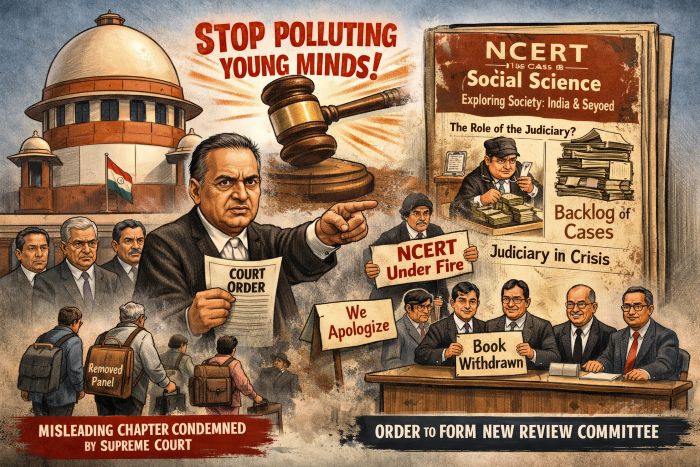
The Supreme Court of India’s strong objection to the portrayal of the judiciary in the new Class 8 Social Science textbook published by the National Council of Educational Research and Training (NCERT)—under a chapter titled “The Role of the Judiciary in Our Society”—amounts to a stern message to the academic body: you have been casual in your approach to work and must “stop polluting young minds”. The urgency shown and the sharp words used by the top court should themselves be read as a commentary on the not-so-diligent book-writing culture within the country’s premier school education academic body.
First, a brief context of the controversy. NCERT periodically revises school textbooks to align them with changes in the curriculum. The same process led to the publication of the new Class 8 Social Science textbook Exploring Society: India and Beyond. After releasing Part 1 earlier as part of curriculum changes aligned with the new education framework in July 2025, NCERT brought out Part 2 on February 23, 2026.
Chapter 4 of the book, titled “The Role of the Judiciary in Our Society”, included a discussion on corruption in parts of the judiciary, the shortage of judges, and the massive backlog of cases in courts. The book reached bookstores on February 24, and within no time the issue snowballed into a controversy. Senior lawyers brought the matter to the attention of the Supreme Court, arguing that the chapter amounted to a calculated attempt to malign the judiciary and expose young students to a biased narrative.
The judges observed that the chapter highlighted only the negative aspects of the judiciary while ignoring its vital contributions. “The content is bound to travel from teachers to students to parents to society…the chapter has no mention of the good work done by the judiciary—protection of rights, streamlining access to justice, legal aid, and safeguarding fundamental rights,” the Bench noted. The chapter also gave the impression that complaints against judges were ignored, as though there were no transparency or accountability mechanisms within the judiciary.
A Bench led by Chief Justice Surya Kant took suo motu cognizance of the issue and criticised the chapter for presenting the judiciary negatively to school students. Following the court’s intervention, the Ministry of Education, Government of India directed NCERT to halt the distribution of the book—both physical and digital copies. NCERT subsequently admitted that the chapter contained “inappropriate textual material” and announced that it would be rewritten.
The Director of NCERT, Dinesh Prasad Saklani, submitted an affidavit tendering an “unconditional and unqualified apology” for the controversial chapter. NCERT acknowledged that the textbook contained inappropriate material and confirmed that the entire book had been withdrawn from circulation. It assured the court that the chapter would be rewritten before the next academic session.
An additional affidavit was filed by the Secretary of the Department of School Education and Literacy, Sanjay Kumar under the Ministry of Education. It also tendered an unconditional apology and assured the court that systemic safeguards would be introduced to prevent such lapses in the future. During the hearing, the Centre’s law officer informed the court that the government deeply regretted the incident, accepted responsibility, and had initiated corrective measures.
However, the Court remained dissatisfied. It directed NCERT to exclude three experts—Michel Danino, educator Suparna Diwakar, and legal researcher Alok Prasanna Kumar—from any role in preparing school curricula or holding positions in state bodies, citing their association with the controversial chapter.
The top court also directed the Union government to constitute a committee of domain experts to review such matters. The panel will include a former judge, an educationist, and a senior legal expert. The Bench led by Chief Justice Surya Kant also took exception to NCERT’s affidavit stating that the controversial chapter had already been rewritten. The court clarified that even a revised chapter cannot be included in the curriculum without approval from the committee of domain experts to be constituted by the Central government.
Commenting on the existing review mechanism, the court remarked that it was “slightly disappointing” that not a single eminent jurist was part of the current approval committee. It directed that any revised chapter must be cleared by a panel comprising one former senior judge, one eminent academician, and one renowned practitioner.
At present, a 19-member National Syllabus and Teaching Learning Material Committee (NSTC), headed by Mahesh Chandra Pant, Chancellor of the National Institute of Educational Planning and Administration (NIEPA), is responsible for approving textbook content and syllabus.
While exposing students to institutional conflicts can help them understand democracy, and debates about judicial power can illustrate the system of checks and balances, equal care must be taken to ensure age-appropriate content. For impressionable young minds, the emphasis should remain on the fundamentals and the constitutional role of the judiciary rather than on complex institutional criticism.
The widespread attention NCERT’s work has drawn because of the Supreme Court’s sharp rap should now galvanise the institution to raise its standards and apply greater diligence to every subject domain and every textbook it publishes. If such lapses could occur in a field scrutinised so closely by legal experts, one wonders whether similar shortcomings may exist in other areas where such scrutiny is absent. NCERT must use this moment to reclaim the academic rigour and credibility that once defined it.