

There is a version of the Samsung India story that most people know, the one measured in market share, smartphone launches, and the sprawling Noida factory that has become one of the world’s largest mobile phone manufacturing facilities. It is an impressive story, but an incomplete one.
The full story, going beyond the product launch headlines, may ultimately prove far more consequential for India’s human capital. This story is being written in the classrooms of Uttar Pradesh and Tamil Nadu, coding labs in Maharashtra and incubation centres at IIT Delhi. It is happening because Samsung has decided that its most important investment is not in the next device but creating an innovation ecosystem where Digital India thrives.
“As we complete three decades in India, we see innovation and education as both an enabler of progress and a catalyst for inclusion. The focus going forward is on how this potential is translated into meaningful impact at scale. At Samsung, we are committed to nurturing a generation of young innovators with the skills, creativity, and collaborative mindset which enables them to grow and address complex societal challenges and contribute to a more inclusive future.” says Mr. SP Chun, Corporate Vice President, Samsung Southwest Asia
Samsung India’s citizenship programmes have benefited 1.5 million people. Samsung’s CSR commitment in India reached Rs144.48 crore in FY2024-25, (increased to Rs 193.89 crore for 2025-26) one of the largest such commitments by any consumer electronics company in India. But the number, however significant, understates what has already been achieved. Over three years, Samsung has assembled one of the most substantive private-sector youth-skilling ecosystems in India, a portfolio of interconnected programmes that collectively target the full journey from classroom to career.
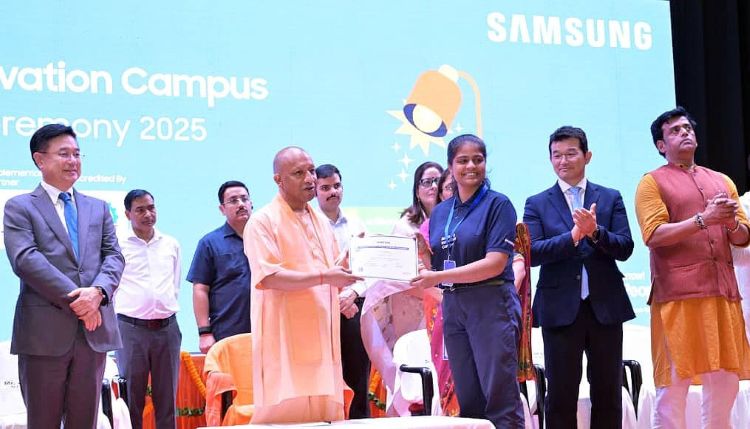
At the core of the ecosystem stands the Samsung Innovation Campus, or SIC with a budget of Rs 77.25 crore for 2025-26 — a flagship programme that trains young people in artificial intelligence (AI), internet of things (IoT), Big Data, and coding and programming. Since its 2022 launch, the programme has trained 6,500 students, with 3,500 certified in 2024 alone across Uttar Pradesh, Delhi NCR, Tamil Nadu, and Karnataka, a 17% increase over the previous year. In 2025, Samsung scaled the programme six-fold: to 20,000 students across ten states, with a commitment to gender inclusion in the syllabus— 48% women participation pan-India going up to even over 70% in Tamil Nadu.
The Maharashtra experiment is a milestone with the first large-scale SIC certification in the state with 1,000 students. Simultaneously, Samsung expanded its reach by enrolling 7,000 students in coding and programming across ten states, with the programme certifying 5,000 students In Uttar Pradesh. This initiative signals a shift from standalone corporate programs to strong government partnerships, transforming well-meaning initiatives into scalable solutions.
“Our young people are the foundation of Uttar Pradesh’s progress and the driving force behind India’s growth story. I am delighted to see global companies like Samsung coming forward to invest in their skills and aspirations. By learning emerging technologies such as Artificial Intelligence, Big Data, and IoT, our students are preparing to lead the industries of tomorrow. This initiative is not just about teaching technology, it is about opening pathways to livelihood, self-reliance, and dignity for our youth. Through this programme Samsung supports our vision of transforming Uttar Pradesh into a hub for skilled manpower and digital excellence. The success of these young people is a reflection of a confident, capable, and future-ready Uttar Pradesh,” said Yogi Adityanath, Hon’ble Chief Minister, Uttar Pradesh.
The programme’s credibility and usefulness have been externally validated. SIC won the CSR Initiative of the Year at the ESSCI National Skills Awards 2024 at Bharat Mandapam — recognition from the Electronics Sector Skills Council of India underscoring the fact that the programme’s design and outcomes meet the standards India’s skills development programme demands.
If the SIC is about building foundational technology competence, the “Solve for Tomorrow” is about the next chapter, using the competencies to solve national problems, with a Budget of Rs 29.88 crore for the current fiscal.
In its fifth year, this national competition has brought The Foundation for Innovation and Technology Transfer (FITT) at IIT Delhi, the Ministry of Electronics and Information Technology (MeitY) and the United Nations in India, to empower young changemakers, With more than Rs 90 lakh in funding for projects for environmental, social, and health challenges, the 2024 edition has introduced a School Track (14-17) and a Youth Track (18-22), fostering an innovation culture among young students.
The results speak for themselves. The 2025 AI Summit saw Paraspeak, a Gurugram-based team whose solution addresses communication accessibility, win the top honour. The four winning teams from the 2024 programme received Rs1 crore in incubation grants and continued development support at IIT Delhi’s FITT Labs. Past winners got an opportunity to be present at the Olympics and the Winter Olympics.
Not every young Indian is headed for a startup or a technology career. In the past, many headed to the retail floor, service centres and Samsung’s Digital & Offline Skills Training (DOST) Sales Programme was precisely for them. DOST Sales 4.0 in partnership with the Electronics Sector Skills Council of India and the Telecom Sector Skill Council, trained thousands of young people from underserved communities for frontline retail roles.
Add it together and the picture that emerges is striking. Samsung Innovation Campus, Samsung Solve for Tomorrow, DOST, and the Nanum employee volunteering platform that institutionalizes corporate citizenship, ensures company-wide value rather than just a compliance exercise.
What is most important is the ambition of the company is structural. It reflects the conviction of a company that has been in India long enough to understand one crucial point. That its most durable contribution to the country in which it operates will not be measured in devices sold, but in capabilities built for a country standing at a demographic tipping point.