

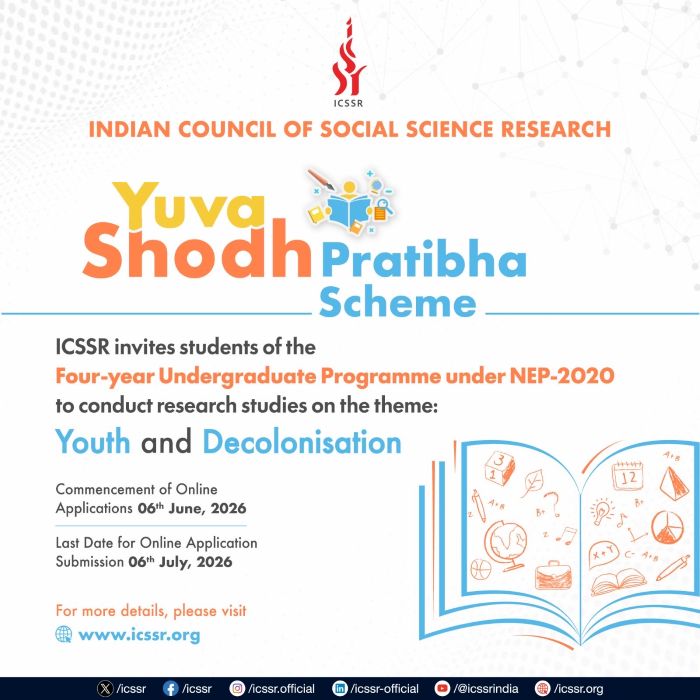
The Indian Council of Social Science Research (ICSSR esb 1969), the apex body of the Government of India for research in the social sciences and humanities, has announced the launch of Yuva Shodh Pratibha, a special research call inviting students enrolled in Four-Year Undergraduate Programmes under NEP 2020 to develop research projects with the objective of decolonizing knowledge, promoting theoretical and critical inquiry in interdisciplinary areas of research, and challenging Eurocentric models of knowledge production and research. Online application for projects will open on June 6 and close on July 6.
Under this call, ICSSR will provide assistance to at least 600 research projects, with each selected project receiving a grant of up to ₹3,00,000 (three lakhs), amounting to a total grant of ₹18 crores. Selected researchers will have eight months from the date of the award to complete their project.
The call is organised around eight research themes. Scholars are invited to submit comprehensive study plans under any of the following domains:
Decolonising Narratives: Indo-Aryan Theories:
Re-examining historiography and agency from the native’s perspective; integrating archaeological, linguistic and genetic evidence; challenging Eurocentric migration theories.
Decolonising Education and Research Methodology, Beyond Macaulay:
Cognitive decolonisation and reclaiming Indian pedagogical methods; decolonial research methods using perceptual knowledge, validity and indigenous postulations in social science; integrating oral traditions and local folklore in learning; revisiting methods of evaluation and assessment.
Decolonising History, Culture and Language:
Re-writing of Bharatiya history; digitising Bhasha records and archives beyond colonial gazetteers; promoting linguistic de-anglicisation in education and governance.
Health, Mental Well-being:
Advancing Indian psychology rooted in Yoga and Buddhist philosophy for mental health through rigorous research of traditional systems; scientific evidence of AYUSH systems; promoting a One Health approach that integrates ecology and society.
Economic and Financial Sovereignty:
Moving beyond Western capitalist models to community-centric indicators, formalising support for the informal sector and the emerging gig economy, reviving indigenous credit systems and cooperatives, strengthening sovereign fiscal policy for Atmanirbhar Bharat and evaluating GST and tax reforms as tools to address colonial financial discrepancies.
Decolonising Finance, Trade and Commerce:
Enhancing financial literacy through joint family models; financial sovereignty and digital India; Indian Ocean and Silk Road trade linkages in modern commerce and maritime mercantile studies.
Decolonising Governance, Law and Political Thought:
Analysing the transition from colonial codes to the Bharatiya Nyaya Sanhita; strengthening legal pluralism by integrating customary laws and Lok Adalats into the formal justice system; promoting Indian political thought traditions drawing on thinkers such as Kautilya, Gandhi and Savarkar; revisiting Indian administration and community governance, modules and institutions; Indian Women thinkers and Decolonial Thought- Savitribai Phule, Maitreyi, Gargi Vachaknavi, Akka Mahadevi, Ahilyabai Holkar, etc.
Rural Development, Environment and Indian Knowledge Systems:
Promoting rural autonomy and self-sufficient village economies, challenging the colonial narrative of India’s “rural backwardness”; integrating Traditional Ecological Knowledge (TEK); designing sustainable models of Indian urbanism aligned with local climates; Traditional and Ecological Approaches for pollution control.
Proposals submitted under the call must adopt an Indian-centric approach, drawing on Indian Knowledge Systems (IKS) and local social realities to challenge Eurocentric frameworks across disciplines. ICSSR invites students to submit comprehensive research proposals or detailed study plans that apply this decolonial orientation to their primary field of study.
Eligibility and submission
Applications are open for submission for students currently in their third or fourth year (semester six and seven) of a Four-Year Undergraduate Programme at any Higher Educational Institution, to apply for grants from ICSSR. Applications must be submitted as a comprehensive research proposal. ICSSR encourages young scholars to demonstrate the spirit of team work and collaborate with their peers to create their own research team. The project team may comprise (at least) two or three students from the same institution. The team shall be led by one student, designated as the Lead Student Researcher, along with Student Researcher-1 and Student Researcher-2.
For further details, please contact:
Indian Council of Social Science Research (ICSSR)
Email: abpaliwal[at]icssr[dot]org| Phone: 08076916717