

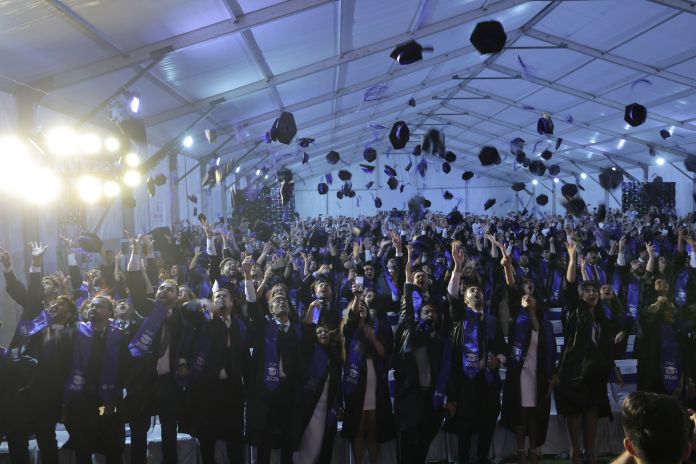
The Union Ministry of Education on July 8 released the All India Survey on Higher Education (AISHE) reports for 2022-23 and 2023-24, showing continued expansion in India’s higher education sector, with enrolment touching a record 4.50 crore, the Gross Enrolment Ratio (GER) reaching 30, and women maintaining higher participation than men for the seventh consecutive year. More than 90 per cent of registered institutions participated in both surveys, with 56,180 of 60,380 registered HEIs submitting data for 2022-23 and 59,533 of 64,756 institutions participating in 2023-24.
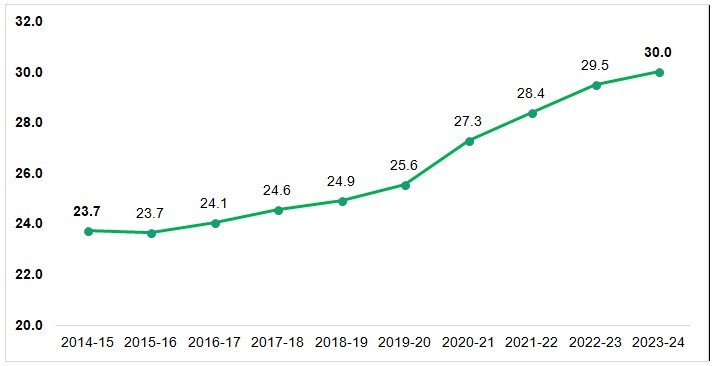
The report shows that India’s Gross Enrolment Ratio (GER)—the proportion of the 18-23 age group enrolled in higher education—has steadily improved from 23.7 in 2014-15 to 29.5 in 2022-23 and 30 in 2023-24. Female GER rose from 22.9 a decade ago to 31.2 in 2023-24, up from 30.2 in the previous year.
Access to higher education has also improved among historically disadvantaged communities. The GER for Scheduled Caste (SC) students increased from 18.9 in 2014-15 to 27.8 in 2023-24, while that of Scheduled Tribe (ST) students rose from 13.5 to 22.8 during the same period.
Women continued to outpace men in higher education participation, with the Gender Parity Index (GPI)—the ratio of female to male GER—standing at 1.08 in 2023-24. The GPI has remained above 1.0 for seven consecutive years, indicating consistently higher female participation in higher education.
Overall student enrolment has grown by 31.5 per cent over the past decade, increasing from 3.42 crore in 2014-15 to 4.46 crore in 2022-23 and 4.50 crore in 2023-24. Female enrolment registered an even faster growth of 42.2 per cent, rising from 1.57 crore to 2.24 crore during the period.
The survey also recorded significant gains in enrolment among socially disadvantaged groups. SC enrolment increased by 51.4 per cent over the decade to 69.72 lakh in 2023-24, while ST enrolment grew by 75.7 per cent to 28.83 lakh. Enrolment of students from Other Backward Classes (OBCs) rose by 60.2 per cent to 1.80 crore.
Science, Technology, Engineering and Mathematics (STEM) education also witnessed steady growth. STEM enrolment increased from 91.5 lakh in 2014-15 to 1.02 crore in 2023-24. The proportion of women in STEM programmes improved from 38.4 per cent to 44 per cent during the same period, reflecting increasing gender diversity in technical and scientific disciplines.
Faculty strength also expanded, with the number of teachers rising to 17.32 lakh in 2023-24. Women accounted for 44.9 per cent of the teaching workforce, with female faculty increasing from 5.69 lakh in 2014-15 to 7.78 lakh in 2023-24.
The Ministry noted that AISHE is based on voluntary participation and self-reported data submitted by institutions through its online portal. While the Ministry carries out validation and scrutiny checks, it said the quality of the information primarily depends on the reporting institutions, and the survey remains subject to the usual limitations associated with large-scale statistical exercises.
The detailed report is available at the following link:
https://www.dohe-education.gov.in/documents/reports/aishe-report-MzN1EjMtQWa?pageTitle=AISHE-Report