

Building on its Awards for Innovations in Educational Administration initiative, the National Institute of Educational Planning and Administration (NIEPA), a deemed university and a leading national centre for research and capacity building in education, organised a two-day national conference in New Delhi on September 2–3.
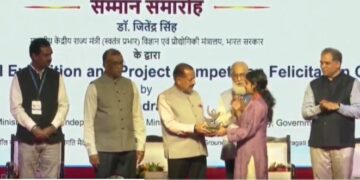
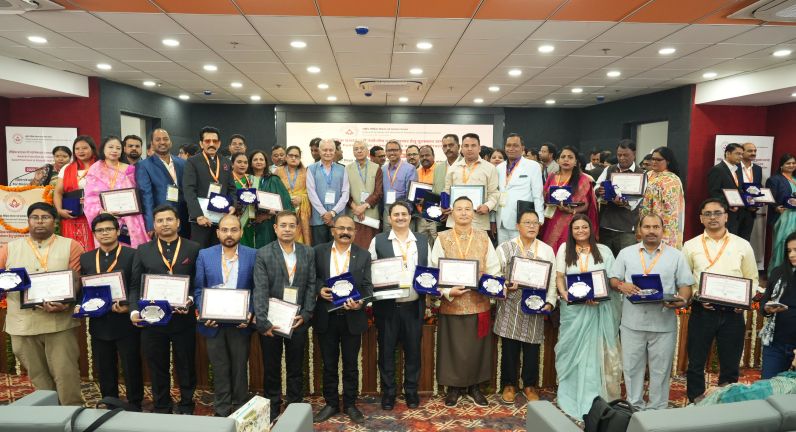
The conference showcased and felicitated 84 award-winning District and Block Level Education Officers from 22 States and Union Territories for the years 2023–24 and 2024–25. The awards were presented by Prof. J. S. Rajput, former Director of NCERT, and Prof. Rama Shanker Dubey, Chancellor of NIEPA.
Instituted in 2013–14, the NIEPA Awards for Innovations in Educational Administration scheme aims to recognise education officers who conceive and implement innovative practices in educational administration. The initiative also seeks to document these interventions and facilitate their wider dissemination and adaptation.
The conference and its technical sessions provided participating officers an opportunity to present their innovations before peers and academic experts. The sessions enabled the practices to be examined, discussed and evaluated, while the exchange of experiences created opportunities for promising approaches to be documented and disseminated for wider adoption.
One of the central objectives of the initiative is to give greater visibility to grassroots innovations that often remain localised despite their potential to improve educational administration and strengthen the delivery of education.
Earlier, the conference was inaugurated by Vinod Shridhar Tawde, National General Secretary of the BJP and Member of Parliament in the Rajya Sabha. A former Education Minister of Maharashtra, Tawde drew upon his experience in education administration to underline the importance of making the system more responsive to the needs of students.
“Education is about giving every child the opportunity to build a better future. Our examination and education systems must therefore ensure that one setback does not determine a student’s destiny. The grassroots experiences shared by teachers and education officers are critical to making our reforms more responsive, inclusive and effective,” he said.
Presiding over the conference, Prof. Rama Shanker Dubey, Chancellor, NIEPA, highlighted an important but often less visible dimension of education reform—the innovations that emerge within the public education system at the point of implementation.
District and block-level education officers routinely work within constraints related to infrastructure, human resources, teacher capacity, technology, community participation and student learning. The initiatives presented at the conference demonstrated how administrators are developing context-specific approaches to address these challenges within the existing education system.
The innovations showcased at the conference covered a wide range of areas, including ICT-enabled education and digital classrooms, mobilisation of physical, human and financial resources, strengthening of school infrastructure, community mobilisation, skill and language development, teacher capacity building, and interventions aimed at improving the overall functioning and quality of schools.
The conference also highlighted the critical role played by district and block-level education officers in bridging the gap between government policy and its implementation in schools and communities.
Prof. Shashikala Wanjari, Vice-Chancellor, NIEPA; Prof. Vineeta Sirohi, Programme Director and Head of the Department of Educational Administration, NIEPA; and Shri Surya Narayan Mishra, Registrar, NIEPA, participated in the deliberations and contributed to the discussions during the event.
Speaking about the initiative, Prof. Shashikala Wanjari said that addressing school dropouts requires sustained efforts and innovative solutions at the grassroots level.
“One of the biggest challenges facing our education system today is the growing number of children who drop out of school, with around 3.4 crore children estimated to be outside the education system. Addressing this requires greater awareness, sustained efforts and innovative solutions at the grassroots level. Today’s programme is an important step in that direction and should inspire many more such initiatives across the country.
“With over 60 representatives from different parts of India being recognised through awards and certificates, we are not only acknowledging their valuable contributions but also creating a platform to share and encourage practices that can strengthen education delivery across the country,” she said.
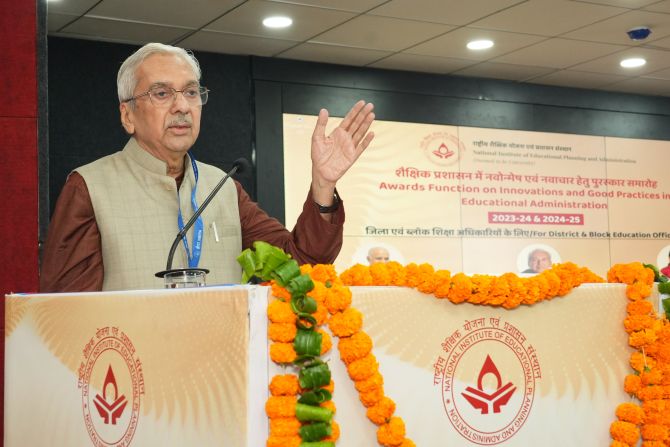
In his special address to the awardees, Prof. Rajput, drawing on his own experiences and anecdotes, told education officers that the success of any policy ultimately depends on its implementers and the extent to which they have internalised its objectives and spirit.
Referring to the S. B. Chavan-led Parliamentary Committee on Value Education in 1999, he said the five core values of Truth, Righteous Conduct, Peace, Love and Non-violence remain as relevant today as ever. These values, he said, teach people to respect differences and promote social cohesion. He added that scholarship, contemplation and reflection are necessary to understand and incorporate their deeper meaning into life and education.
Prof. Rajput also reflected on the relationship between academics and bureaucracy, describing education as an art for academicians and a craft for the bureaucracy. The two, he said, need to understand and complement each other. He cautioned that academicians who move into bureaucratic roles sometimes forget their own learning and merely imitate the bureaucratic mindset. Instead, they should draw upon their academic experience and knowledge to enrich their new roles.
Prof. Rajput, who served as the founding chairperson of the National Council for Teacher Education (NCTE) from 1994 to 1999, also recalled how the Kothari Commission’s decision to make mathematics and science compulsory up to Class 10 had transformed society, benefiting millions of students and enriching the country. He said that while the Commission had advocated the integration of science, technology and production, Kothari later realised that the growing moral degradation in society also needed to be addressed and advocated the incorporation of Gandhian values into his STP framework.
He also spoke about the influence of Indian traditions and knowledge systems on the National Education Policy (NEP) 2020, in whose formulation he was involved. Referring to Swami Vivekananda, he said that having received guidance from a teacher like Ramakrishna Paramahamsa, Vivekananda drew intellectual wisdom and knowledge from the study of ancient scriptures and contextualised those learnings in the contemporary world.
He then spoke about Sri Aurobindo, who was sent abroad by his family to receive a Western education but eventually emerged as a spiritual yogi and an influential nationalist philosopher, drawn by India’s civilisational wisdom. He also referred to Rabindranath Tagore, whose spiritual poetry, he said, brought alive the landscape and spirit of India. “If you study these three personalities, you will learn about India,” he said.
Prof. Rajput also spoke about the rapidly changing landscape brought about by artificial intelligence and urged the officers to prepare themselves for the transformation that lies ahead. “It is a bigger challenge coming your way,” he said, while encouraging them to remain associated with institutions such as NIEPA.