

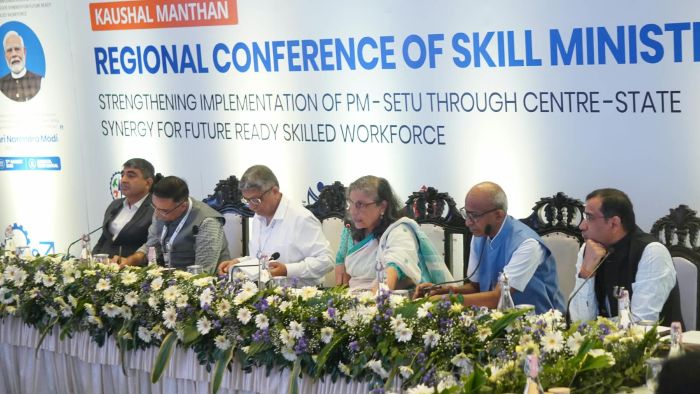
The Ministry of Skill Development and Entrepreneurship (MSDE) convened ‘Kaushal Manthan’, the Regional Conference of Skill Ministers in Kolkata on Aug 17 bringing together Ministers and senior officers from participating States and Union Territory to strengthen Centre–State coordination and advance an industry-connected, outcome-oriented skilling ecosystem.
The participating Ministers shared their States’ experiences and deliberated on ITI transformation, district-level planning, industry participation, integration of vocational and mainstream education, employability, entrepreneurship, inclusion and workforce mobility. They underlined the need to align skilling interventions with State economic priorities while maintaining common national standards for curriculum, assessment, certification and outcomes. Apprenticeship was also recognised as an important bridge between institutional training and the workplace.
The Conference was chaired by Shri Jayant Chaudhary, Minister of State (Independent Charge) for Skill Development and Entrepreneurship and Minister of State for Education, Government of India and was attended by Shri Jagannath Chattopadhyay, Minister-in-charge- Higher Education Department and Technical Education, Training and Skill Development Department, Government of West Bengal; Shri Kunvarjibhai Mohanbhai Bavaliya, Minister of Labour, Skill Development and Employment Department, Government of Gujarat; Guru Khushwant Saheb, Minister for Skill Development, Technical Education & Employment and Scheduled Caste Development, Government of Chhattisgarh; Dr. Gotam Tetwal, Minister of State (Independent Charge), Skill Development and Employment, Government of Madhya Pradesh; Shri Sampad Chandra Swain, Minister of State (Independent Charge) Industries, Skill Development and Technical Education Government of Odisha and Dr HareKrishna Bera, MoS- Technical Education, Training and Skill Development department. Senior representatives from Goa, Jharkhand and the Union Territory of Dadra and Nagar Haveli and Daman and Diu also participated.
Addressing the Conference, Shri Jayant Chaudhary said, “India’s young people bring extraordinary ambition, adaptability and potential. Our responsibility is to connect that potential with future-ready, industry-valued skills and real opportunities. PM-SETU gives us a historic opportunity to reimagine ITIs as vibrant centres of excellence, innovation and aspiration. Achieving this will require strong convergence between the Centre, States, industry and training institutions, aligning policy, infrastructure and investment around the learner. Its success will ultimately be reflected in the careers, enterprises and upward mobility we enable”.
The Minister emphasised that the Pradhan Mantri Skilling and Employability Transformation through Upgraded ITIs (PM-SETU) Scheme should be implemented as a comprehensive institutional reform. He encouraged States to align PM-SETU clusters with priority economic value chains, industrial corridors, MSME concentrations, emerging technologies and upcoming investments, with Spoke ITIs receiving dependable access to Hub laboratories, master trainers, career services and employer networks.
Referring to future-ready capabilities, Shri Chaudhary noted that over 2.10 lakh learners had enrolled under SOAR (Skilling for AI Readiness) by 16 July 2026. He stressed that AI learning must reach schools, ITIs and skill centres across districts, enabling young people not merely to use AI, but to apply, adapt and create with it.
Smt. Debashree Mukherjee, Secretary, MSDE, in her opening address, called for a unified Centre–State implementation architecture. She said that State Skill Policies, District Skill Development Plans and State Skill Development Plans should guide scheme targets, infrastructure investments, trainer deployment and employer partnerships.
During 2024–25, States and Union Territories submitted District Skill Development Plans and State Skill Development Plans. The Conference discussed strengthening these plans with district- and job role-wise demand, institutional capacity, trainer availability and local economic drivers, supported by functional District Skill Committees and annual action frameworks with clear ownership and measurable outcomes.
Shri Dilip Kumar, Director General, DGT reiterated that The transformation of ITIs under PM-SETU is not merely an infrastructure upgrade; it is a commitment to creating industry-responsive institutions that equip youth with future-ready skills, enhance employability, and support India’s journey towards becoming a global talent hub.
Ms. Manasi Sahay Thakur, Joint Secretary, MSDE, made a presentation on PM-SETU, outlining the role of States in identifying clusters, onboarding Anchor Industry Partners, preparing State Implementation Plans and establishing effective governance and monitoring mechanisms.
The Conference also witnessed the launch of a pioneering international skilling programme for 600 OBC youth from Madhya Pradesh, approved by the Government of Madhya Pradesh and implemented by NSDC under the aegis of MSDE. The programme will provide foreign-language and destination-readiness training for opportunities in Japan and Germany across high-demand sectors including caregiving, hospitality, construction and manufacturing. Training will be delivered by NSDC International Limited, a wholly owned subsidiary of NSDC.
The first-of-its-kind initiative will operate through a three-part blended-finance model comprising beneficiary participation, grant funding mobilised through the Social Stock Exchange, and outcome-based financing by the Government of Madhya Pradesh. The model connects specialised training with measurable outcomes and international employment pathways, offering a replicable approach for financing skilling and global mobility at scale.
An MoU for implementing the programme was exchanged between Shri Arun Kumar Pillai, CEO, NSDC, and Shri Sapan Jain, Additional Director, Dept of Backward Class and Minority Welfare, Govt. of Madhya Pradesh, in the presence of Shri Jayant Chaudhary and the participating dignitaries.
The Conference also discussed a unified framework for international mobility covering workforce identification, training, language proficiency, assessment, ethical recruitment and post-placement support. Caregiver mobility was identified as an immediate opportunity requiring destination-linked training, common standards, cultural readiness and worker safeguards.