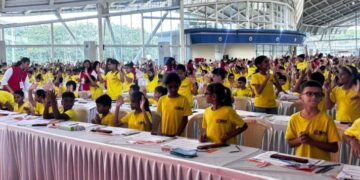


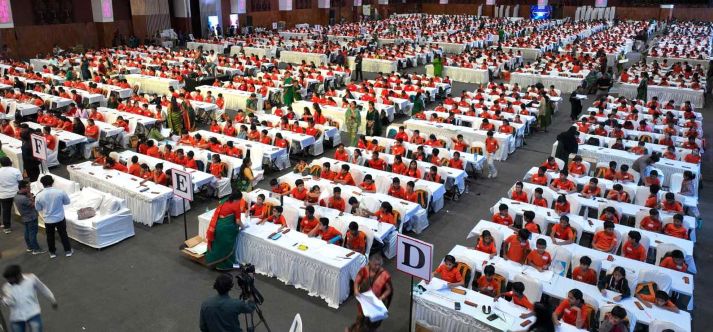
More than 3,200 children aged between 5 and 14 years from across Telangana participated in one of the state’s largest Mental Mathematics championships held on July 12 at Classic Convention Three, Shamshabad. Organised by SIP Abacus, the flagship annual event (22nd edition) provided a platform for children to showcase the cognitive abilities they develop through years of Abacus and Mental Mathematics training.
Challenging the conventional perception of mathematics examinations as silent and stressful, the championship featured an innovative Concentration Round in which participants solved complex mental arithmetic problems while loud music played in the background. Children sang, danced and moved around while continuing to perform calculations with remarkable speed and accuracy. The exercise tested their ability to maintain focus despite distractions—a skill that is becoming increasingly important in today’s fast-paced digital world.
The championship was inaugurated by Pannuru Prabhakar, Principal of ARCA Global International School, in the presence of Dinesh Victor, Founder and Managing Director of SIP Academy India.
Addressing the gathering, Prabhakar said mathematics occupies the highest position among all sciences and branches of knowledge. Ancient India, he noted, recognised its importance centuries ago, and its relevance remains undiminished even in the era of Artificial Intelligence.
Speaking on “Abacus Training in the Age of AI,” Dinesh Victor challenged the belief that mental arithmetic has become obsolete because computers and AI can perform calculations instantly.
“AI can provide answers. Abacus training develops the mind that asks the right questions. AI gives information; Abacus builds brain power,” he said.
Victor explained that Abacus training strengthens concentration, memory, visualisation, analytical thinking and processing speed—core human capabilities that technology cannot replace.
“As AI becomes smarter, mathematics becomes more important than ever. Artificial Intelligence can automate calculations, but it cannot replace reasoning, judgement, creativity and critical thinking. These are the skills children will need to thrive in the future,” he said.
Echoing the sentiment, Prabhakar said, “AI makes calculations easier; Abacus makes thinking stronger.” He emphasised that the objective of Abacus education is not merely faster arithmetic but training the brain to focus, process information rapidly and think systematically. In an AI-driven world, he added, children need strong logical reasoning and mental discipline to evaluate information critically and determine whether an answer actually makes sense.
Highlighting the growing challenge of distraction in the digital age, Victor observed that children today are growing up surrounded by screens, instant answers and shrinking attention spans. “Abacus training provides a healthy cognitive workout that improves concentration, memory retention, visualisation skills, confidence, numerical ability and overall academic performance,” he said.
Drawing a powerful analogy, he concluded: “AI is like a high-speed vehicle. Abacus helps build a better driver. A powerful machine is useful only when guided by a well-trained mind. In the age of AI, the ability to think will be more valuable than the ability to calculate. Abacus develops the thinking brain behind the technology.”