

 AI’s real promise in K–12 education lies in its ability to amplify what great teachers already do, fostering deeper engagement, personalising learning, and making classrooms more inclusive. For K–12 educators, artificial intelligence (AI) is emerging not as a distant dream, but as a practical, accessible partner in the teaching and learning process.
AI is not a substitute for teacher expertise, empathy, or creativity. Rather, it is a powerful catalyst, freeing up time for deeper relationship-building, formative assessment, and differentiated instruction. When integrated with intention and pedagogical best practice, AI can help bridge resource gaps, personalise learning pathways, and make classrooms more inclusive and dynamic. As schools nationwide advance in digital adoption, it’s time to explore how AI can help teachers deliver more engaging, equitable, and effective instruction, while still keeping the heart of education rooted in human connection.
When thoughtfully integrated, AI doesn’t replace the human touch; it empowers teachers to focus on mentorship, creativity, and building meaningful connections with students. The future of education will be shaped by educators who embrace technology as a collaborator, not a substitute, in delivering transformative learning experiences.
Here are ten actionable strategies for harnessing AI to enhance the K–12 classroom experience, drawn from the latest innovations and best practices in education:
- Foster Deeper Student Reflection
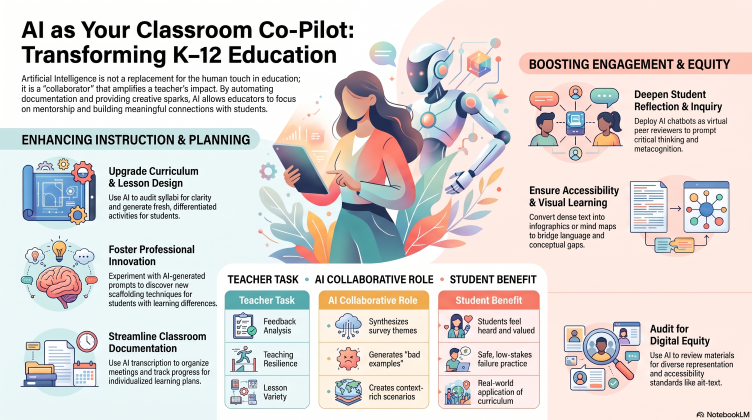
Encouraging students to meaningfully reflect on their learning is a perennial challenge, especially when faced with blank-page syndrome. AI-powered chatbots and conversation tools can act as virtual peer reviewers, prompting students with follow-up questions and nudging them to clarify their thinking. Instead of settling for surface-level responses, students engage in dialogic reflection, building metacognition and critical thinking skills essential for lifelong learning.
- Elevate Syllabus and Curriculum Design
In the rush of daily teaching, educators may not always have colleagues available to vet their syllabus for clarity, inclusivity, or alignment with learning standards. AI tools can review and critique curricular documents, highlighting ambiguous language, potential gaps, or accessibility issues. This allows teachers to iterate quickly and ensure their materials are student-centred, culturally responsive, and ready for today’s diverse classrooms.
- Make Learning Visual and Accessible
Visual learning is a critical component of effective pedagogy, especially for younger students. AI can help teachers convert dense textual information into infographics, mind maps, or even comic strips, supporting multimodal instruction. This makes content more digestible and engaging, and helps bridge language or conceptual gaps.
- Upgrade Lesson Planning with Fresh Ideas
Every teacher knows the challenge of keeping lessons fresh and responsive to student needs. By inputting objectives, grade levels, and classroom constraints into an AI assistant, educators can generate a variety of warm-up activities, formative assessments, or creative closing tasks. Even if only a few are used as-is, this process can spark new ideas that help differentiate instruction and sustain student engagement.
- Encourage Professional Experimentation
One of the most promising aspects of AI is its ability to support teacher professional growth. By experimenting with AI-generated prompts or content, teachers may discover innovative approaches to scaffolding for students with learning differences, including those with ADHD, dyslexia, or limited English proficiency. This spirit of trial and error nurtures a culture of reflective practice, where both teachers and students are learners.
- Design Dynamic, Student-Centred Activities
Project-based learning, inquiry, and real-world application are hallmarks of 21st-century education. AI tools can generate context-rich scenarios, analogies, or mini case studies tailored to any subject or grade. Teachers can use these to create role-plays, debates, or collaborative learning experiences, empowering students to connect curriculum to their own lives and communities.
- Create Safe “Failure” Opportunities
Constructive failure is an essential component of the learning process. Instead of risking embarrassment by spotlighting student mistakes, teachers can use AI to generate “bad examples”, such as poorly reasoned essays or flawed math solutions. Analyzing and correcting these examples in class helps students internalize standards and develop resilience, all in a supportive, low-stakes environment.
- Audit for Equity, Inclusion, and Accessibility
Diversity, equity, and inclusion are top priorities in today’s K–12 education landscape. AI tools can review lesson materials for representation, accessibility (such as alt text or captioning), and language complexity, helping teachers ensure that all students, regardless of background or learning needs, can fully participate. This “digital equity audit” supports schools’ broader missions of social justice and universal learning design.
- Synthesise and Respond to Student Feedback
Collecting student feedback is important, but making sense of it can be overwhelming. AI can analyze open-ended survey responses, reflective journals, or exit tickets, surfacing common themes and actionable suggestions. This empowers teachers to make data-informed adjustments, demonstrating to students that their voices matter in shaping the learning environment.
- Capture and Organise Classroom Interactions
Documentation is increasingly important in K–12 settings, especially for tracking progress in individualized learning plans or parent-teacher conferences. With appropriate consent, AI-powered note-taking and transcription tools can record and organize meetings or small-group sessions. This makes it easier for teachers to reflect, follow up, and maintain continuity in student support.
(The author is an Education Policy Expert and Vice Chairman of Silverline Prestige School, Ghaziabad)