

The crisis of confidence surrounding the National Testing Agency (NTA) and its ability to conduct an examination of NEET’s scale and significance has, quite rightly, become a matter of national concern. What began as an examination controversy has now evolved into a major political and institutional issue. The Supreme Court has made it clear that it is closely observing the conduct of the re-examination before taking up the petitions pending before it. The outcome will be critically important, not only for this year’s candidates but also for the future credibility of India’s examination system.
While discussions have understandably focused on technological safeguards and governance reforms, there is also a growing argument that the NTA requires a stronger statutory or constitutional framework that ensures greater accountability to Parliament. An institution entrusted with determining the futures of millions of students cannot operate without robust mechanisms of oversight and public accountability.
As for the political response, the opposition is doing precisely what a democratic opposition is expected to do—raise questions, demand accountability, and amplify public concerns. In fact, it is noteworthy that an education issue has occupied such significant political and public space after a very long time. Education affects nearly every household, yet it rarely receives sustained political attention unless there is a major crisis.
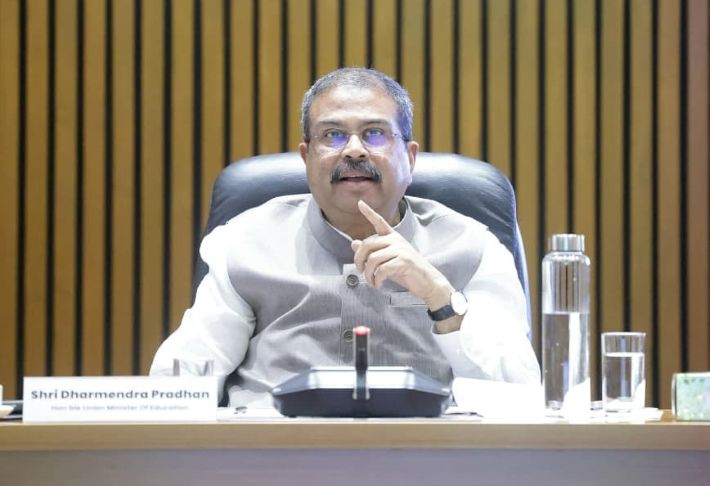
Union Education Minister Dharmendra Pradhan has been at the helm for the past two years. During the NEET 2024 scandal, he projected himself as a leader willing to take tough decisions, and the government moved swiftly to contain the damage. The appointment of the Dr. K. Radhakrishnan Committee and the subsequent reform recommendations were presented as evidence that lessons had been learned and corrective action had been taken. Yet, barely two years later, the system appears to have come full circle.
In public life, moral responsibility is not merely about accepting accountability in words; it is demonstrated through actions. Leaders are ultimately judged by their willingness to own failures that occur under their watch. The minister has stated that he accepts responsibility, but accountability must have a visible measure. It could take the form of a public apology to students and parents, a transparent acknowledgment of institutional failures, or even an offer to step aside pending a full inquiry. Instead, the response has increasingly focused on accusing the opposition of politicizing the issue. That is a misplaced argument. In a democracy, scrutiny and political criticism are not distractions from accountability; they are part of it.
The criminal dimensions of the case, including allegations of wrongdoing and corruption, are being investigated by the CBI and will undoubtedly be examined further during court proceedings. However, an equally important question remains unanswered: where are the voices of the students in this entire conversation? Do the children and young people affected by these decisions have any agency? Are they being heard? Is the system actively seeking to understand their concerns, anxieties, and expectations? Have any government departments conducted meaningful surveys or consultations to assess how students perceive the reforms being introduced in their name?
The larger concern extends beyond NEET itself. The rapid technological transformation of education did not begin with the pandemic, although COVID-19 accelerated it dramatically. For years, there has been a sustained push to introduce technology into every aspect of education—from assessment and administration to teacher training and learning processes. While technology has undeniable benefits, its expansion has often been driven by scale, efficiency, and measurable outcomes rather than by educational philosophy.
The consequence is that education is increasingly reduced to numbers, rankings, dashboards, and performance metrics. Institutions that took decades to build, academic cultures that nurtured intellectual growth, and processes designed to develop critical thinking and human potential have gradually lost their centrality. The language of excellence remains, but too often it exists as a slogan rather than a lived reality. In the pursuit of efficiency, the system risks losing sight of the very purpose of education: the development of informed, capable, and confident human beings.
The NEET controversy is therefore not just about examination security. It is a reminder that trust, accountability, institutional integrity, and student welfare must remain at the heart of educational governance. Without that foundation, no amount of technological reform can restore public confidence.