
• ECCE
  • School Edu
  • Higher Edu
  • Edu Tech
  • Skills
  • Jobs
  • Advertise
  • Login
[t4b-ticker]
  • Home
  • Latest
  • Spotlight
  • Perspective
  • Interview
  • Videos
  • Events
  • Shop
  • Student Kiosk
No Result
View All Result
  • Home
  • Latest
  • Spotlight
  • Perspective
  • Interview
  • Videos
  • Events
  • Shop
  • Student Kiosk
No Result
View All Result
Education21
Home Careerwise

Women’s employment in Urban India jumps 10% in 6 years’: White Paper

education by education
March 7, 2025
in Careerwise, People
0
Women’s employment in Urban India jumps 10% in 6 years’: White Paper
0
SHARES
118
VIEWS
Share on FacebookShare on Twitter

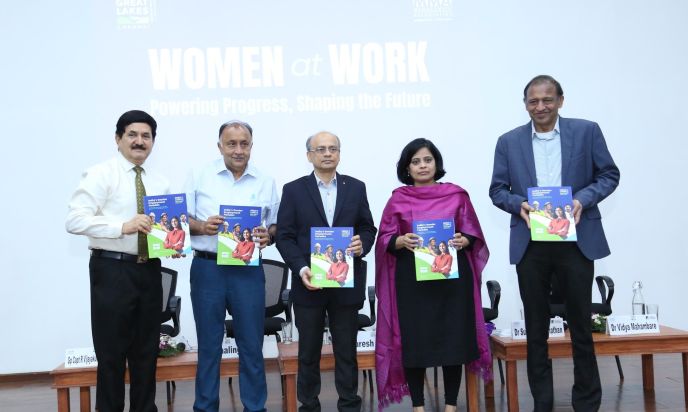
Despite women’s employment in urban India jumping 10% in six years (2017-18 to 2023-24), more than 89 million urban Indian women still remained out of the labour market in 2023-2024, according to a white paper launched by Great Lakes Institute of Management, Chennai, on the occasion of International Women’s Day 2025.

The report highlights the evolving landscape of women’s unemployment in urban India and also warns of pressing challenges including the underutilisation of educated women’s skills and the looming risk of a diversity backlash. As per the report, “India is failing to utilize the skills of over 19 million graduate-educated urban women due to personal choices or constraints from social norms – highlighting a critical waste of educational investment. Factors such as caregiving responsibilities, lack of flexible work arrangements, and commuting challenges continue to prevent many highly qualified women from fully participating in the economy. Meanwhile, Young male unemployment in urban India outpaces women’s (10% vs 7.5% for ages 20-24) in a concerning trend”

Dr Suresh Ramanathan, Dean at Great Lakes Institute of Management, Chennai says, “It creates a risk of diversity backlash if quality job creation doesn’t accelerate to accommodate both genders. The report cautions that if quality job creation remains sluggish, rising female employment alongside male joblessness may trigger societal resistance to workplace diversity since men must earn as per the existing social norm. A deeply troubling insight from the report reveals that employed women in urban India face a higher risk of spousal violence compared to their non-working counterparts. Even more concerning, employed women are more likely to justify spousal abuse (32% vs. 23.5%), potentially due to internalized societal pressures and guilt. This paradox underscores the urgent need for holistic interventions that address gender norms both at home and in the workplace”.

Another important aspect highlighted in the findings is that gender gaps persist even in highly educated households. Even among dual-income, highly educated couples, gender disparities remain stark. In 62% of such families, husbands earn more, despite equal educational qualifications. Additionally, wives continue to take on the primary responsibility for household work in 41% of homes, compared to just 2% of husbands. Meanwhile, the balance remains elusive for urban mothers with access to remote work—86% report spending up to three workday hours on childcare while working. Yet only 44% feel they have adequate support. This reinforces the need for stronger workplace policies that acknowledge and address the realities of working mothers.

Commenting on the report, Dr. Vidya Mahambare, Professor of Economics & Director (Research and Fellow Program in Management), Great Lakes Institute of Management, stated: “While women’s workforce participation in urban India is rising, it is not yet translating into true gender parity in earnings, career growth, and domestic responsibilities. To drive real change, first, we need more employment opportunities for all. Second, we need structural reforms in childcare policies, flexible work arrangements, and a shift in societal norms that continue to burden women disproportionately.”

As India strives for greater gender equality in the workforce, the report emphasises the importance of policy reforms, corporate initiatives, and societal change. By accelerating quality job creation, fostering inclusive workplaces, and challenging entrenched norms, India can unlock the full economic potential of its women workforce.

The full report, titled “India’s Gender Employment Paradox: Key Findings and Policy Suggestions,” is available for download on the https://www.greatlakes.edu.in/chennai/international-womens-day-report

  • Facebook
  • Twitter
  • Instagram
  • LinkedIn
  • RSS Feed
Previous Post

ASDC celebrates the success of women as skilled EV drivers  under Project Sakhi, a JV with BluSmart

Next Post

ESET & Ashoka University launch Cybersecurity Scholarship for Women

education

education

Related Posts

2,400+ students from 160+ academic institutions participate in SDI 2026
Careerwise

2,400+ students from 160+ academic institutions participate in SDI 2026

by education
June 22, 2026
ETS marks one year of the enhanced TOEFL iBT® by deepening support for Indian learners
Careerwise

ETS marks one year of the enhanced TOEFL iBT® by deepening support for Indian learners

by education
June 17, 2026
ISDM and PRADAN launch new frameworks to shift how India measures social impact
People

ISDM and PRADAN launch new frameworks to shift how India measures social impact

by education
June 16, 2026
JEE Advanced 2026 — Results declared, 56, 880 Qualify
Careerwise

JEE Advanced 2026 — Results declared, 56, 880 Qualify

by education
June 1, 2026
NTA advertises for Specialist CTO, CFO and GM (HR) Roles
Careerwise

NTA advertises for Specialist CTO, CFO and GM (HR) Roles

by education
May 21, 2026
Next Post

ESET & Ashoka University launch Cybersecurity Scholarship for Women

  • Facebook
  • Twitter
  • Instagram
  • LinkedIn
  • RSS Feed

Useful Announcements

  • All
  • Useful Announcements

Kalpataru Trust & Veranda IAS to support UPSC 2026 Mains aspirants

June 22, 2026

IIT Graduate launches Skill-Gaming App ‘Crazinos’

June 22, 2026

IIT Delhi CEP opens applications for Healthcare Industry 5.0 programme

June 19, 2026

Registrations open for FEF Season 2, Pitch to Get Rich is set to return

June 19, 2026

QS I-GAUGE Launches Nationwide AI Adoption Survey for Schools and Higher Education Faculty

June 17, 2026

Registrations Closing for 22nd edition of The Himalayan Odyssey soon

June 17, 2026

Registration opens for the upcoming SAT testing cycle: August 7 is the registration deadline

June 15, 2026

ESCP announces launch of a new Bachelor’s degree and three Masters of Science

June 13, 2026

IIT Kanpur Launches New Undergraduate Program in Cybersecurity

June 12, 2026

Anurag University introduces MBA in BFSI

June 12, 2026

Download current issue Not available

https://online.pubhtml5.com/jlyo/bxvr/

Monthly Magazine : Feb 2024

Interactive (Quizzes/Surveys)

Start Monthly Quiz
Education21

An initiative in continuation of Curriculum Magazine, Education21.in, is a platform for New India that aspires to be a valuable innovator, partner and collaborator for a just and sustainable world. Continuing with our steady and 360 degree coverage of education system and skills landscape, we are here more oriented towards learner community.

Useful Links

  • About us
  • Team
  • Contact
  • Editorial opportunities
  • Subscriptions
  • Job Opportunities
  • Features

Important Links

  • Blog
  • Archives
  • People
  • Careerwise
  • Resources
  • Downloadable
  • Old issues

Newsletter

  • Facebook
  • Twitter
  • Instagram
  • LinkedIn
  • RSS Feed

Copyright © 2020 All rights reserved. Education21.

No Result
View All Result
  • Home
  • Latest
  • Spotlight
  • Perspective
  • Interview
  • Videos
  • Events
  • Shop
  • Student Kiosk

Copyright © 2020 All rights reserved. Education21.

Welcome Back!

Login to your account below

Forgotten Password?

Create New Account!

Fill the forms bellow to register

All fields are required. Log In

Retrieve your password

Please enter your username or email address to reset your password.

Log In
Cleantalk Pixel