

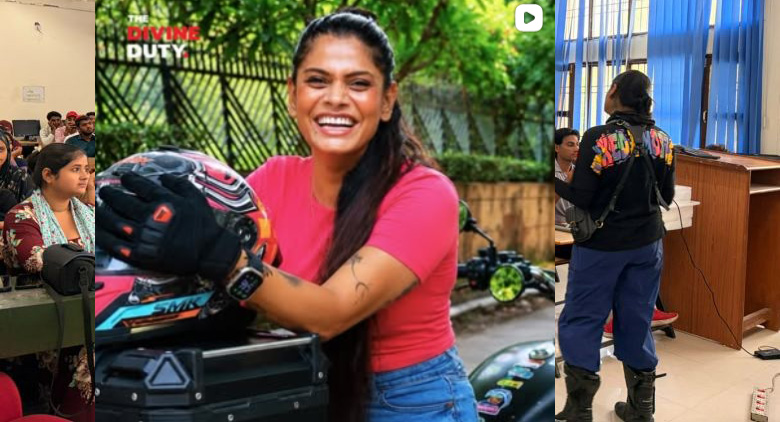
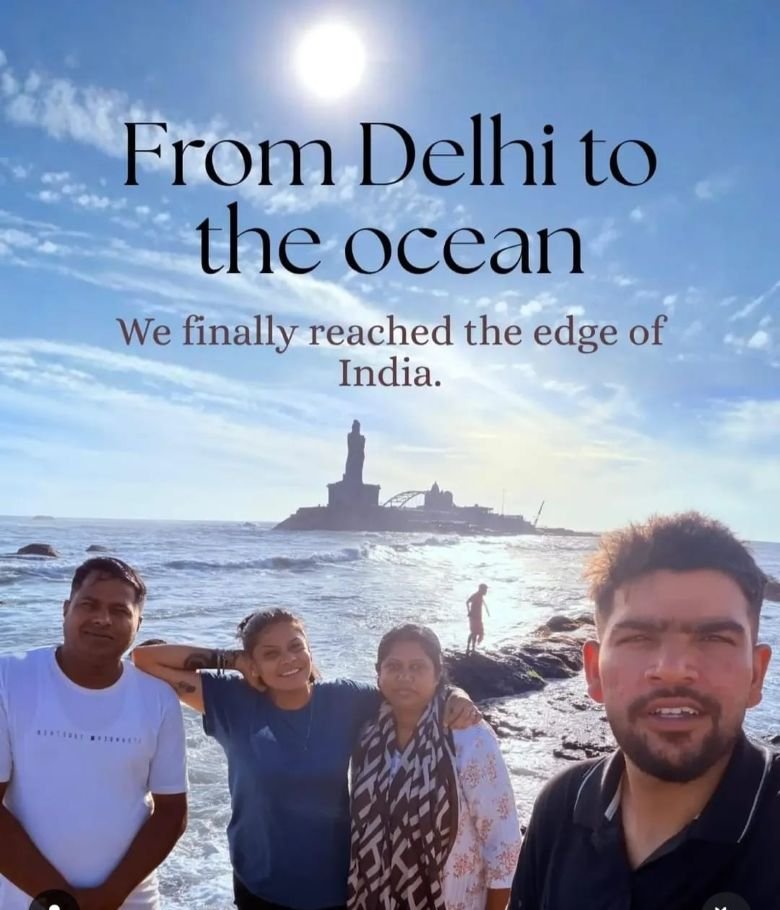
Seher Hashmi Raza, an alumna of the National Institute of Fashion Technology (NIFT), Delhi, is a mental health advocate, artist and certified fashion stylist. The daughter of social activist Shabnam Hashmi and scientist-poet Gauhar Raza, hit the road on August 21 from Delhi’s Constitutional Club leading the ‘Beyond the Horizon: A Ride for Resilience’ expedition supported by The Mariwala Health Initiative for 56 days that saw her speak at 111 sessions on the theme before it concluded again in Delhi on October 15. Her team of four included two coordinating colleagues and a driver who rode alongside. Drawing on her own experiences, she hopes to challenge the stigma surrounding mental illness and encourage people to seek help through such campaigns.
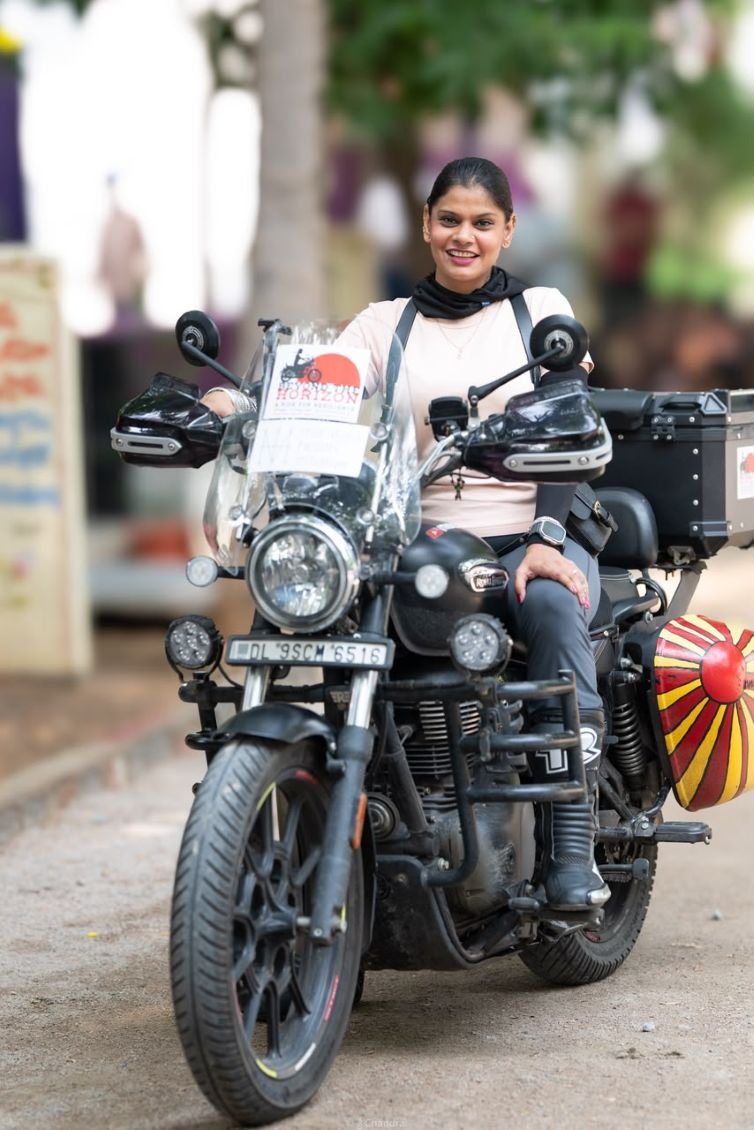
Please tell us how did the idea of a motorcycle expedition to spread mental health awareness came to you and how was the experience after such a long travel?
The idea took shape in February this year when I shared my desire to undertake such a journey with my mother, Shabnam Hashmi. She encouraged me and coordinated the entire expedition. The Mariwala Health Initiative supported us. I am thankful to them and other sponsors, who made me realize this landmark purposeful adventure.
The whole experience was amazing, of course, but very, very tiring. Riding a bike for 56 days, continuously, every other day, and meeting so many people was exhausting. But we were making everyone around us aware of mental health. This is what I wanted to do.
Having experienced myself the different phases a person with mental health conditions can go through, I understand how important it is to make people aware of their struggles. Every other day, we are losing people. Someone or the other commits suicide. That is why I felt it was important to reach out to people in different parts of the country. We need to address unresolved trauma and emotional distress rather than allowing them to accumulate. People should understand that seeking help is not something to be ashamed of.
We covered 14 states and 64 cities, conducting 111 sessions at schools, colleges, small restaurants and NGOs. We also visited Kota, a city known for its coaching institutes and student population, where suicide has been a major concern. It was fulfilling to meet so many people, having firsthand experience of our diverse places, foods and all the fun of travel.
How did people respond to the campaign?
People responded very positively because we were discussing mental health in a different way.
When a psychiatrist or counsellor goes to talk to people about mental health, they often get nervous because of the stigma. But when a survivor like me talks to them, they feel that if this person is doing well, perhaps they can do well too. Even recognising that you may be experiencing a mental health condition and need to seek help is an important step in our case with low level of awareness.
During the campaign, most people told us that, for the first time in their lives, they were attending a session on mental health. They did not know much about it. In some villages, people still attribute mental health difficulties to supernatural causes, such as possession by spirits or ghosts. Therefore, awareness is very important. People must know that it is like any other disease and what is more crucial to know is you can get kidney, liver or lung transplant, even you can fix face through cosmetic surgery but we can never change the damn brain and the brain gets stuck in the trauma of so many years if we’re not taking stuff out of it. I told everyone that it is very important to empty the brain from time to time so that you can make space in it because you can’t change it. For your good physical health, having proper mental health is necessary, both are closely connected, and mental well-being deserves the same attention as physical fitness. I think I was quite successful in sending out the message and people responded warmly. (You can visit her Instagram account for details of the expedition Seher Hashmi (@perfectlyimperfectseher)
During the expedition or otherwise, do people approach you for help? How do you support such people?
Yes, many people approach me. Some come to me in tears, while others contact me privately through Instagram. I would give them information and what resources and support system is available. Some people could not talk to me directly, so they used to message me on Instagram. I would reply. I have tried to help people take that first step towards getting professional support.
I also share counsellors’ contact details and help people find psychiatrists in their cities. In some cases, we assisted in arranging appointments with counsellors. Financial support from sponsors or reduced fees from practitioners could also help make treatment more affordable and that is also an effort at times.
During the expedition, I made people aware of the government’s Tele-MANAS helpline (14416 or 1-800-891-4416), which many people did not know about. The service offers free, confidential mental health support round the clock, in multiple languages. Helplines can be particularly useful for children who are afraid of being identified or are unable to discuss their problems with parents or teachers.
I would tell them that the helpline is their new best friend. If they do not want to tell anyone, they can talk to the helpline. They do not have to give their name. It is available in all languages.
These services can provide an important first point of contact for people who need someone to listen to them without judgment.
Coming to a general question, what are the major barriers to accessing mental health care in India?
We do not have enough counsellors. And even where they are available, treatment is often unaffordable. The actual treatment and therapies are very costly. We need more facilities in the government sector.
I have written to political leaders and other authorities, urging them to use public funds to build the capacity needed to address mental health concerns and make treatment accessible to people from all economic backgrounds. Awareness alone is not enough. People need access to professionals who can help them.
What role should schools and colleges play in supporting the mental health of young people?
Children spend eight or nine hours a day in school. If a child is facing difficulties, is different from other children, needs extra classes, cries frequently or cannot concentrate, there has to be an effort to understand what is happening. In my case, schools were very insensitive when I was growing up. They threw me out of school. That shouldn’t happen.
Every school should have a counsellor who can identify children experiencing emotional or psychological difficulties and help them access appropriate support. Parents should also be involved, when necessary, without making children feel embarrassed or ashamed. If a child is failing or unable to study, there has to be a reason. We need to understand that instead of blaming the child. Mental health challenges can affect people at any age, from young children to older adults. No age group is immune to stress that may become difficult to manage.
There has to be more sensitivity. If a child is struggling, teachers and principals should try to understand the reason rather than simply labelling the child as difficult or incapable. If schools do not understand, teachers do not understand, principals do not understand, and parents do not understand, where will the child go? We need to create an environment where children can speak openly about their problems and feel that someone will listen to them. These children may be going through something that requires attention and support.
How important is family support in helping someone cope with mental health difficulties?
Family support is extremely important. If my family is not supportive and does not understand me, and keeps taunting me about why I am not going out, why I am not talking to people or why I am shouting, how am I supposed to handle myself?
Even today, my parents sometimes ask me about my state of mind. That is important because mental health is not something that can be addressed once and then forgotten.
Parents need to be sensitive to their children’s emotional needs. They should not dismiss their difficulties as drama or attention-seeking behaviour.
They should build a relationship in which children feel comfortable sharing their problems without fear of being judged or scolded. That is what my parents did. I can talk to them about anything. Children need to know that they can approach their parents when something is bothering them. If they are afraid of being judged, they may stop sharing their problems altogether.
What would you like to tell young people who are struggling with mental health difficulties?
Problems will come. But if you face them, you will become stronger. That is what I have done for so many years. I had issues, but I fought them, and now I can help so many other people.
It is easy to break up. It is easy to give up. But we can do something about it. Share your issues with the right people, not people who will explain theories of life to you, but people who will listen. Counsellors will give you advice, psychiatrists will give you medicines, and counsellors may tell you to walk for 50 minutes. But you have to motivate yourself. If something did not happen today, try again. Keep trying.
Professional treatment, including counselling and medication when prescribed, can be important. But you also need patience and the willingness to continue making an effort.
What will people say? I always tell people that people will always say something. So why deal with that? Instead, deal with yourself. Do whatever you want to do. Also, understand the risks of social media addiction and try to stay away from its cognitive effects.
Do not allow the fear of social judgment to determine your choices. Keep seeking support, whether that means taking another attempt, speaking to a counsellor, taking prescribed medication or raising your voice for your rights. It took me 10 years to fight depression and suicidal thoughts but here I am a better and successful person leaving all that behind.
Finally, what are your plans for the next phase of your mental health awareness campaign?
I plan to continue my mental health awareness work with another campaign in March. I hope to conduct sessions at different locations across the National Capital Region. I want to do an international ride. I have to do a lot of planning, but I will do that too, slowly.