

Pune Knowledge Cluster, under the Office of the Principal Scientific Adviser to the Government of India, in collaboration with Salaam Bombay Foundation, organised EduConclave 3.0 on January 30, 2026, at Savitribai Phule Pune University.
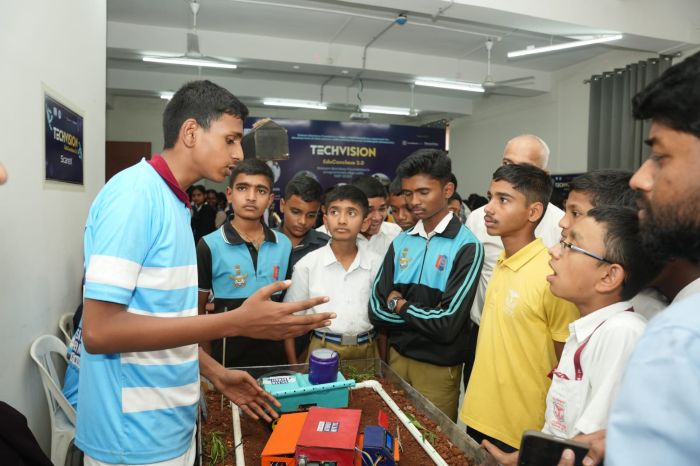
A key highlight of EduConclave 3.0 was TechVision, a student-led technology exhibition where students from government and government-aided schools presented solutions to real-world challenges. More than 750 students from over 25 schools across Mumbai, Pune and Nashik participated, developing over 100 projects across robotics, artificial intelligence and other new-age technologies. The top 14 projects were showcased at the conclave, which was attended by over 1,000 students from 19 government schools in Pune.
Among the notable innovations was SpoilAlert, developed by students Ayush Bhosale and Shreyash Bile. The handheld food safety scanner detects whether food is fresh or spoiled by sensing spoilage gases and changes in colour and moisture, with results displayed instantly on a screen. Designed as a low-cost, non-destructive device, it aims to reduce food waste and help prevent foodborne illnesses.
In the agriculture category, ShetiSuraksha, an autonomous farming robot created by Arjun Vishwasroa and Soham Hajare, attracted attention for its practical application. The robot monitors plant and soil conditions, waters only dry areas, detects rainfall, deters pests, and sends real-time updates to the farmer’s phone. The solution is designed to save water and labour while supporting healthier crops and more efficient farm management.
Other innovations include: SalineGuard Pro (saline monitoring system that silently tracks fluid levels and alerts nurses in time – enhancing patient safety without disturbing hospital calm), NextGen Cart (a smart shopping cart that scans barcodes, verifies item weight, and shows real-time billing on your phone – making checkout faster, fairer, and hassle-free), Poll Wizard (digital voting system that ensures secure, duplicate-free polling with instant results and easy Excel-based data management), FallWatch (bike-mounted fall detection system that senses accidents and instantly shares live location with emergency contacts for faster lifesaving response), among others.
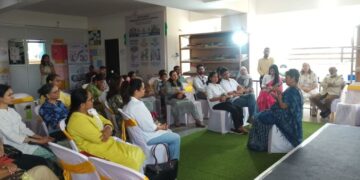
The two-day conclave brought together educators, policymakers and STEM practitioners to explore new and practical approaches to STEM education in India. The programme featured hands-on workshops on Artificial Intelligence and Zero-Cost Game-Based Learning, a panel discussion on building future-ready classrooms, and a STEM showcase highlighting emerging education technologies.
Dr. Priya Nagaraj, Interim-CEO, Pune Knowledge Cluster (PKC) said, “We are very happy to be hosting the third year of EduConclave, which is our annual education conference. This year’s focus is on integrating digital pedagogies into school teaching and learning practices. We are happy to see that we have more than 70 participants, and we have a very large student-led exhibition as part of EduConclave this year.
EduConclave 3.0 concluded with a strong call to action to ensure equitable access to quality STEM education across regions and school systems. By placing students at the centre of innovation and learning, the conclave reaffirmed a shared commitment to building inclusive, future-ready education ecosystems that empower young minds to explore, innovate and lead.