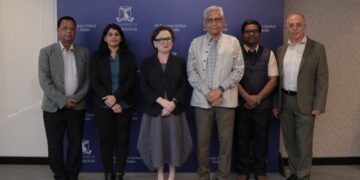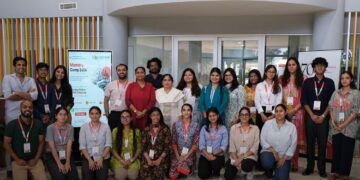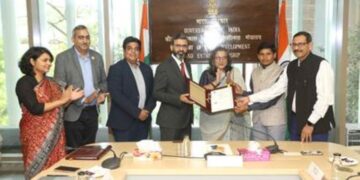


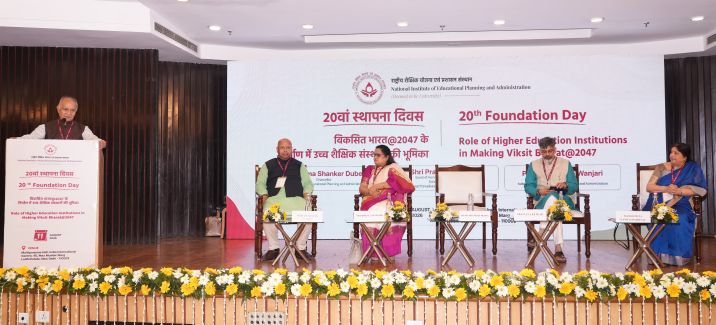
Marking its 20th Foundation, the National Institute of Educational Planning and Administration (NIEPA), a Deemed to be University under the Ministry of Education, on Aug 11 announced the launch of a Master of Arts in AI Education and Master of Arts in School Leadership in New Delhi.
With nearly 65% of India’s population under 35 and a target of 50% Gross Enrolment Ratio by 2035, NIEPA is on a mission to build and strengthen the governance capacity required for a future-ready higher education system. In 2025-26, NIEPA strengthened evidence-based educational planning through 128 national and international programmes reaching 7,634 participants. The Foundation Day celebration also featured 7 Higher Education book releases and international collaborations.
The celebratory occasion brought also together senior policymakers, education leaders, scholars, faculty members and administrators to reflect on the role of higher education institutions in shaping India’s development.
Prof. Rama Shanker Dubey, Chancellor, NIEPA, said, “As India advances towards Viksit Bharat@2047, higher education institutions must become centres of knowledge, innovation and responsible leadership. NIEPA’s work in educational planning, policy research and capacity building is vital to strengthening institutions and enabling evidence-based decision-making across the education system.”
The programme was graced by Prafulla Ketkar, Editor, Organiser, Bharat Prakashan (Delhi) Limited, as guest of honour, who during his keynote speech on the theme ‘Role of Higher Education Institutions in Making Viksit Bharat@2047. He said, “Everyone talks about 2047. PM Modi has made an important point while talking about Viksit Bharat@2047. He said by 2035, we need to decolonise our minds.”
Shri Ketkar also emphasised the central role of higher education institutions in India’s long-term national transformation. “Without decolonisation, there wouldn’t be renationalisation and without that, there wouldn’t be Viksit Bharat@2047. The moment we say India, it becomes a geographical identity. Bharat is more of an educational, knowledgeable, cultural identity. ‘Bha-Rat’ itself means those who always seek knowledge and light. Bharat is a civilisational tradition; while India is a geographical identity. That’s why our constitution accepts both terms: India and Bharat.” he added.