


Indian Institute of Technology Madras (IIT Madras) researchers have identified the Indian Ocean and Bay of Bengal as potential storage sinks for storing large amounts of carbon dioxide (CO2). Called ‘CO2 sequestration,’ this process envisages the ocean acting like a storage reservoir for greenhouse gas which will help to decarbonize industrial clusters.
The researchers found that CO2 can be stored permanently in the ocean in the form of solid hydrate beyond 500 m of sea depth through the liquid CO2, thereby can be helpful to make our industrial clusters carbon neutral.
The key findings of this research is that it can help devise large-scale CO2 storage and utilize the fullest potential of oceans to decarbonize the world without harming marine ecology. This research can also help India achieve its National decarbonisation and climate change goals.
The stored carbon dioxide can create an eco-friendly ice-like substance called ‘Gas Hydrates’. One cubic meter of gas hydrate can sequester approximately 150-170 cubic meters of CO2 under oceanic conditions beyond 500 meters.
Thus, gas hydrates-based storage has huge potential to decarbonize India’s industrial clusters. This research will pave pathways to develop large-scale sequestration in subsea sediments that help the scientific community to fulfill India’s net-zero targets.
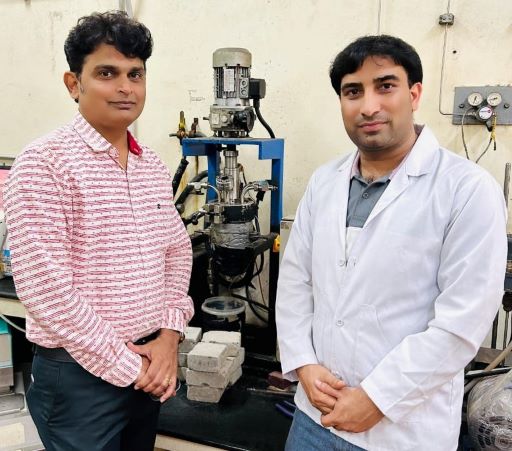
The research was led by Prof. Jitendra Sangwai, Department of Chemical Engineering, IIT Madras, and Mr. Yogendra Kumar Mishra, Research Scholar (Prime Ministers Research Fellow), IIT Madras.
The findings were published in several research papers in reputed peer-reviewed journals including Energy Fuels (DOI: https://doi.org/10.1021/acs.energyfuels.3c00581, https://doi.org/10.1021/acs.energyfuels.3c02311) and Fuel (DOI: https://doi.org/10.1016/j.fuel.2024.130990).
Highlighting the importance of this research to India, Prof. Jitendra Sangwai, Department of Chemical Engineering, IIT Madras, said, “Methane hydrates have been in the ocean for millions of years without affecting the environment. Methane is a more potent greenhouse gas than CO2. This attracts researchers to explore the ocean to store CO2 permanently. Our analysis shows that at above 2,800 m depth, CO2 is denser than seawater, which offers an additional gravitation barrier for CO2 to escape.”
Prof. Jitendra Sangwai added, “Our dependence on fossil fuels will continue for foreseeable future till we find reliable source of energy to completely replace fossil fuels. Thus, CO2 capture and sequestration is a very important precursor to achieve net-zero goal. Once CO2 is captured from source, it needs to be sequestered safely. CO2 sequestration in oceans will be beneficial for India as, according a conservative estimate, the Bay of Bengal alone can be able to sequestrate several hundred giga tonnes of anthropogenic CO2 in oceans and marine sediments, which is equivalent to several years of total GHG (Greenhouse Gas) emission emitted by India. Some countries in Europe (e.g., Norway and Denmark) are working on CO2 storage in the North Sea.”
Once the CO2 is permanently stored as a gas hydrates, it does not allow for any reemission into the atmosphere owing to gravitational and hydrate permeability barrier in the subsea sediments.
The Key findings of their research include
- Beyond 2,800 m of sea depth, CO2 liquid is denser than seawater.
- Thus, beyond 2800 m sea depth, CO2 can be stored permanently in the form of liquid pool and solid hydrate, and
- It will not permit any reemission into the atmosphere owing to the gravitational and permeability barrier offered by subsea sediments.
- The subsea clay sediments improve the mechanical and thermal stability of gas hydrates which help for long-term CO2 storage potential.
Elaborating further, Mr. Yogendra Kumar Mishra, Research Scholar (Prime Ministers Research Fellow), IIT Madras, said, “There are different ways to sequester CO2 to reduce its impact on the environment. Using the ocean as a CO2 storage sink is an attractive proposition but storing CO2 directly into the ocean at shallow depth can harm marine life. Hence, CO2 needs to be stored permanently in the ocean in the form of liquid pools or solid hydrates beyond a certain depth.”
Further, Mr. Yogendra Kumar Mishra said, “Another attractive option is to store CO2 in subsea sediments as this will have less impact on marine ecology. The subsea sediments have tiny spaces that can hold CO2 and over the period of time stored gas form ice-like gas hydrate crystals in the pores. This will further reduce the permeability of hydrate-bearing sediments and create a permeability barrier.”
The IIT Madras Research team has observed that hydrate formation is more efficient and stable at higher clay concentrations. The clay inclusion in seawater improves the kinetics of hydrate formation as compared to seawater alone. Some promoters such as tetrahydrofuran (THF) further enhance hydrate kinetics synergistically with clay that will help in large-scale CO2 storage in subsea sediments.
Studying the concentration of clay, properties of additives, and local bathymetry information of the ocean can help figure out the best way to store CO2 in the subsea sediments.
BACKGROUND
The last 100 years of the Industrial Revolution have seen a significant rise in the living standards of mankind and industrial growth. Consequently, CO2 emissions were found to have increased from 5 Giga tonnes of carbon (GtC)/year to 9.9 GtC/year in the last 40 years due to the combustion of fossil fuels, construction, manufacturing, and various industrial activities. Moreover, expeditious urbanization, deforestation, and construction activities made the situation difficult in terms of CO2 emissions.
Immediate steps are required to confine the global temperature increase within 2 °C and global carbon dioxide emissions to ∼1100 Gt CO2 between 2011 and 2050. However, with the current and predicted use of fossil fuels and various industrial activities, it is a challenging task but there is also an opportunity to address it.
CO2 sequestering offers a promising alternative to managing CO2 emissions and helping the world achieve its climate targets. There is no other attractive option than oceans as it covers 2/3 the surface of our earth.