

With air pollution during the winter months escalating into a public health emergency across large parts of northern India—most acutely in the National Capital Region (NCR) of Delhi—and with deteriorating air quality now affecting nearly 130 cities nationwide, the crisis is increasingly being recognised as a national challenge rather than a localised one. A broad consensus is emerging on the need for concerted, coordinated, and sustained action to confront this persistent and deeply embedded societal problem.
In early January 2026, the Supreme Court injected renewed urgency into the issue, expressly disagreeing with the Commission for Air Quality Management (CAQM) for its failure to clearly identify the principal causes of air pollution in the Delhi-NCR. The Court directed CAQM to convene a meeting of domain experts and submit, within a compressed timeframe of two weeks, a consolidated report identifying major pollution sources and proposing credible solutions to the worsening crisis.
For several years now, Delhi’s annual average PM₂.₅ concentrations have hovered between 85 and 100 µg/m³—more than double India’s National Ambient Air Quality Standards (NAAQS), 2009, which prescribe an annual average limit of 40 µg/m³ and a 24-hour limit of 60 µg/m³, and nearly twenty times higher than the World Health Organization’s recommended guideline. During winter, unfavourable meteorological conditions such as low wind speeds and temperature inversions trap pollutants close to the ground, intensifying what has become a recurring and predictable “pollution season.”
In December 2025, extremely poor air quality—often with Air Quality Index (AQI) levels exceeding 400—combined with cold-wave conditions, forced authorities to shift primary classes to online mode and adopt hybrid arrangements for senior students. In effect, air pollution has begun to directly disrupt schooling, undermining educational continuity and exposing the social costs of environmental neglect.
The health implications are severe and well documented. Fine particulate matter (PM₂.₅), which penetrates deep into the lungs and enters the bloodstream, is the most harmful component of Delhi’s air pollution. Children and the elderly are particularly vulnerable. Prolonged exposure aggravates asthma and chronic obstructive pulmonary disease (COPD) and significantly increases the risk of cardiovascular events, including heart attacks and strokes. Reported estimates indicate that between 2022 and 2024, Delhi hospitals recorded over 200,000 cases of respiratory illnesses directly linked to air pollution.
This grim reality persists despite decades of judicial oversight by the Supreme Court of India, which has consistently affirmed the Right to Clean Air as an intrinsic part of the Right to Life under Article 21 of the Constitution. Landmark interventions—including the conversion of public transport to compressed natural gas (CNG) in 2002, directions to notify and operationalise the Graded Response Action Plan (GRAP), and judicial support for the National Clean Air Programme (NCAP)—have significantly shaped India’s air-pollution governance framework. Yet, the lack of sustained improvement points to persistent gaps in enforcement, coordination, and accountability.
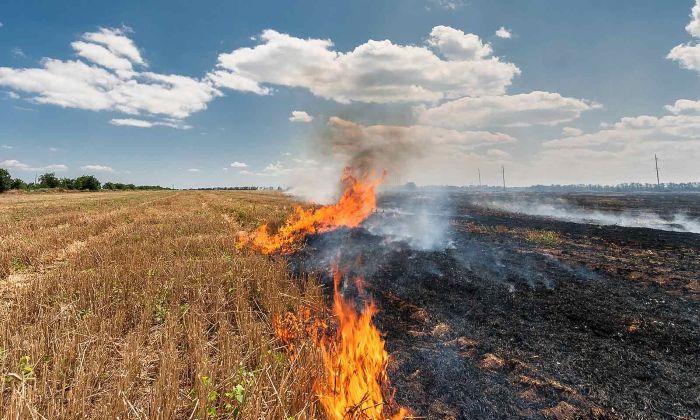
Air pollution in the Delhi-NCR is deeply entrenched and multi-causal. While vehicular emissions, road and construction dust, and industrial activity dominate pollution levels for much of the year, winter months see a sharp escalation due to stubble and crop-residue burning, along with solid biomass combustion. Several studies estimate that these sources may contribute up to 40 per cent of winter pollution, transforming the issue into a complex inter-state challenge marked more by political contestation and blame-shifting than cooperative federal action.
Against this backdrop—and responding to persistent calls for Indian higher educational institutions (HEIs) to play a stronger role in applied research, product development, and innovation addressing pressing societal challenges—Chitkara University, located in the heart of Punjab, has emerged with a path-breaking solution to stubble burning. Researchers at the Chitkara University Research and Innovation Network (CURIN) have developed an eco-friendly technology that converts rice straw into high-purity silica gel using a microwave-assisted chemical process.
Although the techno-economic analysis for commercial deployment is still underway, early indicators suggest that CURIN’s innovation could offer a viable long-term solution to air pollution caused by stubble burning. Silica gel—valued for its moisture-absorption properties and its ability to prevent mould growth, corrosion, and spoilage—has extensive industrial applications across pharmaceuticals, cosmetics, electronics, food packaging, and storage, ensuring a stable and sustained market for the end product.
In rice straw, silica is primarily bound to cellulose through interactions involving hemicellulose and lignin. Conventional extraction methods have historically been chemically intensive, technically complex, and economically unviable, limiting widespread adoption. Reflecting on the origins of the innovation, Dr K. K. Mishra, Professor of Physics and Electronics and Pro Vice-Chancellor (Quality Assurance) at Chitkara University, observes:
“About two years ago, as stubble burning began dominating daily news cycles, discussions within the university prompted students and faculty to brainstorm alternative solutions. We began experimenting in our laboratories, and the idea of microwave-assisted chemical synthesis emerged as a viable alternative to conventional extraction processes.”
The microwave-assisted chemical synthesis approach leverages both thermal and non-thermal microwave effects to accelerate chemical reactions. This significantly shortens processing time, enhances mass-transfer efficiency, and reduces overall energy consumption compared to traditional heating methods. The patented technology enables efficient extraction of silica from rice-straw ash and its conversion into high-purity silica gel, with the added advantage of being suitable for decentralised and semi-automated operations.
With strong institutional backing, the technology has been patented, and the research team has secured two patents related to the innovation. An industry partner collaborating on the R&D has already expressed interest in commercial production and is currently assessing plant-level and mechanical requirements for scaling up the process.
While the project remains in the techno-economic validation phase, researchers see a clear win–win proposition. Silica gel commands stable market demand, while ash bricks depleted of silica fetch higher prices, making them more attractive to buyers. Together, these value propositions offer strong economic incentives for farmers to monetise crop residue rather than burn it. The technology also enables entrepreneurs to extract residual silica even from ash, further expanding value-addition opportunities.
Once commercialised, this innovation holds the potential to substantially reduce stubble burning over the coming years while catalysing rural micro-enterprises, strengthening local value chains, reducing dependence on imported silica, and offering a practical, market-driven solution to crop-residue burning. By integrating sustainability with economic viability, the initiative aligns with multiple global sustainability goals—ranging from clean resource utilisation and rural employment generation to industrial innovation, pollution reduction, responsible production, and climate-change mitigation.
Chitkara University’s leadership in impactful and responsible research demonstrates how academic innovation can translate into real-world solutions. While the long-term answer to environmental degradation in north Indian farmlands lies in crop diversification and a gradual reduction in paddy cultivation, higher educational institutions must remain at the forefront of mitigating the adverse legacies of the Green Revolution, industrialisation, and rapid urbanisation—anchoring sustainability through science, innovation, and social responsibility.
—Autar Nehru