

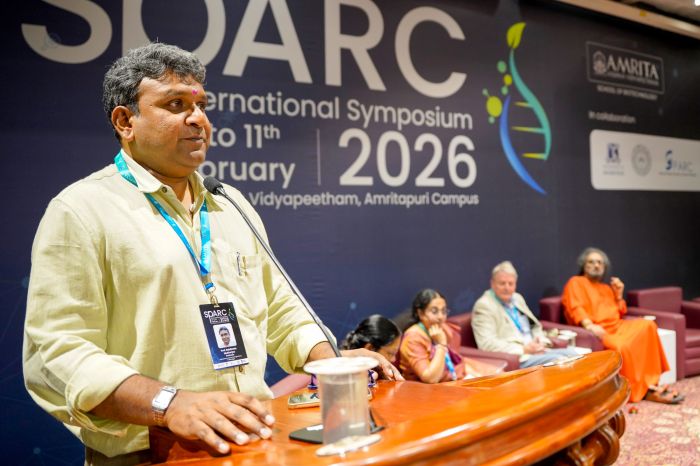
Held from February 9 to 11, 2026, the symposium was jointly organized by the Amrita School of Biotechnology, Indian Institute of Technology Kanpur, University of Melbourne, and the Ministry of Education, under the Government of India’s SPARC (Scheme for Promotion of Academic and Research Collaboration). It featured intensive discussions on molecular therapeutics, diagnostics, disease biology, antimicrobial resistance (AMR), computational and AI tools in medicine, immunity, and clinical translation, reflecting SPARC’s objective of fostering high-impact international research partnerships.
The event brought together leading scientists, clinicians, and policymakers from India and abroad to strengthen global academic and research collaboration. It also saw participation from senior faculty and researchers from leading global institutions, including multiple departments of the University of Melbourne, IIT Kanpur, IIT Kharagpur, Delhi University, Regional Centre for Biotechnology, and Amrita’s interdisciplinary clinical and life sciences ecosystem.
Speaking on the significance of the collaboration, Prof. Richard Strugnell, Professor of Microbiology and Immunology at the University of Melbourne, said:
“SPARC provides a powerful framework to bring together complementary strengths across institutions and countries. Our engagement with Amrita and IIT Kanpur demonstrates how international collaboration can accelerate discoveries in areas such as infectious diseases, antimicrobial resistance, and immune-mediated disorders, while ensuring that research outcomes translate into real-world health impact.”
Highlighting the importance of India–global research linkages, Prof. Sandeep Verma, Professor at IIT Kanpur, noted:
“The SPARC initiative has enabled meaningful scientific exchange between premier Indian institutions and global universities. This symposium reflects how interdisciplinary collaboration—spanning biotechnology, chemical engineering, AI, and clinical sciences—can address complex health challenges and build sustainable research ecosystems.”
Emphasising the transformative role of life sciences in shaping the future of healthcare and research, Dr. Bipin Nair, Dean – Life Sciences, Amrita Vishwa Vidyapeetham stated:
The SPARC program of the Ministry of Education has enabled a strong partnership that brings together IIT Kanpur’s tradition of academic rigor and technological innovation; the global perspective and research excellence of the University of Melbourne as well as Amrita University’s emphasis on value-based education and societal impact making it a truly complementary partnership and a win-win-win situation for all.
The symposium also included faculty interactions, poster presentations by young researchers, and structured discussions aimed at developing joint research proposals, student and faculty exchanges, and long-term institutional partnerships.
Earlier, welcoming the international delegates, Dr. Maneesha V. Ramesh, Pro Vice Chancellor, Amrita Vishwa Vidyapeetham, emphasized:
“Amrita’s participation in SPARC aligns with our commitment to globally relevant research rooted in societal impact. By bringing together leading institutions under this platform, we are creating pathways for translational science that serves public health, innovation, and national priorities.”
The event concluded with a reaffirmation of continued collaboration under SPARC, focusing on co-developed research programs, shared infrastructure, and capacity building for early-career researchers, reinforcing India’s growing role as a hub for international scientific collaboration.