

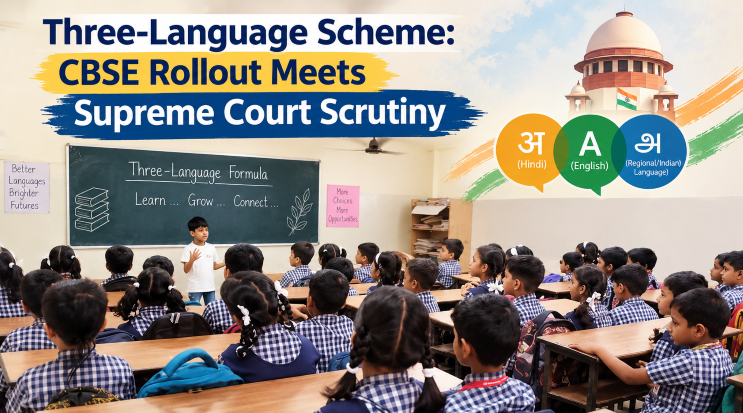
The three-language formula, recommended by the Kothari Commission (1964–66) to promote multilingualism and national integration, has survived successive education policies and reviews and continues to find place in the National Education Policy (NEP) 2020. Yet, nearly six decades after it was first proposed, its implementation remains one of the most contentious issues in Indian school education.
The debate acquired fresh intensity this year after the Central Board of Secondary Education (CBSE) issued a May 15 circular requiring its more than 33,000 affiliated schools to make the study of three languages compulsory in Class 9 from July 1, 2026, as part of the alignment of its scheme of studies with NEP 2020 and the National Curriculum Framework for School Education (NCF-SE) 2023. Under the new framework, languages are designated R1, R2 and R3, with at least two of the three required to be Indian languages.
The move triggered protests and legal challenges, with petitions filed in the Supreme Court against the CBSE directive. The petitioners have raised concerns ranging from inadequate infrastructure, shortage of trained teachers and availability of textbooks to assessment mechanisms, academic burden and the disruption of language combinations already being followed by students. The Supreme Court agreed to examine the challenge on May 27.
Following the controversy, the CBSE issued detailed guidelines on June 29, providing some concessions and clarifications. Students already in Class 9 were allowed to continue with their existing language combinations during the transition, while the Board also clarified that there would be no Class 10 Board examination for the third language. The third language would instead be assessed at the school level.
The June 29 guidelines also extended the new three-language framework to Class 6 for the new cohort. Under the framework, at least two of the three languages are to be Indian languages. A foreign language can be chosen only as the third language after two Indian languages, or as an additional fourth language. Until dedicated R3 textbooks become available, Class 9 students are to use the relevant Class 6 R3 textbooks.
This extension to Class 6 has now become an important part of the litigation.
On August 20, while hearing the petitions, the Supreme Court stressed that children should not be subjected to undue pressure and asked the CBSE to revisit aspects of the policy’s implementation. The Court made it clear that it was not questioning the introduction of the three-language policy itself, but was concerned about the manner and timing of its implementation, including the availability of adequate human resources and other infrastructure.
The Court returned to the issue on September 9. A three-judge bench headed by Chief Justice of India Surya Kant asked the CBSE to consider exempting the current Class 6 batch from the three-language policy for this academic year. The hearing was deferred to September 17. The Court’s suggestion does not, at this stage, amount to a final exemption or a stay of the policy.
The immediate implementation of the policy is therefore in a state of uncertainty, although the Supreme Court has not formally stayed the CBSE circular. The larger question before the Court is how a major curricular change should be introduced without disrupting students who have already begun their schooling under an earlier language arrangement.
A debate dating back to 1968
It is pertinent to recall that the original three-language formula was never implemented uniformly across India. The Kothari Commission envisaged a graduated approach to language learning—one language, generally the mother tongue or regional language, at the lower-primary stage; two languages at the middle stage; and three languages at the secondary level.
Broadly, the proposed combinations were to include the regional language, Hindi and English in non-Hindi-speaking states, and Hindi, English and another modern Indian language in Hindi-speaking states.
The formula faced political and practical challenges from the beginning. Tamil Nadu, which witnessed intense agitation against the perceived imposition of Hindi during 1965–67, opposed the three-language formula and has continued with its two-language policy. Other states and school systems evolved their own adaptations, often driven less by the original prescription and more by practical considerations and perceived student benefits.
Over time, a different pattern emerged in many schools, particularly within the CBSE system. Students commonly studied an additional language in Classes 6 to 8, with the third language often functioning as an additional or optional language. On entering Class 9, students could generally continue with two languages as their principal language subjects, while the third could be dropped.
This arrangement also provided flexibility in the senior secondary stage. Having studied three languages earlier, students could potentially choose any one of them as their compulsory language subject in Classes 11 and 12.
Central government-run schools have traditionally offered Sanskrit widely as a third language, while many private schools have offered foreign languages, recognising their potential value for international mobility and higher education.
The current dispute has now brought a much larger question to the forefront: what constitutes an Indian or “native” language?
Is English an Indian language?
Section 4.2 of NEP 2020 says that the three-language formula will continue to be implemented while taking into account constitutional provisions, the aspirations of people and regions, and the need to promote multilingualism and national unity. It further says that the three languages will be chosen by states, regions and students, provided that at least two of them are “native to India”.
This formulation has acquired particular significance in the current litigation.
The CBSE framework distinguishes between Indian and non-Indian languages, with the third-language slot potentially being occupied by a language outside the Indian-language category. This has raised questions about the future place of foreign languages, which could effectively become additional or fourth-language choices in many schools.
The petitioners have also questioned whether the CBSE, as an executive body, has the authority to introduce such a sweeping change in school education. They have argued that NEP 2020 represents executive policy intent and does not, by itself, have the status of legislation enacted by Parliament.
The classification of English has emerged as one of the most intriguing aspects of the dispute.
English is an associate official language of the Union and has played a major role in India’s administration, higher education, judiciary, business and inter-state communication. Yet it is not classified as a native Indian language under the present NEP-CBSE framework.
During the proceedings, the Supreme Court bench comprising Chief Justice of India Surya Kant and Justices Joymalya Bagchi and V. Mohana observed that whether English could be considered an indigenous language might require constitutional examination based on historical and other relevant considerations. The bench described it as a debatable and larger issue that could be taken up later.
The issue is complicated by India’s linguistic history. English was introduced into India through colonial rule. Yet, over generations, it has developed a distinctly Indian form, with its own vocabulary, idioms, pronunciation and patterns of usage. For many Indians, particularly those educated in English-medium schools, it is acquired from childhood and functions as a first or primary language in everyday life.
English is consequently described by linguists and scholars as an Indian variety of English and, increasingly, as an Indian language in a sociolinguistic sense, even though it is not indigenous in the historical sense.
The question before the Court is therefore larger than whether English is widely spoken in India. It is whether an established and Indianised variety of a language that originated outside the country can, in law and education policy, acquire the status of an Indian or “native” language for the specific purpose of the three-language formula.
A clear judicial or policy position could settle one of the most contentious aspects of the present debate. If English were recognised within the policy framework as capable of satisfying the requirement of a language “native to India”, it could substantially alter the practical operation of the three-language formula.
It could also provide schools with a more workable framework, given that English is already deeply embedded in Indian education, and functions as an important intra-national link language.
At the same time, such a classification would raise its own constitutional and linguistic questions. A language can be deeply Indian in its contemporary social use without being indigenous to the subcontinent in its historical origin. The distinction between these two meanings of “native” is likely to remain central to the debate.
Infrastructure versus prescription
Beyond the debate over English, the practical challenge of implementing the formula across India remains formidable.
India has 22 languages listed in the Eighth Schedule of the Constitution, besides hundreds of other languages and linguistic varieties. Creating adequate infrastructure—including trained teachers, curricula, textbooks and assessment mechanisms—across such a diverse linguistic landscape will inevitably be a long-drawn process.
The concern is also whether languages outside the better-resourced and more widely taught group could face indirect discrimination. A policy intended to promote multilingualism could paradoxically narrow the practical choices available to students if schools lack the resources to offer a sufficiently broad range of languages.
“The tragedy in our case is that our children don’t learn any language well, if you consider the ASER reports, which have consistently highlighted that children are unable to read and write even lower-grade texts. So, the government needs to focus on where it matters the most—teachers and teaching quality,” says Gurcharan Das, public intellectual, author and former CEO and managing director of Procter & Gamble India.
Instead of simply adding another language to the curriculum, he argues, schools need greater support through language laboratories, learning tools and technology.
“Our teachers, who themselves lack proficiency in most cases, need handholding,” he says.
Das points out that English and Hindi are among the fastest-growing languages of articulation and employment in India and argues that market forces, rather than government decrees, are ultimately more powerful in determining which languages gain wider usage.
He also believes that languages are better learnt at an earlier age. “The idea of adding a language in Class 9 looks stupid, as languages are better learnt much earlier,” he says.
Das also sees the possibility of Hinglish evolving into a widely spoken language of its own in the future. “English as a modern language emerged from the market. Elites spoke French and church Latin. The people on the street developed English and then the advent of Shakespeare made English what it is today, the number one, franca lingua,” he adds. Who knows Hinglish also produces a Shakespeare of its own!
CBSE’s wider Class 9 changes
The three-language scheme is not the only major change being introduced for CBSE schools this academic year. Vocational education, art education, artificial intelligence and computational thinking have also been introduced in the Class 9 curriculum.
Vocational education has been added as a compulsory subject. The CBSE has also done away with the Basic and Standard Mathematics categorisation introduced in 2020, leaving students with a single Standard Mathematics curriculum. At the same time, Advanced Mathematics and Advanced Science have been introduced for students who want to engage with higher-order concepts.
These advanced subjects are optional and are not part of the Board examination. Their school-based assessment will, however, be reflected as an additional component in the final marksheet.
“Schools like ours had been challenging interested students with higher-order questions, but now the Board has formalised this through Advanced Mathematics and Science,” says Sanjay Yadav, Secretary, National Progressive Schools’ Conference (NPSE), and Principal of Ahlcon International School, Mayur Vihar, Delhi.
“The good thing is that these have not been made compulsory and have also been exempted from the Board examinations. This move will certainly encourage students who seek careers in STEM, as examinations often bring resistance and stress. Essentially, some of the concepts taught in Classes 11 and 12 can now be introduced to students earlier,” he says.
However, Yadav identifies Art Education as an area that could pose implementation challenges for schools.
“We are trying to figure out how best schools can collectively engage with CBSE and devise implementation strategies,” he says.
The Delhi government has also endorsed the CBSE rollout. With Delhi not having a separate school education Board of its own, government schools too will have to implement and deal with the implications of the new schemes.
From policy ambition to implementation challenge
The Supreme Court proceedings may consequently determine more than the immediate fate of the CBSE’s Class 9 language policy. They could force a wider reconsideration of what India means by a “native language” in a multilingual, post-colonial society—and, by extension, how the three-language formula should work in the 21st-century classroom.
The larger question is whether the ambitious curricular changes under NEP 2020 are being introduced with sufficient preparation, infrastructure and transition time.
For schools, the concern is not necessarily with multilingualism or with exposing children to additional areas of learning. It is the pace and manner of implementation. A language policy affecting millions of students requires trained teachers, appropriate learning material and adequate time for schools and families to adjust.
The three-language controversy may therefore force a larger policy question: should India’s language policy be driven primarily by prescription, or should it create the conditions in which languages can be learnt well and allowed to grow organically?
The answer could determine not only the immediate fate of the CBSE’s new language framework but also how India negotiates the complex relationship between its indigenous languages, its colonial linguistic inheritance and the languages that its children increasingly use to study, work and communicate.
- Autar Nehru