

Ahead of the March 12 hearing in the High Court on the Delhi School Education (Transparency in Fixation and Regulation of Fees) Act, 2025, the Delhi government last week announced that it will set up three Project Monitoring Units (PMUs)—each comprising 10 chartered accountants—to conduct comprehensive financial audits of around 1,794 private unaided recognised schools in the national capital.
The Directorate of Education (DoE) has floated a tender for the project, estimated at ₹6.3 crore, with officials indicating that the exercise will be carried out over the course of a year. The PMUs will be tasked with inspecting schools and examining their financial records in accordance with the Delhi School Education Act and Rules, 1973.
The move is noteworthy because the Rules framed under the new Fee Act have been criticised for effectively replacing public scrutiny with audits conducted by chartered accountants engaged by the school managements themselves—an arrangement that raises concerns about a customer–client relationship. The creation of government-backed PMUs could therefore be seen as an attempt to blunt that criticism and make the auditing process more credible. Past experience with official committees has shown that such exercises often drag on for years and eventually reduce compliance to little more than paperwork.
Against this backdrop, the March 12 hearing assumes added significance. The government’s reliance on the 1973 law also stands out at a time when the much-publicised Delhi School Education (Transparency in Fixation and Regulation of Fees) Act, 2025— enacted on August 14, 2025, and operationalised on December 10 through notification of its Rules—designed to curb unregulated or arbitrary fee hikes by private schools in the National Capital Territory of Delhi and to provide a long-awaited legal framework for addressing the issue, has run into immediate legal headwinds.
Notably, the new Fee Act—introduced as an additional layer over two existing regulatory frameworks, the Delhi School Education Act, 1973, and the Right of Children to Free and Compulsory Education Act, 2009—was passed without stakeholder consultations on a problem that has persisted for decades. Its draft was also kept confidential until the final stages. As the current legal challenge unfolds, these aspects are increasingly being highlighted, raising questions not only about the procedural process behind the law but also about its substantive soundness.
New Fee Act Imbroglio
The very first notification issued on December 24, 2025—and subsequently revised on February 1, 2026 ordering the mandated formation of School Level Fee Regulation Committees (SLFRCs) under Section 4(1) of the Act by all recognised unaided private schools in Delhi (approximately 3,000 institutions), has been kept in abeyance by the Delhi High Court order of Feb 28 following a batch of petitions filed by various school associations challenging the constitutional validity of the Act, its Rules, and the notification itself. Although the Court is scheduled to hear the matter on March 12, the constitution of SLFRCs by schools has, for the time being, been effectively put on hold. As such the implementation of the fee fixing mechanism has been delayed and the fee for the time being will be governed by the previous rules.
Multiple private school associations—including the Public Schools on Private Land Society, the Association of Public Schools, the Action Committee of Unaided Recognised Private Schools, the Forum for Promotion of Quality Education for All, the Delhi Public School Society, the Rohini Educational Society, Ryan International School and others—have filed independent petitions challenging the Directorate of Education’s notification. These petitions, now clubbed together by the Court, primarily seek a stay on the implementation of the notification, arguing that the 10-day deadline for constituting SLFRCs and applying the Act from the 2025–26 academic session was impractical, particularly when nearly two-thirds of the academic year had already elapsed. The Naya Samaj Parents Association has filed a petition against granting the stay. The school associations following a closer reading of the newly notified Rules also contend that SLFRC is unconstitutional as it will result in taking away the legitimate right of the schools to determine the fees and permitting the DoE to fix the fees for all the schools as there is no possibility to have unanimous decision in the SLFRC between the members having conflicting interest and is a major ground of these petitions for judicial review.
Among the specific concerns raised is the requirement under Section 7(XII) of the Rules that fee proposals before the SLFRCs must be approved by consensus and in the presence of all members—contrasted with a majority-based decision-making process for District Fee Appellate Committees. Petitioners have also pointed to the lack of clarity regarding the interplay between three key statutes: the Delhi School Education Act, 1973; the Right of Children to Free and Compulsory Education Act, 2009; and the new Fee Act. Additionally, the Delhi School Education (Removal of Difficulties) Order issued on February 1 under Section 21 of the Act—empowering the government to address implementation challenges within two years of the law’s commencement—is itself under challenge as being unconstitutional.
It is pertinent to mention that under the Section 4 (1) of the DSE (Transparency in Fixation and Regulation of Fees) Act, 2025, every school has to constitute a SLFRC comprising of five parents, three teachers (both categories to be selected through lottery), a chairperson nominated by the management, principal as secretary and government representative as observer before July 15 for approving fee proposal for a period of three years. Any dispute or appeal against the proposal has to be adjudicated by district appellate committee before September 30 and then any unresolved dispute will be addressed by a state level Fee Revision Committee under the three-level fee committee mechanism provided under the Act.
In the current case, initially in January after the High Court didn’t grant a stay on the DoE notification (through it extended the deadline by 10 more days), the petitioners went to the Supreme Court, where facing mounting legal pressure, the DoE withdrew its insistence before the Supreme Court on implementing the law for the current academic session after which the apex court remitted the matter back to the High Court. On February 1, DoE issued the Delhi School Education (Removal of Difficulties) Order to help itself. It also issued a revised directive to schools to constitute SLFRCs by February 10 for the purpose of fixing fees for three academic years starting 2026–27. The government described the advancement of the timeline from July 15 to February 10 as a “one-time measure” to ensure a regulated fee structure from April 1. This led the High Court to urgent hearings where the bench comprising of Chief Justice Devendra Kumar Upadhyaya and Justice Tejas Karia to order for keeping the notification in abeyance and allowing petitioners to collect the same fees for the Academic Year 2026-27 as was collected for the previous academic year till the fee is fixed / approved in terms of the provisions of the Act and the Rules, subject to outcome of the petitions. “We are of the opinion that challenge to the Act and the Rules requires careful consideration during the final hearing of these Petitions commencing on 12.03.2026,” the Court said.
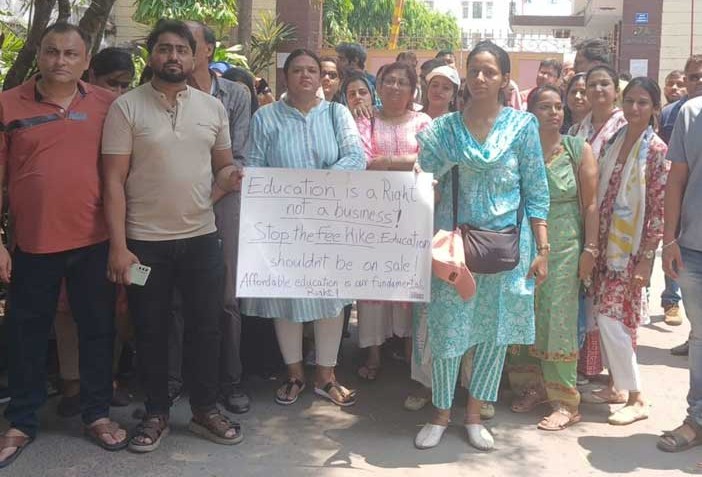
Khagesh Jha, an activist advocate, who also runs Justice for All (an NGO), representing the parents association says that they are opposed to stay as it will be used by schools to charge unapproved fees from the students as the case has exposed this new law on several counts and the legal battle itself may be prolonged. “There are inconsistencies and ambiguities, which the Court will scrutinize and pass orders, but we want the fair interplay among the three laws and reservation for EWS category mandated for around 400 schools that got concessional land from DDA along with other rights of students to be protected.”
Amid the courtroom battle, the DoE on February 25 launched a dedicated online platform allowing parents to formally challenge fee hikes and track complaints on its website. The portal includes a “Fee Review Committee” section with an online form titled “Feedback Regarding School Fee Hike.”
The Fee Review Committee is chaired by former Rajasthan High Court Chief Justice Anil Dev Singh, with chartered accountant J.S. Kochar and former Additional Director of Education R.K. Sharma as members. Officials say the system introduces a structured, trackable grievance mechanism and incorporates safeguards to prevent retaliation against students.
With the next High Court hearing scheduled for March 12 and the new academic session only weeks away, the fate of Delhi’s ambitious fee-regulation experiment hangs in the balance. Whether the Act emerges as a durable reform or a cautionary tale in legislative haste will depend on how the courts navigate the competing claims of regulatory necessity, institutional autonomy, and parental protection.
For now, the fee tussle in Delhi is far from settled—and all eyes remain on the High Court as the legal challenge unfolds. –Autar Nehru