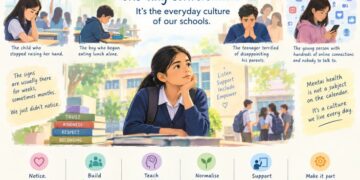


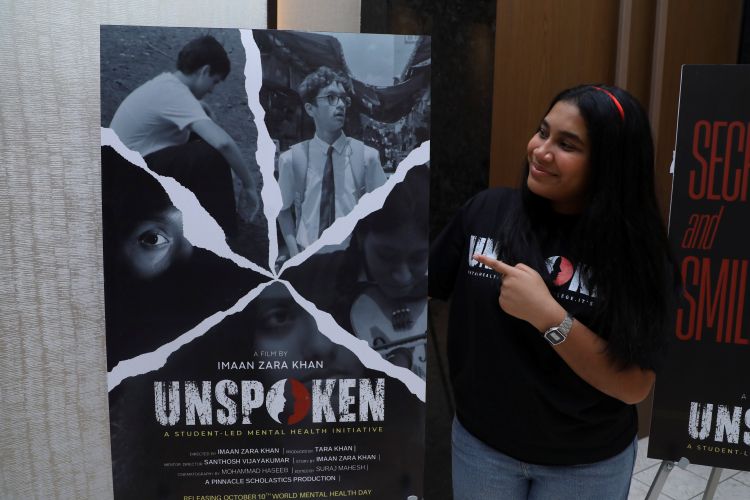
At just 16, Bengaluru student Imaan Zara Khan has brought adolescent mental health to the screen with Unspoken, a short film exploring the emotional struggles of teenagers across different social and cultural backgrounds. The film premiered at Prestige Falcon Towers, Bengaluru, on the occasion of World Mental Health Day.
The private screening brought together approximately 100 invited guests from education, research, mental healthcare, policy, media and the film’s cast and crew. The screening was followed by a structured panel discussion on adolescent mental health and the importance of early recognition and support.
Written and directed by Imaan, a Grade 11 student at Indus International School, Bengaluru, Unspoken follows four teenagers navigating vastly different realities. Separated by geography, culture and socioeconomic circumstances, their experiences reveal a common struggle: the difficulty of recognising, understanding and expressing what they are going through.
Featuring an all-student cast making their acting debuts, Unspoken brings authentic student voices to its portrayal of adolescent experiences.
The film explores a question often overlooked in conversations around youth mental health: what happens when a young person wants to speak but cannot find the words to describe what they are feeling?
Unspoken forms part of Project S.A.F.E. (Student Advocacy for Emotional Well-Being), founded by Imaan as a student-led initiative combining research, storytelling and systems-oriented advocacy to strengthen adolescent mental health support in schools. Informed by her ongoing research under academic mentorship, including guidance from experts at NIMHANS, the film is designed to serve as a starting point for guided discussions, student reflection and research-based evaluation.
Speaking about the film, Imaan Zara Khan, Director of Unspoken and Founder of Project S.A.F.E., said:
“We keep telling young people to speak up, but what happens when you don’t have the words for what you’re feeling? That was where Unspoken began. These four teenagers couldn’t be more different, yet their struggles are remarkably similar. I wanted to show that silence doesn’t always mean everything is okay. And beyond encouraging young people to speak, we need systems that recognise when someone is struggling and know how to respond.”
Project S.A.F.E. is now scheduled for a presentation at 1M1B Summit at the United Nations Office in Geneva in November.