

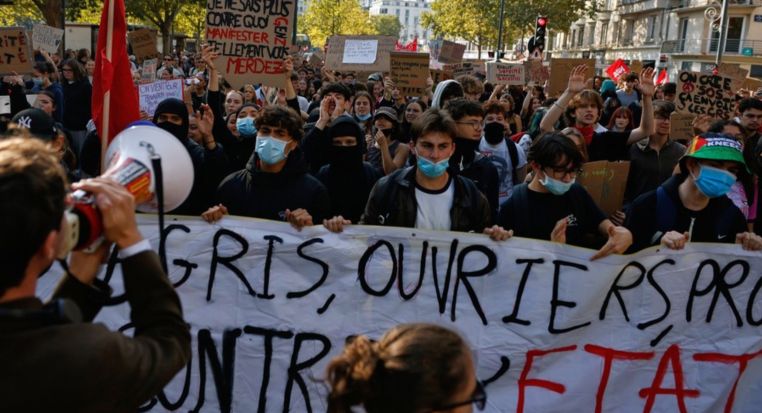
After a day of massive mobilisation across France over school conditions and staffing shortages, the government has opened a new dialogue with students even as the protests widen beyond high schools to universities and draw in teachers, parents, trade unions and other public-sector workers.
The nationwide demonstrations on October 6 marked the biggest mobilisation so far in a protest movement that began in the Paris region in mid-September, initially over shortages of teachers and other staff and concerns about the condition of school infrastructure.
The French Interior Ministry put the number of demonstrators at about 256,000 nationwide, including around 56,000 in Paris, while organisers claimed that as many as 450,000 people took part across the country. The protests involved high-school students as well as university students, teachers, parents and trade-union activists.
In response, the government has launched a special “lycée democracy” period, beginning October 7, under which every high school will devote half a school day to dialogue between students and the school community. Students will be able to raise difficulties and discuss their expectations, while regular classes will continue during the remainder of the day.
The Education Ministry has also opened a national consultation of high-school students, running from October 5 to 23 through the government’s Agora platform. Prime Minister Sébastien Lecornu has meanwhile asked ministers to accelerate teacher recruitment, address dilapidated school buildings, respond to staffing shortages and engage directly with students—the issues that initially brought students onto the streets.
The government is thus attempting to respond to the substantive concerns at the heart of the movement while simultaneously taking a tougher position on violence and disruption.
From school grievances to a national movement
What began as a largely school-focused protest has expanded rapidly.
By October 1, Le Monde reported that more than 1,020 high schools—around one in four nationwide—had been affected, including 222 blockades.
The movement has since acquired a broader social and political dimension. University students have joined demonstrations in solidarity with high-school students, while teachers, parents and trade unions have increasingly participated in the mobilisation.
The university component is particularly significant because it has transformed what initially appeared to be a dispute over school resources into a wider debate about France’s education system, access to higher education, student living costs and public spending.
University student organisations are scheduled to meet Higher Education Minister Philippe Baptiste on October 7. Student leaders have indicated that, in the absence of concrete commitments, university blockades could resume from October 8.
Students put forward a wider agenda
On October 5, the Union étudiante, Union syndicale lycéenne, UNEF and Solidaires étudiant·es, with support from other student organisations, presented a common platform titled “10 mesures d’urgence pour la jeunesse”.
The demands extend well beyond the immediate complaints about school buildings and teacher shortages.
The student organisations are calling for:
- Emergency renovation of schools and universities.
- More teachers and education staff, including additional support and health personnel.
- Changes to school and university schedules.
- An end to selection through Parcoursup and Mon Master, the national platforms used for access to higher education and master’s programmes.
- Greater student participation in school and university governance.
- Higher student grants and improved housing assistance.
- A €1 meal for all students, alongside greater funding for university catering.
- An end to differentiated tuition fees for non-EU foreign students and abolition of the CVEC student contribution.
- Rent freezes and expansion and renovation of CROUS student accommodation, which provides subsidised student housing and services.
- An end to what the student organisations describe as repression and police violence against the movement.
The platform therefore places the protests within a much broader discussion about affordability, access to education, student welfare and the relationship between young people and the state.
Violence adds another dimension
Alongside the largely peaceful demonstrations, some protests have turned violent.
Authorities have reported fireworks and other projectiles being thrown at police, damage to school property, clashes with riot police, fires at or near schools, and attacks involving teachers and police.
By the end of October 6, the Interior Ministry said 6,547 people had been detained since September 28, including 488 on October 6 alone. Forty-three police officers were reported injured on October 6.
The violence has become a major political point of contention. Government officials have condemned attacks on police and teachers and damage to public property, while student and opposition groups have argued that isolated incidents should not be used to discredit the broader movement.
The government has also accused La France Insoumise (LFI) and activists on the far left of contributing to the radicalisation of the protests. LFI has rejected the accusation, arguing that the government is using incidents of violence to divert attention from the students’ substantive grievances.
The government is additionally considering measures that would make parents financially responsible for damage caused by their children during unrest.
The distinction between the mass movement and violent incidents is consequently becoming an important part of the political debate surrounding the protests.
The budget battle behind the protests
The confrontation is also unfolding against the backdrop of France’s difficult fiscal situation.
The students are demanding substantially greater public investment in education, student welfare and public services at a time when the government is seeking to reduce expenditure and bring down its large budget deficit.
The 2027 budget has therefore emerged as an important part of the dispute.
For the student organisations, the issue is not simply whether schools should receive more teachers or whether dilapidated buildings should be repaired. Their platform links education spending with housing, student food, grants, access to university and the affordability of studying.
The government, meanwhile, faces pressure to contain public spending while responding to growing demands for investment in public services.
This has broadened the significance of the protests beyond education policy. The demonstrations have increasingly become part of a wider debate over public services, inequality and the distribution of the costs of fiscal adjustment.
Meanwhile, Student organisations have warned that without concrete responses they could resume blockades from October 8. Trade unions are also preparing further mobilisation.
The next phase could therefore determine whether the movement remains principally a protest over the condition of France’s schools or develops into a broader youth and social movement centred on education, student living conditions and public spending.
For now, the government’s strategy is to combine dialogue over the students’ substantive grievances with a tougher response to disruption and violence. Whether that is sufficient to contain the mobilisation will depend largely on the government’s ability to translate its promises of consultation and investment into concrete measures.