

Phagwara-based Lovely Professional University (LPU), a multidisciplinary private university established in 2005, is facing one of its most serious crises following violent student protests triggered by an unverified social-media allegation of sexual assault on campus. Spread over about 600 acres, the university has more than 35,000 students and offers over 200 programmes across 40-plus disciplines, according to LPU’s own published material.
The university has suspended regular classes for 10 days from September 28 and postponed mid-term examinations until further notice. Students were allowed to return home in consultation with their parents or guardians. The present crisis developed in two stages.
On September 10, Laxmi Chandra, 21, a B.Tech Agriculture student, died after allegedly falling from the seventh floor of a girls’ hostel leading to the usual questions about the case and broader concerns relating to hostel safety by students. Police began investigating the circumstances surrounding her death and the case is still being probed.
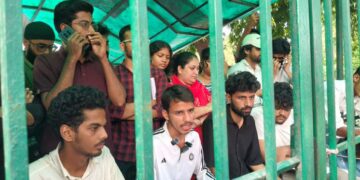
However, the immediate trigger came on the intervening night of September 26 and 27, when messages circulated on social media alleging that a female student had been raped in Girls Hostel-3 (GH3). According to the complaint subsequently recorded by police, the alleged incident was said to have occurred on September 23 and involved an unidentified person. Students gathered outside the hostel demanding answers and action. The allegation has not been independently established; LPU denied that the incident had occurred, while police registered a case and began an investigation.
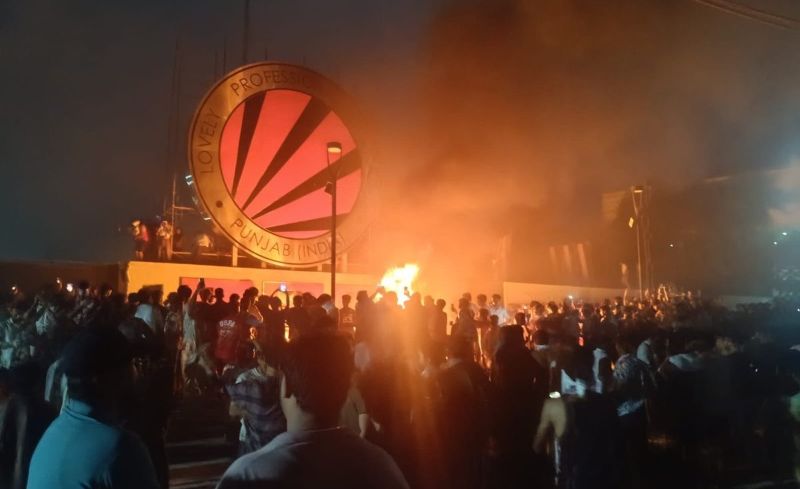
The protest soon escalated into vandalism and arson, with university property damaged and shops in the campus’s Uni Mall reportedly vandalised and looted. Protesters subsequently moved outside the university and blocked NH-44, disrupting traffic on the Jalandhar–Phagwara stretch for several hours.
The confrontation later turned violent, with clashes between protesters and police and police vehicles being set on fire. Punjab Police subsequently registered three FIRs against unidentified persons in connection with the violence. The cases relate to the campus violence, the highway blockade and alleged looting/property damage, with charges reported to include attempt to murder, robbery and assault or obstruction of police personnel.
At the same time, despite LPU’s denial that any rape had occurred and its description of the circulating claims as false and fabricated, police registered an FIR under Section 64 of the Bharatiya Nyaya Sanhita (BNS) against an unidentified person. Police have said they would examine CCTV footage, forensic evidence and call records before reaching a conclusion. In preliminary inquiries, police said they had been unable to substantiate the allegation at the location identified by protesting students.
Two separate Special Investigation Teams (SITs) are now looking into the two dimensions of the episode.
The first SIT, headed by Major Singh, SP, Phagwara, is investigating the sexual-assault allegation. It includes DSP Palwinder Singh, a woman police inspector and student representatives.
A second eight-member SIT, also headed by Major Singh, has been constituted to investigate the subsequent violence, including arson, attacks on police, alleged robbery and vandalism. The team includes three SP-rank officers.
The episode has also generated competing claims about the involvement of outsiders. Police have said they are examining the possibility of external elements being involved. At the same time, police clarified that people carrying walkie-talkies seen on the LPU campus during the unrest were Indian Army personnel, rather than unidentified outsiders involved in the violence.
The Punjab and Haryana High Court has now brought the matter under judicial scrutiny. On September 30, while hearing a PIL filed by LPU B.Tech student Ravi Raj, who has sought a court-monitored CBI investigation, the court directed Punjab Police to submit a detailed status report. The court has specifically sought clarification on whether the incident referred to in the September 26 social-media post actually occurred, what action was taken if it did, and what steps were taken regarding the circulation of the post if it did not. The next hearing is scheduled for October 8.
The case has also acquired a political dimension. LPU founder-chancellor Ashok Mittal, a Rajya Sabha MP, left the Aam Aadmi Party and joined the BJP in April 2026. Punjab is due to hold Assembly elections in 2027. The political context has inevitably attracted attention, although there is presently no established evidence linking the LPU violence to any political party.
Mittal has himself alleged that the unrest was part of a wider conspiracy aimed at damaging LPU and Punjab. That remains his allegation, rather than an established finding of the investigation.
Beyond the immediate questions of whether the alleged sexual assault occurred and who was responsible for the subsequent violence, the episode has exposed a significant trust deficit between sections of the student community and the university administration.
Then it also appears that there is an underlying reason why people don’t believe LPU versions readily. A perception exists in some quarters in Jalandhar and others that a lax and condoning security culture at LPU may have been exploited by trafficking criminals at times. And then there are also views held commonly about private universities.
Whatever the final findings, the episode presents LPU with an opportunity to undertake a transparent review of campus security, hostel access, student grievance mechanisms, crisis communication and student welfare. For a university of LPU’s scale and national ambitions, rebuilding confidence may ultimately depend less on reputation claims and more on how convincingly it addresses questions raised by students, parents, the local community and the investigations now under way.