

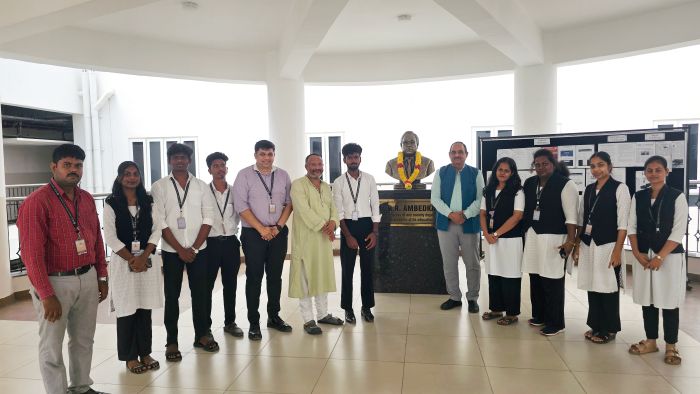
The Centre for Human Rights Studies and the Centre for Social Justice at the SRM School of Law observed Social Justice Day on September 17 with a public lecture on “Ending Manual Scavenging and Caste Discrimination” delivered by Ramon Magsaysay Award laureate and National Convenor of the Safai Karamchari Andolan (SKA), Bezwada Wilson.
Aligning his address with the larger ethos of Social Justice Day, Wilson urged the audience to look beyond technological and economic progress and confront the deep-rooted social inequities that continue to shape the lives of marginalized communities. He drew a clear distinction between sanitation work and manual scavenging, describing the latter as a dehumanizing system sustained by caste and patriarchy and perpetuated under the guise of employment.
“How can a society ask one human being to clean another’s excreta, pay them a pittance, label them an employee, and act as if nothing is wrong? In our society, there is a direct link between slavery and livelihood; if you refuse slavery, you lose your livelihood,” Wilson said.
During the lecture, Wilson recounted aspects of his upbringing in the township of Kolar Gold Fields (KGF), challenging romanticized portrayals of the region and drawing attention to the historical exploitation of marginalized Dalit labourers. He recalled realizing the true nature of manual scavenging when he was 15, reflecting on how a deeply degrading practice had been normalized by society while being denied or ignored by the administration.
Reflecting on the nearly four-decade-long movement of the Safai Karamchari Andolan and its landmark litigation before the Supreme Court in 2003, Wilson spoke of the persistent gap between legislation and implementation. He criticized what he described as bureaucratic apathy and said manual scavenging continues in parts of India because of a systemic reluctance to acknowledge the existence and scale of the problem.
Addressing the law students directly, Wilson called upon future lawyers and advocates to develop a strong moral compass and use their professional responsibilities to hold institutions and those in positions of power accountable. He emphasized that legal education must go beyond knowledge of statutes and precedents to engage with questions of dignity, equality and social justice.
Speaking on the occasion, Prof. (Dr.) Y.S.R. Murthy, Pro Vice Chancellor (Law), SRMIS, highlighted the role of legal education in addressing structural inequalities and strengthening the values of constitutional justice.
“Hosting Mr. Bezwada Wilson on Social Justice Day serves as a vital reminder of our collective responsibility as legal scholars and practitioners,” he said.
The programme concluded with an interactive question-and-answer session, providing students and faculty an opportunity to engage with Wilson on issues surrounding manual scavenging, caste discrimination, constitutional rights and the continuing struggle for social dignity.