

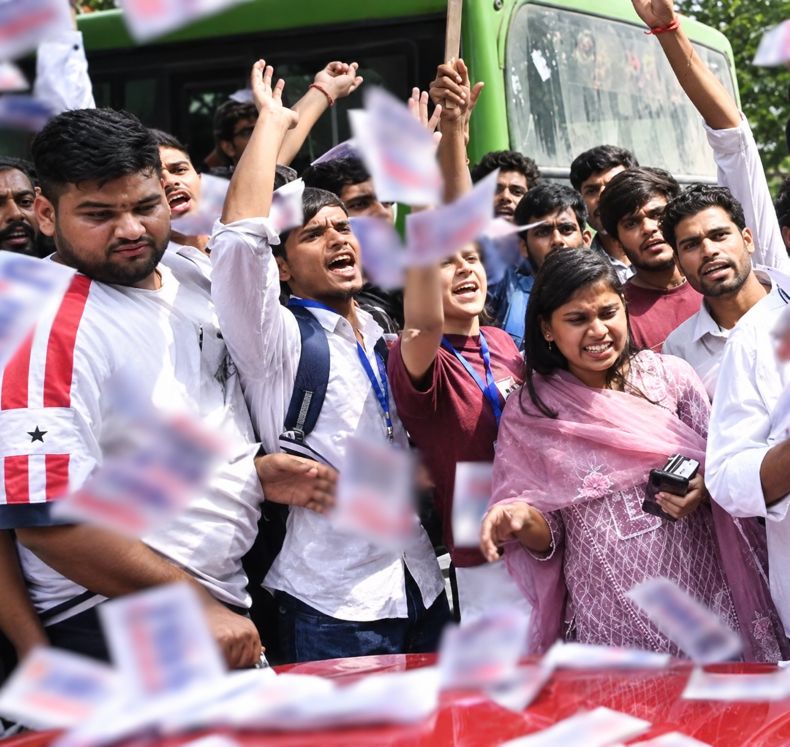
The decks have been cleared for the Delhi University Students’ Union (DUSU) elections on September 18, with the Delhi High Court declining to interfere with the scheduled polls while simultaneously placing the university and its election authorities under an obligation to ensure that political parties do not interfere in the student election process.
The development came after the court on September 16 disposed of a petition challenging the ongoing DUSU election process on the ground that candidates associated with political-party student organisations were being allowed to contest in violation of the Lyngdoh Committee recommendations and directions of the Supreme Court.
In Vijeta v Union of India & Ors, a Bench comprising Chief Justice Devendra Kumar Upadhyaya and Justice Tejas Karia held that merely being a member of a political party’s student wing does not, by itself, disqualify a student from contesting a student-union election.
The court, however, drew a distinction between membership of a student wing and participation or interference by political parties in the election process. It made clear that the university and the Chief Election Officer have a responsibility to ensure that the elections remain free from such interference and that the Lyngdoh Committee recommendations, the Supreme Court’s directions, the university’s election code and other applicable laws are complied with.
The petition had also raised concerns about campaign material allegedly carrying political-party names and symbols. The court took note of a poster appended to the petition that purportedly displayed the name and election symbol of a political party and said such conduct needed to be checked by the university and election authorities. It also reminded the authorities of their obligation to comply with the Delhi Prevention of Defacement of Property Act, 2007.
The ruling therefore removes the immediate legal uncertainty over Friday’s poll, but also leaves the university with a clear responsibility to police the boundary between student politics and formal political-party involvement.
Polling will now take place as scheduled on September 18 across Delhi University colleges in two shifts, with voting for students attending morning classes scheduled from 8:30 am to 1 pm, followed by the evening shift from 3 pm to 7:30 pm. Voting will be conducted through EVMs. Counting is scheduled for September 19.
The final central-panel contest has seven candidates for president, five for vice-president and four each for secretary and joint secretary, making a total of 20 candidates for the four principal DUSU posts.
The principal panels are:
| Post | ABVP | NSUI | AISA-SFI |
| President | Yash Dabas | Vijay Shankar Meena | Ananya Raturi |
| Vice-President | Ishu Maurya | Veer Chatrath | Akshat Shikhar |
| Secretary | Riya Chhawdi | Namrata Chaudhary | Stanzin Deskyong |
| Joint Secretary | Lakshya Raj Singh | Gopal Chaudhary | B Parijaat |
There are also Independent candidates in the final field. The contest is thus broader than a simple two-way ABVP-NSUI race, with the AISA-SFI alliance also fielding a full central panel.
The Satya Niketan PG building collapse, in which seven people, including five Delhi University students, died, has cast a long shadow over this year’s campaign. Student accommodation, safety and campus infrastructure consequently emerged as some of the most prominent issues during campaigning.
Alongside housing and safety, placements, transport, campus infrastructure and student welfare featured prominently in the manifestos and campaign messaging of the principal panels.
The tragedy has also brought renewed attention to the gap between the number of students requiring accommodation and the availability of university hostels, making student housing a particularly visible issue in this year’s election.
The 2026 election has also demonstrated how dramatically DUSU campaigning has moved into the digital space. While traditional campaigning has not disappeared entirely, Instagram reels, short videos, memes and AI-generated campaign material have become a prominent part of the election. Hindustan Times reported that campaign teams are increasingly using AI to produce humorous and visually engaging reels and posters designed for rapid circulation on social-media platforms.
At the same time, The Indian Express, reporting on the final day of campaigning, found a striking contrast between the university’s restrictions on conventional campaign material and the continued visibility of physical campaigning at some locations, with pamphlets seen around the Faculty of Law even as reels and other digital content dominated the online campaign.
The university’s efforts to impose restrictions on campaigning appear to have reduced, but not eliminated, some of the practices that have traditionally accompanied DUSU elections.
There was reported littering and the appearance of campaign material at some locations during the final day, while isolated confrontations were also reported. At the same time, the scale of physical defacement and overt disorder appeared considerably more limited than the worst episodes associated with earlier DUSU campaigns. The final campaign day, however, was not entirely incident-free.
Reports of some clashes between supporters of rival student organisations, with ABVP and NSUI workers making competing allegations about assaults have appeared.
With campaigning over, the focus has now shifted to peaceful polling and crowd management. The university has made arrangements for identity verification and security at polling centres. Reports indicate that students will need appropriate identification to vote, while special arrangements have been made for eligible first-year students who may not yet possess the conventional university identity card. Police deployment and crowd-management measures have also been planned around polling locations.
The EVMs are being delivered to colleges before polling and will subsequently be secured ahead of counting on September 19.
Whether the heightened campaign activity, the prominence of student-safety and housing issues and the extensive social-media outreach translate into another increase in participation will become clear only after polling.The university’s final turnout figure will therefore provide an important measure of student engagement with this year’s election.
For now, all eyes are on polling-day discipline, turnout and whether the tightly regulated campaign can translate into a peaceful election — before the EVMs reveal the outcome on September 19.
Picture abhi baki hai dost… stay tuned!