

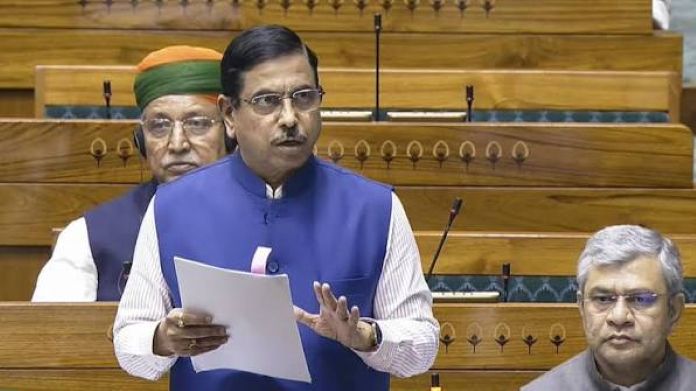
The Central Government has reiterated that it is providing a comprehensive range of scholarships, fee concessions, education loans and digital learning initiatives to ensure that no deserving student is deprived of higher education because of financial constraints. Replying to a question in Parliament, Union Education Minister Pralhad Joshi said the National Education Policy (NEP) 2020 places strong emphasis on improving access, equity, affordability and inclusion in higher education.
“The Government is committed to ensuring equitable access to quality higher education for all students, particularly those belonging to economically weaker families,” the minister said.
The minister also highlighted the significant expansion of higher education over the past decade. India’s Gross Enrolment Ratio (GER) in higher education increased from 23.7 in 2014-15 to 30 in 2023-24, while female GER rose from 22.9 to 31.2 during the same period. GER among Scheduled Castes increased by 8.9 percentage points, while that of Scheduled Tribes rose by 9.3 percentage points.
The increase in participation has been accompanied by a sharp rise in student enrolment. Total enrolment in higher education grew from 3.42 crore in 2014-15 to 4.50 crore in 2023-24, adding more than 1.08 crore students to the system.
Scholarships
In FY 2025-26, the Central Government has provided about 1.09 crore scholarships for pursuing Post-Matric and Higher Education. This includes about 36 lakh scholarships for students from Other Backward Classes (OBC), Extremely Backward Classes (EBC) and Denotified Tribes (DNT); about 48 lakh scholarships for Scheduled Castes (SC) students; and about 24 lakh scholarships for Scheduled Tribes (ST) students.
The Post-Matric scholarship schemes for SC, ST and OBC are Centrally Sponsored Schemes being implemented by States and UTs and administered by the Ministry of Social Justice & Empowerment and Ministry of Tribal Affairs. Under these scholarship schemes, the benefits are extended to all the students belonging to SC, ST and OBC, subject to their parental income ceiling and as per scheme guidelines.
Schemes
Department of Higher Education (DoHE) implements the Pradhan Mantri Uchchatar Shiksha Protsahan (PM-USP) Yojana comprising of scholarship schemes namely (i) PM-USP Central Sector Scheme of Scholarship for College and University Students; and (ii) PM-USP Special Scholarship Scheme for Jammu & Kashmir and Ladakh, to provide financial assistance for pursuing higher education to eligible students belonging to economically weaker families, as per scheme guidelines.
The Government, to make higher education affordable in institutions like Indian Institutes of Technology (IITs) and National Institutes of Technology (NITs), is providing relaxation in tuition fee to students from economically and socially weaker sections of the society.
From AY 2016-17, the complete fee waiver is being provided for Scheduled Castes, Scheduled Tribes and PwD students and economically backward students (whose family income is less than Rs 1 lakh per annum), and also 2/3rd remission of fee for other economically backward students (whose family income is between Rs 1 lakh to Rs 5 lakh per annum). The 31 NITs & IIEST- Shibpur are also providing 100% tuition fee waiver to students belonging to SC/ST/PH category to pursue postgraduate (M.E./M.Tech.) programmes in their institutions.
PM-Vidyalaxmi
PM-Vidyalaxmi, a new central sector scheme in November 2024, with the objective to ensure that no student is denied the opportunity to pursue higher education due to financial constraints. Under the scheme, collateral-free and guarantor-free education loan is provided to all the students, who get merit-based admission in top Quality Higher Education Institutions (QHEIs) and who desire to avail the education loan and there is no upper limit for this. Further, for students with annual family income up to Rs 8 lakh, the scheme provides 3% interest subvention on education loans up to Rs 10 lakhs. Since the launch of this Scheme on 6th November 2024 till 21st July 2026, 1,12,817 collateral-free and guarantor-free PM Vidyalaxmi education loans have been sanctioned. The amount sanctioned is Rs 15,634.78 crore.
PM USP-CSIS Scheme
The Department of Higher Education is implementing the PM-USP Central Sector Interest Subsidy Scheme. Under the PM USP-CSIS Scheme, full interest subvention is provided to all students who are pursuing technical/professional courses from NAAC accredited Institutions or professional/technical programmes accredited by NBA or Institutions of National Importance or Central Funded Technical Institutions (CFTIs) and whose annual family income is up to Rs 4.5 lakhs for loans up to Rs. 10 lakhs, during the moratorium period. There is no upper limit on the number of student beneficiaries for this Scheme.
PM-USP CGFSEL
Under the Pradhan Mantri Uchchatar Shiksha Protsahan Credit Guarantee Fund Scheme for Education Loans (PM-USP CGFSEL) of the Central Government, credit guarantee is provided for education loans sanctioned up to Rs 7.5 lakhs. The guarantee cover is up to 75% of outstanding default. Further, under the model education loan scheme of theIndian Banks’ Association, the repayment period for education loan is up to 15 years after moratorium period (course year plus one year).
Supporting access through hostels and digital learning
Girls hostels
To improve access, particularly for women, the Union Budget 2026-27 proposes establishing one girls’ hostel in every district, especially to support students pursuing STEM education.
Female participation in STEM has steadily improved, with women’s share in STEM enrolment increasing from 38.4% in 2014-15 to 44% in 2023-24, according to AISHE.
SATHEE
The Department of Higher Education, in collaboration with IIT Kanpur, launched SATHEE (Self Assessment, Test & Help for Entrance Examination) in November 2023. The free platform provides high-quality preparation resources for examinations such as JEE, NEET, CUET, ICAR, SSC and IBPS. More than 21 lakh learners have registered so far.
SWAYAM and SWAYAM Plus
Under the National Mission on Education through Information and Communication Technology (NMEICT), the government operates the SWAYAM platform, offering free online courses from premier institutions.
Since its launch, SWAYAM has delivered more than 20,000 courses, recording cumulative enrolments exceeding six crore.
To strengthen industry-academia collaboration, the Ministry has also launched the multilingual SWAYAM Plus platform. As of July 2026, it offers more than 500 industry-aligned courses across 15 sectors in partnership with 89 industry partners.
Infrastructure support to higher education institutions
Through the Higher Education Financing Agency (HEFA), the government has financed infrastructure development, including hostel facilities, in Centrally Funded Institutions. Since its inception in 2017, HEFA has disbursed loans worth ₹24,977.62 crore up to March 2026.
The minister said financial support to Central Universities has also expanded significantly. While ₹5,603.79 crore was released during 2013-14, the government released ₹1,13,943.55 crore between 2014-15 and 2025-26. An allocation of ₹17,440 crore has been made for 2026-27 to support academic, administrative and infrastructure development.
One Nation One Subscription
The government also highlighted the One Nation One Subscription (ONOS) initiative, which provides nationwide access to scholarly journals for eligible higher education and research institutions.
The scheme currently provides access to more than 13,000 journals from 32 publishers, covering 7,499 higher education and research institutions across the country.