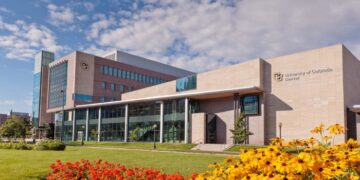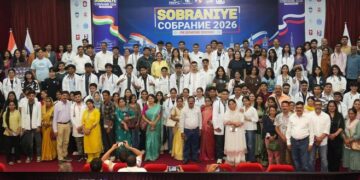


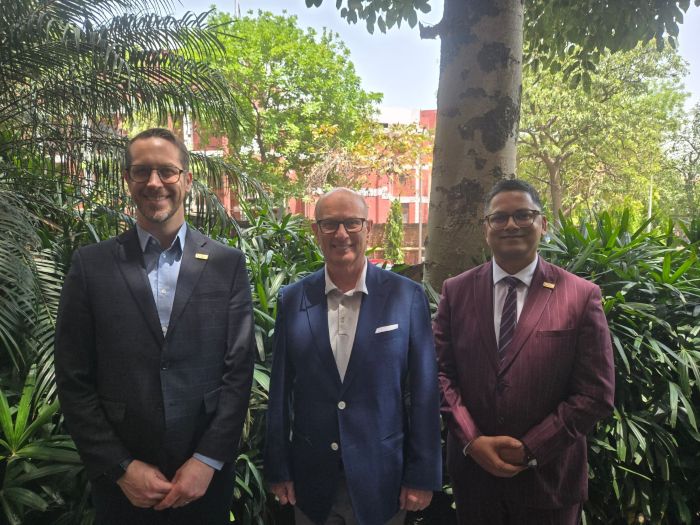
A day after signing a non-commercial Service and Cooperation Agreement with India’s National Economic Forum (NEF), Cape Breton University (CBU)—a leading Canadian public university based in Nova Scotia—outlined an ambitious roadmap to strengthen its engagement with India’s higher education ecosystem.
Speaking during his India visit, President and Vice-Chancellor David C. Dingwall emphasized that CBU is building structured and accessible pathways for Indian students through partnerships with leading Indian higher education institutions. The university is already engaging with private universities such as BML Munjal University, Parul University, Navrachna University, and LJ University. These collaborations reflect CBU’s intent to foster deep, long-term institutional relationships—moving beyond transactional exchanges toward co-created academic ecosystems.
The agreement positions NEF as CBU’s official convening partner in India, enabling structured engagement with stakeholders across central and state governments, as well as premier academic institutions. The partnership will focus on advancing student mobility, faculty exchange, institutional collaborations, and joint research initiatives.
Designed to enable focused, protocol-aligned dialogue, the MoU entrusts NEF with stakeholder mapping, outreach facilitation, and engagement structuring. This is expected to open avenues for curated roundtables and institutional interactions, ensuring meaningful and outcome-driven engagements that deepen CBU’s strategic presence in India.
Highlighting the significance of the partnership, Dingwall said, “India stands out as a priority geography for Cape Breton University, given the scale, ambition, and evolving strengths of its higher education ecosystem. This collaboration provides a focused platform to expand student pathways, deepen institutional linkages, and build research partnerships aligned with shared global priorities.”
Jagdip Rana, Executive Director of NEF, added, “This engagement is anchored in translating global academic intent into structured, high-impact collaboration for India. By convening the right government and institutional stakeholders, we are enabling a more deliberate and outcome-driven approach to international partnerships.”
The agreement is expected to serve as a stepping stone toward long-term collaboration frameworks, including joint research programmes, academic exchanges, and knowledge partnerships—contributing to a more robust and future-ready India–Canada higher education corridor.
Dingwall is currently leading a university delegation on a six-city India tour covering Delhi, Gurugram, Noida, Vadodara, Ahmedabad, and Hyderabad. This marks one of CBU’s most extensive outreach efforts in the country to date, aimed at formalizing mobility frameworks and strengthening institutional ties.
The renewed academic engagement comes at a time when India–Canada relations are showing signs of recovery following a period of diplomatic strain. Recent outreach by Canadian leadership has helped reset bilateral ties, with education emerging as a key pillar of cooperation. Addressing concerns around delays in Canadian student visa processing could further reinforce this positive momentum.
At a press conference in New Delhi on April 28, Dingwall reiterated CBU’s commitment to preparing Indian students for global careers. With a campus representing over 70 countries and more than 60 areas of study, the university offers a globally connected, student-focused learning environment.
“India is fast emerging as a global powerhouse of talent and innovation,” Dingwall said. “Our goal is to create meaningful pathways for student success by combining quality education with practical exposure and industry readiness, enabling students to thrive in a global environment.”
Beyond academia, the delegation is also engaging with policy and institutional stakeholders, including the National Economic Forum and the State Council of Educational Research and Training (SCERT), Telangana, to align academic initiatives with India’s evolving economic and industry needs.
On the possibility of establishing a campus in India, Dingwall struck a cautious note, indicating a preference for gradual expansion through local partnerships. He also highlighted strong student interest in programmes such as Master’s degrees in Artificial Intelligence, Business Analytics, Digital Marketing, MBA in Community Economic Development, Renewable Energy, Hospitality, and research-focused disciplines.