

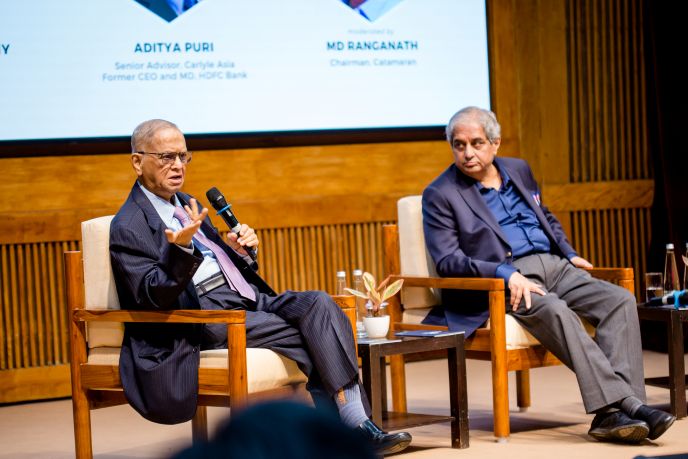
Speaking at the session titled ‘The Art of Building Legendary Companies’, hosted by Catamaran in association with IIM Bangalore, Mr. Puri said that businesses which focus only on growth or profits without establishing strong values and systems are unlikely to be sustainable.
“If you don’t set the culture right on day one, if you don’t set the systems and your purpose on day one, you will never build a sustainable organisation. If your only objective is top line or profit, you don’t see the full picture. That cannot be the purpose of your existence,” he said.
The session was moderated by M.D. Ranganath, Chairman, Catamaran, and attended by entrepreneurs, business leaders, students and faculty. Ms. Sudha Murty, Chairperson, Murty Trust, and Mr. U. Dinesh Kumar, Director (In-charge), IIM Bangalore, were also present.
Reflecting on institution-building, Mr. Murthy said his goal with Infosys was never just financial success but long-term respect and trust.
“I never wanted Infosys to just be the largest in terms of revenue, net profit or market cap. I wanted it to be the most respected company in the eyes of its stakeholders. Trust is built over time through fairness and sacrifice. Leaders must be unequivocal about values and demonstrate them consistently through action,” he said.
He noted that this philosophy translated into equitable wealth creation, with Infosys stock delivering an annualised return of 47 per cent during his leadership.
Drawing from his experience at HDFC Bank, Mr. Puri highlighted that credibility with customers, employees and investors comes from relevance and integrity, not elitism.
“The purpose of your existence is to be relevant, to be a valuable member of society, and to be respected. The right product, the right fit, at the right price, delivered with integrity—and whatever you earn must be fairly distributed,” he said, adding that organisations must continuously reinvent themselves while holding on to core values.
Praising Mr. Puri, Mr. Murthy said, “In my opinion, Aditya is the finest entrepreneur produced by our country post-Independence. What is truly impressive is that he succeeded in the Indian environment—taking an institution from zero revenues to a market capitalisation of nearly USD 155 billion.”
The discussion offered practical insights for students and early-stage founders on building enduring companies, drawing lessons from an era when capital was scarce but conviction, values and long-term thinking were the key drivers of success.