

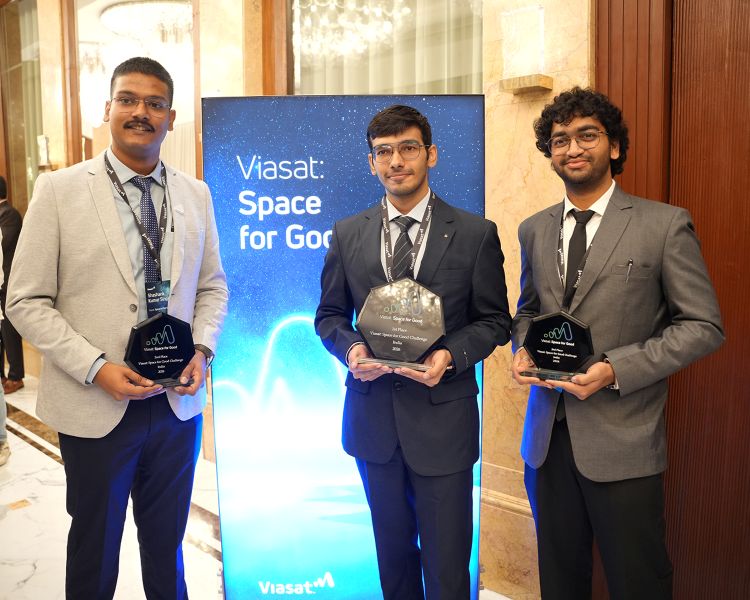
Adeetya Uppal of IIT Kharagpur has been named the winner of the Viasat: Space for Good India Challenge 2026, a flagship STEM innovation competition organized by Viasat Inc. in strategic partnership with the Indian National Space Promotion and Authorization Centre (IN-SPACe). Shashank Kumar Singh of IIT Gandhinagar (PhD researcher in Biological Sciences and Engineering at IIT Gandhinagar, originally from Lucknow) and Aryan Gupta of IIT Roorkee (Pre-final year Mechanical Engineering student at IIT Roorkee, originally from New Delhi) were awarded second and third place, respectively, for their innovative concepts.
In addition to being named the overall winner, Adeetya Uppal (Fourth-year Aerospace Engineering Dual Degree (B.Tech + M.Tech) student at IIT Kharagpur, originally from Navi Mumbai) will receive ₹5,00,000 to further develop the innovation and advance its real-world application. The competition brings together exceptional university talent from across India to develop innovative solutions that leverage space and satellite technologies to solve meaningful challenges on Earth. The top three winners will receive cash prizes to help further develop and scale their solutions.
At the finals in New Delhi on Oct 28, Adeetya Uppal, presented DRISHTI: AI Guardian for Sustainable Orbits, a solution designed to autonomously detect threatening space debris, calculate optimal satellite avoidance maneuvers, and transmit real-time collision avoidance commands over Viasat’s satellite network. By reducing response times from hours to seconds, the concept aims to improve satellite safety, preserve fuel, and protect the orbital infrastructure that supports global communications, navigation, and disaster response. The concept was selected by a panel of leading space industry experts, government representatives, and satellite technology leaders for its innovation, practicality, scalability, and potential to create lasting social impact.
The winning concept stood out among six finalist projects that demonstrated the transformative potential of satellite-enabled technologies. This year’s finalists addressed challenges ranging from AI-powered orbital debris avoidance and satellite-enabled disaster warning systems to crop health monitoring from space and emergency communications solutions designed for natural disasters.
Adeetya Uppal, winner of the Viasat: Space for Good India Challenge 2026 said, “I am fascinated by the space domain and the vast possibilities and opportunities that it holds. I have been working on problems related to space debris, which paved a way for me to give a shot at automating the collision avoidance today. The Viasat: Space for Good experience was really exciting. It gave me a fresh perspective on a lot of things, including how to build and present my ideas and how to look at the problems from a different angle. It feels really great to win the 2026 challenge and seeing the fruits of my hard work materialise.”
The finalists were selected following a rigorous multi-month evaluation process that attracted submissions from students across India. As part of the program, participants received mentorship and engagement opportunities with Viasat engineers and industry professionals, helping them develop practical, real-world applications of space technology.
Gautam Sharma, Managing Director at Viasat India said, “The ideas showcased through this year’s Viasat: Space for Good India Challenge demonstrate the remarkable ingenuity and purpose-driven innovation emerging from India’s student community. These finalists have looked beyond the technology itself and focused on how space-enabled solutions can address real challenges facing people, communities and industries. At Viasat, we believe connectivity and access to technology can unlock human potential, and this challenge reflects that vision in action. By bringing together students, educators, industry experts and leaders from India’s growing space ecosystem, we are helping cultivate the next generation of innovators who will use technology to create meaningful and lasting impact.”