

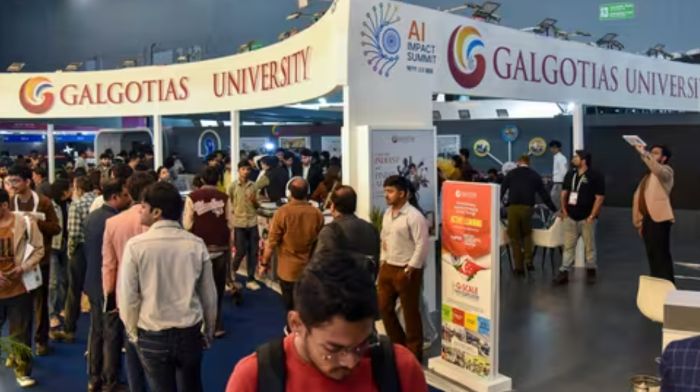
Noida-based Galgotias University (established in 2011), a private multidisciplinary institution with an enrolment of around 30,000 students, found itself at the centre of a national controversy during the India AI Impact Summit 2026 in New Delhi. The university was widely mocked and trolled after appearing to imply that the Unitree Go2 — a commercially available Chinese-made robotic dog — was an in-house innovation.
At its exhibition stall, a robot labelled “Orion” was showcased prominently. On camera, university spokesperson Prof. Neha Singh enthusiastically described the robotic dog as something “developed by the Centre of Excellence at Galgotias University.” That statement quickly caught the attention of netizens, who identified the device as an off-the-shelf product available globally.
The backlash was swift. Summit organisers reportedly asked the university to vacate its stall, citing reputational concerns for both the event and India’s technological ecosystem. The university issued a formal apology, attributing the claim to an “ill-informed and unauthorised representative” rather than an institutional position. It later clarified that the robot was merely an educational tool and not an in-house invention.
The timing intensified the scrutiny. Only days earlier, the university had publicised a ₹350-crore investment in its AI initiatives, including its University AI Centre and the Centre for Artificial Intelligence & Technology (CAIT). Against that backdrop, the optics of misrepresenting a commercially available robot struck many observers as deeply problematic.
This episode has also revived discussion around the university’s research claims. Since its inception, Galgotias has filed approximately 2,297 patent applications. However, only about 24 patents have been granted — roughly a 1% conversion rate. While patent filings signal research activity, the gap between filings and grants raises legitimate questions about depth, quality, and impact. Premier institutions often file fewer patents but achieve significantly higher grant rates and global citations.
The issue is larger than one university. Many private institutions in India have expanded rapidly, sometimes leaning heavily on marketing narratives around “innovation,” “global rankings,” and “research excellence.” In some cases, ingenuity in managing research metrics — including aggressive filing strategies or citation practices — becomes part of brand building. Ranking agencies, including international ones, have at times been accused of enabling this race for visibility. Regulators, often constrained by bureaucracy and systemic weaknesses, frequently award high ratings and approvals that do not always align with global research standards.
None of this negates the vital role such universities play. Private institutions have absorbed enormous demand for higher education and fulfilled the aspirations of lakhs of students who would otherwise have limited options. They are indispensable to India’s demographic reality. But there is a difference between expanding access and claiming cutting-edge excellence.
Building world-class innovation ecosystems is a slow, painstaking process. It requires sustained investment in faculty depth, research culture, peer-reviewed output, global collaboration, and technological originality. Milestones cannot be manufactured through branding exercises. Institutions must recognise where they stand on the ladder of excellence — and take pride in their genuine contributions — while committing honestly to long-term research development.
Ironically, the robot dog controversy may serve a useful purpose. It has triggered a wider debate about India’s technological standing at a time when the country aspires to be a global AI powerhouse. While India has made notable strides in digital infrastructure and AI applications, it still lags significantly behind leaders such as the United States and China in producing high-impact foundational innovations and world-class hardware.
If anything positive emerges from this episode, it should be a renewed insistence that innovation is measured by outcomes, originality, and impact — not optics. The debate must continue, not to shame one institution, but to demand higher standards across India’s rapidly expanding higher-education and technology ecosystem.
Quality and depth — not spectacle — will ultimately define India’s technological future.