
• ECCE
  • School Edu
  • Higher Edu
  • Edu Tech
  • Skills
  • Jobs
  • Advertise
  • Login
[t4b-ticker]
  • Home
  • Latest
  • Spotlight
  • Perspective
  • Interview
  • Videos
  • Events
  • Shop
  • Student Kiosk
No Result
View All Result
  • Home
  • Latest
  • Spotlight
  • Perspective
  • Interview
  • Videos
  • Events
  • Shop
  • Student Kiosk
No Result
View All Result
Education21
Home School Edu

NCERT’s Revised Class 8 Social Sciences Textbook: Unmaking the Mughals or Rewriting the Past?

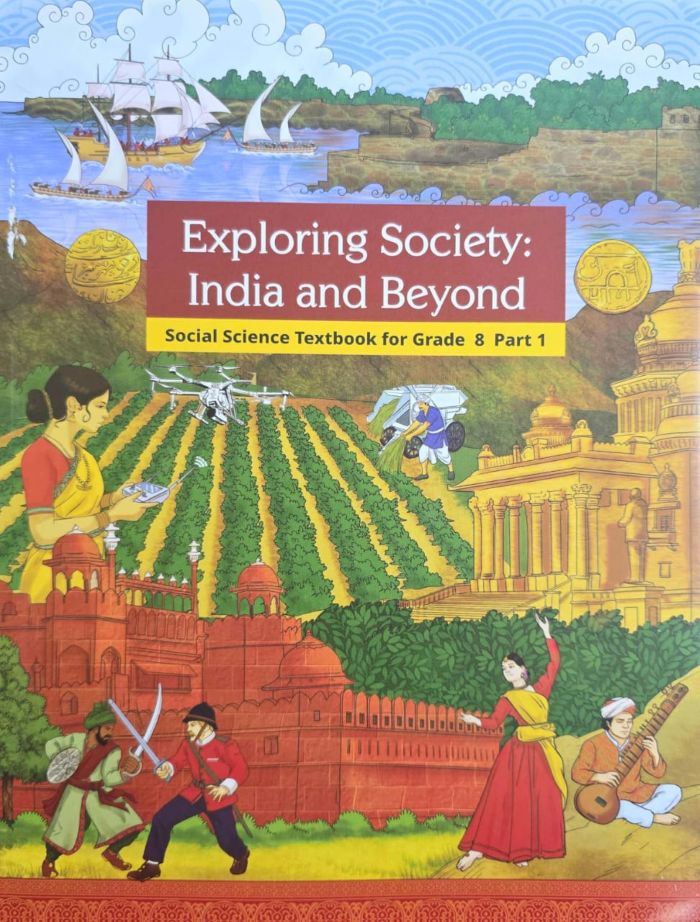
The new class 8 NCERT Social Science textbook, Exploring Society: India and Beyond (2025–26), restructured under the National Curriculum Framework for School Education (NCF SE) 2023, relocates the coverage of the Delhi Sultanate and Mughal era to Class 8 and places a sharp emphasis on violence, conquest, and religious intolerance associated with Mughal rulers.

education by education
July 18, 2025
in School Edu, Spotlight
0
NCERT’s Revised Class 8 Social Sciences Textbook: Unmaking the Mughals or Rewriting the Past?
0
SHARES
80
VIEWS
Share on FacebookShare on Twitter

The revision and release of the new textbook early this week has stirred considerable debate across academic, political, and public spheres. At the core of the controversy is the textbook’s portrayal of Mughal rulers—Babur, Akbar, and Aurangzeb—as figures defined by brutality, religious intolerance, and conquest-driven violence. While NCERT defends the changes as part of a broader curriculum reform aligned with the National Education Policy (NEP) 2020, critics argue that the revisions reflect ideological bias and a distortion of historical complexity.

In an education system often seen as a reflection of national values, the new NCERT Class 8 Social Science textbook has reignited India’s long-simmering debate over how history should be taught, interpreted, and remembered. While the NCERT claims the changes are rooted in evidence and aligned with the National Education Policy (NEP) 2020, critics argue the revisions reflect selective interpretation, ideological agenda, and communal undertones. The omission of women rulers like Raziyya Sultan and Nur Jahan has further raised concerns over gender representation, adding another layer to the criticism.

The intent, according to NCERT, is to present an “unsanitized and honest” history that encourages critical thinking rather than moral judgment. Yet the tone and focus of the revisions raise questions about whether this approach promotes understanding — or exacerbates historical fault lines.

The revised chapters portray:

  • Babur as a “brutal and ruthless conqueror,” accused of mass killings and building “towers of skulls.”
  • Akbar, long portrayed as a symbol of syncretism, is now described as exhibiting a “blend of brutality and tolerance,” referencing the Chittorgarh massacre.
  • Aurangzeb, predictably, is framed through acts of temple destruction, religious edicts, and the reimposition of the jizya tax on non-Muslims.

These portrayals are accompanied by a disclaimer:

“No one bears any blame today for what happened in the past. History is not to be used to blame people or communities… but to understand how societies functioned in the past.”

While proponents argue that textbooks have long romanticized the Mughal era, downplaying their military conquests and religious intolerance in the name of secularism. For them, this revision is a form of “de-greenwashing” — an attempt to reclaim historical truth.

Opponents see this as part of a broader ideological trend, where Hindu nationalist narratives shape curriculum decisions. The fear is not only distortion, but the potential to fuel communal sentiment among young learners, especially when the brutal acts of one religion’s rulers are spotlighted, while those of others are downplayed or omitted.

At stake is not just what history is taught, but how it’s framed. Is the revision a move toward historical clarity or a calculated step in the saffronisation of Indian education?

Supporters, including BJP leaders like R.P. Singh, have lauded the changes as long overdue. “It’s time our children learn the complete, unfiltered history – not a whitewashed version that glorifies invaders,” Singh posted on X. He invoked historical wounds — such as Babur’s invasions and the martyrdom of Guru Arjan Dev Ji under Jahangir — to justify the textbook’s tone.

On the other hand, historians like Romila Thapar have warned of the dangers of selective storytelling, cautioning against framing history as a binary conflict between Hindus and Muslims. Critics emphasize that the violent dimensions of other rulers — Hindu or otherwise — remain conspicuously absent, including figures like Harsha of Kashmir or Chola emperors who also destroyed temples for political ends.

As with most modern controversies, the discourse has spilled onto social media platforms:

  • Hashtags like #HistoryReclaimed and #DeGreenwashing have trended among supporters.
  • Critics have countered with accusations of “RSS-fication” of education, calling the revision a weaponization of textbooks.

In this polarized environment, educational content becomes cultural ammunition — with classrooms at risk of becoming arenas of ideological indoctrination.

This textbook row is not the first — and likely won’t be the last. From the 1977–79 Emergency-era textbook edits to the recent removal of Islamic empire chapters from Class 12 books, textbook politics has long mirrored India’s evolving ideological climate.

But the larger question persists:

If history is about fostering critical thought, then reducing complex figures to heroes or villains undermines that goal. If it’s about building national identity, then whose identity is being promoted — and at what cost?

The NCERT’s revision is more than an academic update — it is a contestation over national memory. Whether it succeeds in cultivating historical consciousness or merely stirs up political division depends on how it is taught, received, and contextualized.

One thing is clear: the classroom remains a deeply contested space in India’s ongoing struggle to define its past — and, by extension, its future.


  • Facebook
  • Twitter
  • Instagram
  • LinkedIn
  • RSS Feed
Previous Post

IIIT Hyderabad Launches Online Minor Program in Modern Machine Learning

Next Post

Anurag University celebrates 2nd Convocation Ceremony with over 2,200 Graduates

education

education

Related Posts

Gopi Birla Memorial School, Mumbai inaugurates Aerobay STEAM Innovation Lab in tribute to founders’ legacy
School Edu

Gopi Birla Memorial School, Mumbai inaugurates Aerobay STEAM Innovation Lab in tribute to founders’ legacy

by education
December 12, 2025
GIIS Hadapsar hosts the GIIS Marathon 2025 spotlighting its cause for the year, “Run for a Greener Tomorrow.”
School Edu

GIIS Hadapsar hosts the GIIS Marathon 2025 spotlighting its cause for the year, “Run for a Greener Tomorrow.”

by education
December 12, 2025
Christel House India to open its 4th school in India in Thane next year
Latest

Christel House India to open its 4th school in India in Thane next year

by education
December 12, 2025
‘Muthoot Shiksha Jyothi’ launched in 75 Govt Schools by Muthoot Finance
School Edu

‘Muthoot Shiksha Jyothi’ launched in 75 Govt Schools by Muthoot Finance

by education
December 11, 2025
NHAI & ROADIS donates 100 Bicycles to girl students Girl Students for mobility and continuing education
School Edu

NHAI & ROADIS donates 100 Bicycles to girl students Girl Students for mobility and continuing education

by education
December 10, 2025
Next Post
Anurag University celebrates 2nd Convocation Ceremony with over 2,200 Graduates

Anurag University celebrates 2nd Convocation Ceremony with over 2,200 Graduates

  • Facebook
  • Twitter
  • Instagram
  • LinkedIn
  • RSS Feed

Useful Announcements

  • All
  • Useful Announcements

ESCP Business School laynches New MSc in Economics and Policy for Business

December 12, 2025

Acharya Bangalore B-School Announces TEDxABBS 2025 “Moments Defining Us”

December 12, 2025

BITS Pilani announces new exam dates and application timelines for BITSAT 2026

December 12, 2025

GLS University to launch B. Design (Hons.) programme in animation & VFX and Game development

December 10, 2025

Henry Harvin launches Indo-Berlin German Language School

December 10, 2025

MDI Gurgaon Announces January 2026 Management Development Programmes

December 10, 2025

IITM Pravartak launches “The Smart Shield: AI-Powered Cybersecurity Mastery Program

December 10, 2025

Technology Innovation Hub (TIH) to host ATMAN 3.0, an 8-week Accelerator on HealthTech Startups

December 10, 2025

MAT December 2025 – Registrations Close on Dec 15, 2025

December 9, 2025

Amrita Vishwa Vidyapeetham’s Ph.D. admission applications for Ph II close on December 15, 2025

December 6, 2025

Download current issue Not available

https://online.pubhtml5.com/jlyo/bxvr/

Monthly Magazine : Feb 2024

Interactive (Quizzes/Surveys)

Start Monthly Quiz
Education21

An initiative in continuation of Curriculum Magazine, Education21.in, is a platform for New India that aspires to be a valuable innovator, partner and collaborator for a just and sustainable world. Continuing with our steady and 360 degree coverage of education system and skills landscape, we are here more oriented towards learner community.

Useful Links

  • About us
  • Team
  • Contact
  • Editorial opportunities
  • Subscriptions
  • Job Opportunities
  • Features

Important Links

  • Blog
  • Archives
  • People
  • Careerwise
  • Resources
  • Downloadable
  • Old issues

Newsletter

  • Facebook
  • Twitter
  • Instagram
  • LinkedIn
  • RSS Feed

Copyright © 2020 All rights reserved. Education21.

No Result
View All Result
  • Home
  • Latest
  • Spotlight
  • Perspective
  • Interview
  • Videos
  • Events
  • Shop
  • Student Kiosk

Copyright © 2020 All rights reserved. Education21.

Welcome Back!

Login to your account below

Forgotten Password?

Create New Account!

Fill the forms bellow to register

All fields are required. Log In

Retrieve your password

Please enter your username or email address to reset your password.

Log In
Cleantalk Pixel