

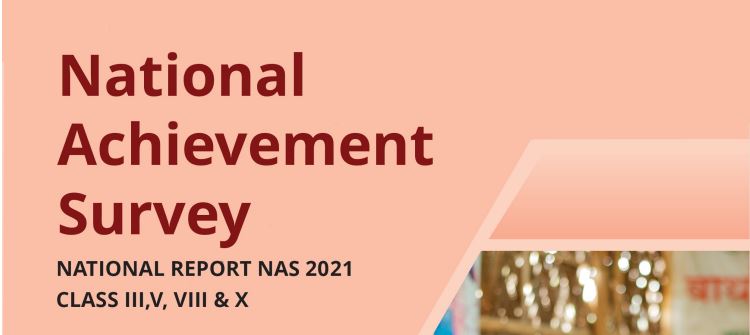
The Department of School Education and Literacy, Ministry of Education on May 25 released the National Achievement Survey (NAS) 2021 report. The 89-page NAS 2021 is based on the analysis of NAS that took place on November 12, 2021 across 1.18 lakh schools in 720 districts from both rural and urban areas with about 34 lakh students from class 3, 5, 8 and 10 taking a performance outcome test. While class 3 and 5 students appeared in three subjects—Language, Mathematics and Environmental Science (EVS) with 25 questions in each of them, class 8 students appeared in Language, Mathematics, Science and Social Science with 32 questions in pen and paper assessment. Class 10 students were also assessed in Modern Indian Language, Mathematics, Science, Social Science and English.
In the scaled score of 500, the national average for class 3 was 323 in language, 306 in mathematics, and 307 in EVS. For class 5 the average was 308, 284 and 283 in these subjects. For class 8 where students were assessed for four subjects—language, mathematics, science and social science, the national average stood at 302, 255, 250 and 255 respectively. Class 10 assessment averaged result for modern Indian language was 260, for mathematics 220, science 206, social science 231 and English 271.
In the final analysis Punjab clearly raced far ahead with all round impressive performance and on top in almost all classes and subjects barring a few where the UT of Chandigarh came on the top. Not surprisingly therefore, the former Chief Minister of Punjab, Captain Amarinder Singh, tweeted about this stellar performance while taking a dig at this critics.
https://twitter.com/capt_amarinder/status/1529837954457165824
Earlier, it was state of Kerala which had been dominating educational development index and other performance rankings nationally. Surprisingly, Delhi, which under AAP government has been showcasing improvements in school education as ‘revolutionary’ has been consistently not showing so in surveys of this kind. While Covid pandemic is a big factor in the results of this nationwide survey and on individual performance of the students, still Delhi’s performance calls for introspection. During covid, the state switched over to online but as one expert put it, it has garbage in and garbage out kind of model where teachers were made to act merely as postmen/women and thereby diminishing their involvement and student interaction. “It was a lot of exchange of digital notes and reports and just a fill in exercise all through,” the expert remarked.
Incidentally, in the run up to Punjab polls politicians from AAP and Congress for months together were locked in discussing their education development and achievements and NAS 2021 proved it was Punjab indeed. Interesting the current Punjab AAP government, which assumed office on March 16 this year didn’t celebrate state’s achievement as would have in “AAP style”.
The top performing states in class 3 in languages are Punjab (355), Kerala (342), Rajasthan (339), Chandigarh (335) and Jammu & Kashmir (333). In Mathematics, it is Punjab (339), Maharashtra (316), Madhya Pradesh (315)), West Bengal (314) and Kerala (313). In EVS, Punjab (334), Rajasthan (322), Kerala (318) and Chandigarh (313) are on the top in that order.
Similarly in class 5, in the language Punjab (339) leads the chart followed by Rajasthan (326), Manipur (322), West Bengal (318) and Maharashtra (317). In Maths only two states Punjab (318) and Rajasthan (306) crossed a 300 score. These two states also dominated EVS subject achievements with score of 310 and 304 respectively.
The class 8 analysis shows Punjab again leading with a score of 338 in languages followed by Chandigarh (334), Haryana (325), Goa (324) and Ladakh (321). In Maths, Punjab top scores 297 folloed by Rajasthan (286) and Chandigarh (285). In Science subject, Punjab with 287 heads the table with Chandigarh at second position with 285. In Social Sciences, both Punjab and Rajasthan have got an average of 288 followed by Chandigarh (287), Haryana (268) and J&K (267).
Class 10 averages put Chandigarh top in MIL with 290 followed by Punjab (288), Haryana (284), Delhi (283) and Rajasthan (280). In Maths again, Punjab comes to top with 273 followed by Chandigarh (261), Rajasthan (256) and Haryana (242). In Science Chandigarh (260), Punjab (254), Rajasthan (238) and Delhi (233) was the top order. Punjab (287), Chandigarh (270), Rajasthan (261), Delhi (259) and Goa (256) are toppers in social science. Chandigarh with 345 in English is followed by Punjab (330), and Puducherry/Delhi (321).

Prima facie the data suggests that the region of Punjab, Rajasthan, Haryana and Delhi along with Maharashtra and West Bengal are on the right track in school education and if only these states put more efforts, it could be a good development. Chandigarh, which is a PISA candidate can draw some solace from the result but still it could have done better.
Importantly, the NAS 2021 took place under the shadow of covid pandemic where students were not fully prepared, schools were closed and even there were suggestions to postpone it. So, these results may well fall short of reality but surely all its indicators are well in place and provide a lot of input for assessment of school education system and how to infuse improvements.
In her message in the NAS 2021 report, Anita Karwal, Secretary, Department of School Education and Literacy says, “ Rather than focusing on rote memorization ability, NAS21 focused on assessing competency-based skills, which focus on children to focus on analyze, reason and communicate their ideas effectively and build their capacity for a life-long learner. NAS 21 Reports will be effectively used in analyzing and understanding education system of the country by focusing on achievement of the students in various grades and through subject specific learning outcomes.”
Union Education Minister, Dharmendra Pradhan in his message hoped will help understand the impact of multifaceted learning approach adopted during the pandemic and its effectiveness on children particularly from socio-economic backgrounds. NAS 2021 report says 72% of those students assessed had accessed digital devices. And 24% had none. 38% of students during pandemic faced learning difficulty.
Though no big revelation an overwhelming 78% of students from the sample found learning burdensome with lots of assignments—a real input that policy planners need to consider making learning easy and engaging.
Another important observation contained in the report is that only 52% of the teaches had undergone professional development training at DIET and other recognized providers. The teacher absenteeism was reported at 7%.
This nation-wide survey was administered by the CBSE in one single day at the same time. The survey was managed through the technology platform designed and developed by National Informatics Centre (NIC).
In order to capture student attainment of Learning Outcomes at the end of Classes III, V, VIII and X, an OMR based achievement test comprising of Multiple-Choice Questions (MCQs) was conducted. It assesses competencies and skills achieved by the students at different levels of school education through meticulously developed and field-tested items.
The report is based on the performance in all subjects through disaggregation by gender (female, male), Area (Rural and Urban), Management of schools (Government, Government aided and Private unaided) and Social Groups (Schedule Caste (SC), Schedule Tribe (ST), Other Backward Communities (OBC) and General.
The Government of India has been implementing a sample based National Achievement Survey (NAS) for classes III, V, VIII and X with a cycle period of three years. Previous NAS was held in 2017/2018.
-AN
(Please note: This story will appear in our June edition of Curriculum. If you have any feedback or inputs, please email us your comments at curriculum.mag@gmail.com before 13th June. Thanks)