

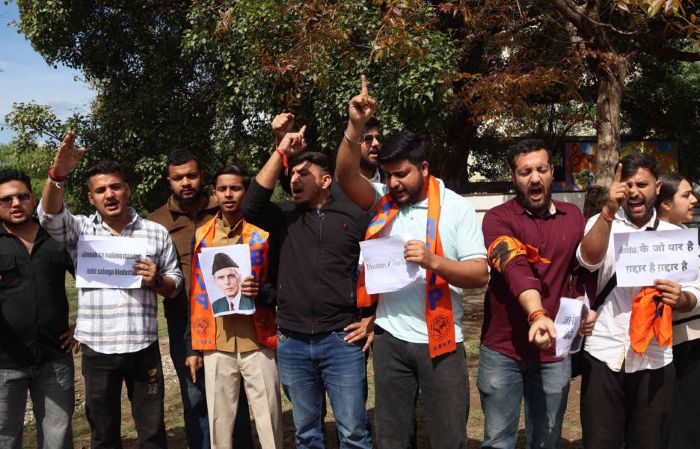
Assertion is not argument—and in the context of university education, it is often counterproductive. The threat of agitation by the Akhil Bharatiya Vidyarthi Parishad (ABVP) against revised history and political thought chapters at University of Jammu illustrates precisely this problem: a strong reaction unsupported by rigorous reasoning.
The controversy revolves around the inclusion of Muhammad Ali Jinnah (founder of Pakistan), Syed Ahmad Khan, and Muhammad Iqbal—all historically associated with Muslim political thought and, by extension, debates around Partition of 1947. It is pertinent to mention that Jinnah has long been part of the postgraduate political science curriculum at the university. Earlier, he was included in a chapter on the “two-nation theory,” discussed as a key idea behind the Partition of India. However, in the revised syllabus, Jinnah now appears in a chapter titled “Minorities and the Nations,” where he is presented as a leader of minorities in India.
Last week after the revised topics were revealed, ABVP which staged a protest in the campus contended that these very same individuals played a role in the partition of the country and propounded the Two-Nation Theory and therefore teaching about them poses a concern. Its spokesperson said that academic freedom should not disregard national sentiments and termed the decision “unacceptable” to students and adding if minorities are to be represented in the curriculum, figures who “genuinely worked for minorities” should be included, not those associated with the country’s division.
The department, led by its head, has defended the syllabus as pedagogically sound and nationally consistent. The argument is straightforward: political science education requires engagement with diverse ideological perspectives. Figures such as Vinayak Damodar Savarkar, M. S. Golwalkar, Mahatma Gandhi, B. R. Ambedkar, Jawaharlal Nehru, and Sardar Patel are also taught—not as objects of reverence, but as subjects of critical inquiry. Excluding Jinnah or others would not only distort intellectual inquiry but also disadvantage students preparing for competitive examinations like the NET, where such thinkers remain part of standardized curricula.
Following the protest, the university referred the matter to the Departmental Affairs Committee of the Political Science Department of the University and it has recommended removal of topics (PIPSTC 102 of the one-year Postgraduate Programme and course content of P2PSTC 302 of the Two-year PG programme in Political Science). The question here is the haste and unanimity shown by the review panel must be a cause of concern. A curriculum revision that was an academic exercise—aligned with National Education Policy 2020 and University Grants Commission guidelines—has instead been drawn into the vortex of political contestation. Politicians including Baramulla MP Engineer Rashid and others have started amplifying it and ultimately it may become a recipe of Muslim marginalization narrative. And for ABVP it is mere assertion.
More fundamentally, history education must move beyond selective remembrance. Scholars and students alike have a responsibility to examine the intellectual, political, and social currents that shaped the subcontinent. Removing influential figures from curricula risks impoverishing scholarship and weakening society’s ability to critically engage with its past.
If certain scholarly perspectives are considered—such as the argument that communal identities and extremisms were, in part, shaped or exacerbated by colonial strategies—then figures like Jinnah or others may be understood not merely as ideological drivers but also as actors within a larger geopolitical design. Some scholars argue that movements such as Darul Uloom Deoband and the spread of reformist ideologies were influenced, directly or indirectly, by broader colonial dynamics that included promotion of Wahabi ideology, including efforts that may have distanced communities from syncretic traditions.
The role of colonial policies in fostering communal divisions in British India, the later global dynamics of Cold War politics, and the instrumentalization of religious identity in conflicts—from South Asia to Afghanistan—underscore the need for nuanced, historically grounded analysis rather than reductive conclusions. This understanding may also help in deciphering and deal with the contemporary events shaping the perceptions.
In the end, education must resist the pull of political simplification. Universities are not arenas for enforcing consensus; they are spaces for cultivating informed disagreement. To replace argument with assertion, or inquiry with agitation, is to undermine both academic integrity and intellectual progress. A place like Jammu looking at becoming an education city can ill afford this.