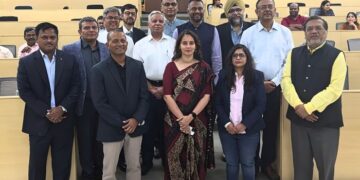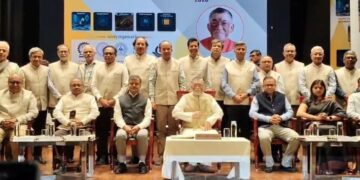


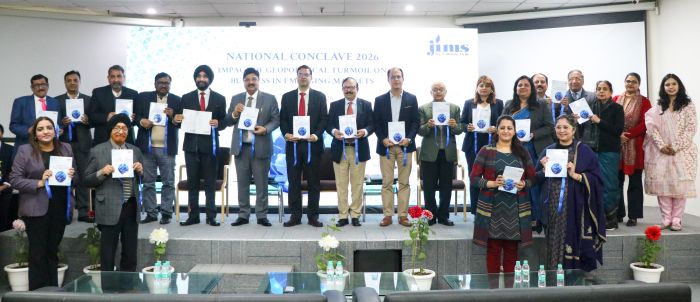
The PGDM-International Business Department of the Jagan Institute of Management Studies (JIMS), Rohini on Feb 5 organized the National IB Conclave 2026 on the theme “Impact of Geopolitical Turmoil on Business in Emerging Markets”. The objective of the conclave was to identify the sectors that face the biggest vulnerabilities and where the genuine opportunities lie.
The conclave began with an inaugural session that set the tone for the day by highlighting the new global order being shaped by trade shifts, conflicts, sanctions, and new global alliances. The speakers discussed the implications of the new global order for India’s global positioning and, by extension, for emerging markets dependent on global trade, finance, and energy.
Dr Ashok Bhagat, Dean – Corporate Relations and Placements, JIMS Rohini, delivered the keynote address, stating the relevance of the geopolitical issues given the contemporary global business environment and their impact on the Indian economy.
The first panel discussion, “Business Under Impact – Quantifying Challenges from Geopolitical Turmoil in Emerging Markets,” sought to translate geopolitical uncertainty into tangible economic facts. The panelists explored the challenges of trade disruption, commodity price volatility, risk of capital flows, and the growing need for companies to restructure supply chains and cope with rising operating costs.
The eminent panelists emphasized the need to promote Indian exports to new markets and shift dependence away from traditional markets like the USA. They deliberated upon China’s manufacturing capabilities of producing in large volumes and the support provided by the Chinese government through world-class infrastructure for boosting the secondary sector of the economy. They also emphasized on the need for quality improvement of Indian goods to make them more competitive in foreign markets. Furthermore, they highlighted that ease of doing should not just be a policy on paper but in practice.
The second panel, “India’s Way Forward – Strategic Responses to Geopolitical Turmoil,” explored how India can improve its preparedness against geopolitical turmoil by means of trade diversification, diplomatic strategies, energy partnerships, technology partnerships, and regional cooperation agreements. The panel focused on the need for a vision-driven approach to safeguard economic interests while making India more competitive in the rapidly changing global setting.
Key deliberations focused on addressing Balance of Payments (BOP) challenges through diversification of exports and imports, strategic utilisation of FTAs, promotion of local-currency trade, energy portfolio diversification, and strengthening Indian financial instruments. Growth opportunities were highlighted in fintech, digitisation, clean and green energy, EVs, defence manufacturing, and semiconductor development, supported by infrastructure upgrades and India’s manpower advantage.
The panels were addressed by renowned speakers, Dr Ashminder Singh Bahal, Founder Bahal Associates and Air Commodore, Indian Air Force; Mr Pravin Kumar, Deputy General manager, RBI; Mr Rahul Kashyap, Group Executive Director, PRP group; Mr Rajeev Bansal, CEO Celestial Lifestyle Ltd and VP Indian Industries Association; Ms Kavita Sirothia, General manager – International Business, Indogulf Cropsciences Ltd.; Mr Atish Yadav, Head IB, Delmonte Foods Pvt Ltd; Mr Nishit Kumar Sood, CEO BYLD Group; Mr Ratan Sehgal, Managing Director, Hybon Elevators & Escalators; Mr. Japneet Singh Sethi, Chief Growth Officer- Asia, iGaming (Alumni PGDM-IB 2013-15); Mr Ashish Jain, Deputy Director General & Regional Head (NR), FIEO; Dr MP Singh, Director- IB, Steel Master International (FZE), Dubai and Faculty JIMS Rohini, and Dr Krishna Murari Kumar, Faculty JIMS Rohini.
The conclave concluded on an optimistic note that, despite challenges such as rupee depreciation and rising capital costs, India is firmly moving in the right direction, aligning democratic values with strategic business interests.