

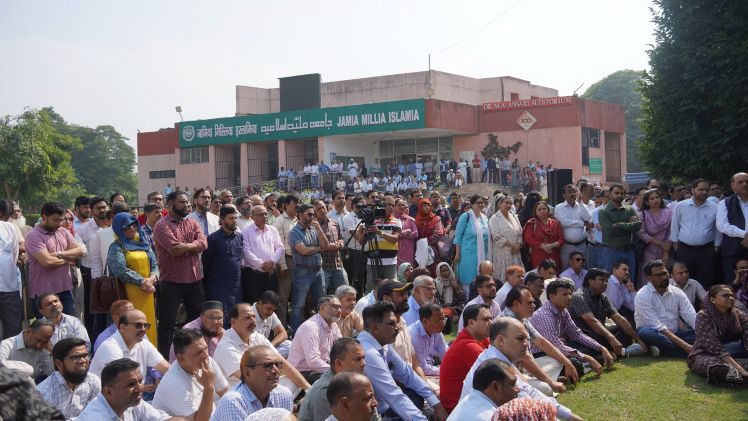
The protest at Jamia Millia Islamia (JMI) over the resumption of student union elections has reportedly been called off after the university administration announced that elections to the Jamia Millia Islamia Students’ Union (JMISU) would be held within a stipulated timeframe. An order issued on October 26 states: “The Jamia Millia Islamia Students’ Union Election will be held after 15 days, from the date of approval of the constitution of the Students’ Union of Jamia Millia Islamia.”
The order also addresses other demands raised by the protesting students, including the revocation of suspension orders and show-cause notices issued to them, and the formation of a committee to examine the role of security personnel in handling the protests that began on October 12. The students had been demanding a definite timeline for the election process and had called for the Proctor’s resignation.
The 106-year-old Jamia Millia Islamia, a premier central university, is the only central university in Delhi without an active student union. The last JMISU was constituted in 2006, but the union was subsequently suspended following recurring incidents of campus violence, including clashes, attacks on teachers and disruptions of academic activities.
The renewed demand for restoring student union elections comes amid a wider wave of student activism and protests across university campuses in recent months. Acknowledging the demand, the university administration constituted a committee on October 18 comprising Prof Zubair Meenai, Dean of Social Sciences, as the chairperson; Professor Luqman Ahmad Khan, Dean of Life Sciences; Professor Aslam Khan, NMPCR; Professor Amarjeet Singh, CNESRP; and Professor Neelofar Afzal, DSW, as members, to engage with the protesting students and explore a way forward. Sections 23(j) and 23(k) of the Jamia Millia Islamia Act, 1988, empower the university to frame statutes concerning institutional affairs, including student bodies and their functioning.
The committee held four rounds of discussions with the protesters and issued an appeal on the night of October 25, urging them to call off their agitation. However, the appeal initially failed to end the protest. Reports of vandalism and the defacement of campus walls with objectionable slogans further heightened tensions.
The developments prompted a meeting involving more than 1,500 teaching and non-teaching staff members, along with JMI Vice-Chancellor Prof. Mazhar Asif and Registrar Prof. Md. Mahtab Alam Rizvi, to deliberate on the situation and discuss the way forward. Concerns were reportedly raised over the students’ continued agitation and the involvement of leaders and representatives of local, regional and national political parties and groups. Faculty members expressed apprehension that these developments could further aggravate the campus atmosphere, potentially leading to disorder, vandalism and further defacement of university property.
Amid the escalating tensions, the university ordered that classes be conducted online and advised students not to attend classes on campus until further orders.
The administration’s October 26 order marks a significant step towards resolving the impasse. A formal response from the protesting students is awaited. Nevertheless, the agitation appears to have brought the long-standing demand for the restoration of student union elections closer to fulfilment.
The onus is now on the student community to ensure that the process moves forward constructively. While the restoration of an elected student body would provide students with a platform to represent their concerns, the experience of the past should also serve as a reminder of the need to preserve academic discipline, respect democratic processes and engage in constructive dialogue. The revived JMISU should emerge as an independent platform for student representation, free from undue external interference and avoidable provocations, where differences are debated democratically rather than allowed to escalate into confrontation.