

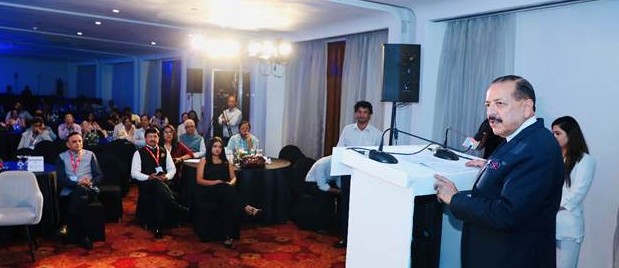
Health is no longer limited to being free from disease or receiving treatment for a particular ailment. It encompasses physical and mental well-being, the environment in which people live and work, work-life balance and overall ease of living. This changing understanding of health makes prevention and healthy living an important part of the healthcare approach. This was said by Dr. Jitendra Singh, Union Minister of State (Independent Charge) for Science & Technology and Earth Sciences and MoS PMO, Personnel, Public Grievances and Pensions, Atomic Energy and Space at the Health & Wellness Summit 2026 in New Delhi on September 25. healthy younger generation, he said, will be central to realising the vision of Viksit Bharat 2047.
The Minister, who is a diabetologist as well said that India’s substantial rise in life expectancy has also brought a changing disease profile. At the time of Independence, India’s average life expectancy was barely around 45 years; today, people are living considerably longer, while health challenges such as cardiovascular diseases and Type 2 diabetes, along with other lifestyle-related non-communicable diseases, have become increasingly prominent. He said that India’s health priorities must evolve alongside the country’s changing demographic and disease profile. The transition towards longer lives makes it increasingly important to ensure that people do not merely live longer, but also enjoy better physical and mental well-being.
He said that over the last decade, India has increasingly moved towards a broader understanding of health, with greater emphasis on Ayurveda, Yoga and wellness centres alongside modern healthcare.
The Minister said that science and technology have an important role in addressing emerging health challenges, particularly by developing solutions that are affordable, accessible and suited to local needs. India’s scientific ecosystem, he said, has demonstrated its ability to respond to major public health challenges, including during COVID-19, when Indian laboratories rapidly isolated and sequenced the SARS-CoV-2 genome, contributing to the development of indigenous vaccines.
He said that the focus now must also be on translating scientific research into technologies and products that can benefit large populations. Translational research, bringing together medicine, science, technology and industry, can help develop affordable diagnostics, biosensors, drug-delivery technologies and other healthcare solutions.
Dr. Jitendra Singh said that continued collaboration among medical practitioners, researchers, industry and other stakeholders will be important in developing practical solutions for emerging health challenges. The objective, he said, should be to build a healthier India in which preventive healthcare and wellness become an integral part of the country’s journey towards Viksit Bharat 2047.