

By Varun Juneja, Associate Director, CodingZen
 There’s more to coding than meets the eye: a broader, more applicable skill known as computational thinking. While coding is a method, computational thinking is an approach. And it’s not limited to computer science. It’s in every subject: math and science, of course, but also literature and history.
What Exactly Is Computational Thinking?
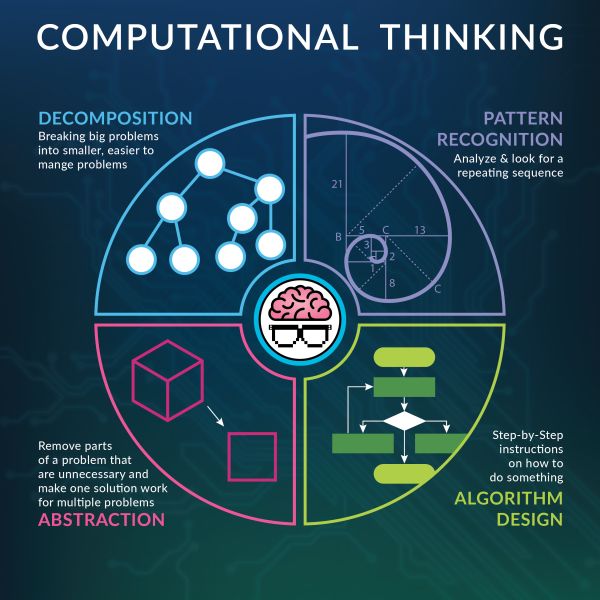
Computational thinking is a method of problem-breaking, seeing patterns, creating logical steps, and designing effective solutions. It encompasses essential skills such as
- Decomposition: Dividing a large task into smaller pieces
- Pattern Recognition: Seeing similarity and trends
- Abstraction: Picking the essence, leaving the rest out
- Algorithmic Thinking: Developing a step-by-step solution to problems
Think of it as being able to think like a coder, even though you’re not one.
Why All Subjects Require It—Science & Math
These subjects already pay off with logical thinking and problem-solving, but computational thinking can take them to the next level. For example, a biology major can apply abstraction to simulate how a virus is transmitted. In mathematics, algorithmic thinking assists students in coming up with step-by-step procedures to solve equations or proofs. It renders learning more intuitive and application-oriented.
Literature & Languages
Unexpectedly, computational thinking actually improves how students read between the lines in stories, dissect text, or organise essays. Decomposition facilitates the dismantling of a story, while recognition of patterns assists in spotting literary themes. Even grammar, when learnt in terms of algorithms, is simpler to understand.
History & Social Studies
Learning history tends to be about examining cause-and-effect sequences and comprehending sophisticated systems such as revolutions or political transitions. Here, computational thinking assists learners in creating organised ways of thinking through historical information and social trends. Abstracting the essence of things and keeping context retains depth of understanding.
Art & Design
Designers and artists tend to use predetermined steps or patterns, be it painting, animation, or computer prototype. Computational thinking cuts these artistic processes short, particularly in digital design, where common sense and art mesh together beautifully.
Outside the Classroom: A Lifelong Skill
The true strength of computational thinking is its ability to be universal. It not only shows students what to think but also how to think. It enables them to:
- Work with real-world problems in the most efficient way
- Deal with big and complicated work
- Adopt ambiguity and make a clear structure
- Be consistent but adaptable
No matter if students become engineers, writers, architects, or business entrepreneurs later in life, this thought pattern equips them to face unanticipated problems with assurance.
From Coding to Curiosity
One of the most compelling advantages of computational thinking is the way that it fosters curiosity. The act of decomposing problems and recomposing them stimulates exploration. It leads students to ask improved questions—not merely What’s the answer? But “why does this work? and “Is there a better way?
It also supports a growth mindset. When students make mistakes, they learn to do it differently. They discover that errors are not fatal but merely data—something to examine, comprehend, and add to.
Rethinking How We Teach
To infuse computational thinking throughout subjects, education systems must change:
- Curriculums must emphasise thinking strategies, not merely memorised content.
- Teachers must be trained to incorporate problem-solving in all lessons.
- Assessments should reward creativity, logic, and flexibility, not just final answers.
- Early education should introduce these skills through puzzles, games, and storytelling.
In the race to prepare students for the future, coding is often viewed as the ultimate skill. But it’s computational thinking—thinking, the foundation of coding—that holds the key to long-term success.
Through instruction that encourages students to think logically, creatively, and flexibly, any subject can be used as a springboard for curiosity. And thus, education transforms from memorisation to meaningful knowledge.
When computational thinking becomes a customary practice in the classroom, curiosity becomes a way of life.