

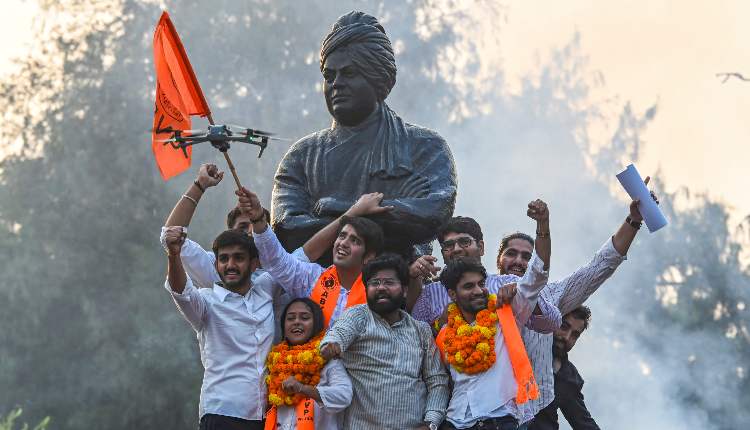
The Akhil Bharatiya Vidyarthi Parishad (ABVP) secured three of the four central-panel positions in the Delhi University Students’ Union (DUSU) elections, with Yash Dabas winning the presidency, Riya Chhawdi the secretary’s post and Lakshya Raj Singh the joint secretary’s position. Independent candidate Deepanshu Shokeen won the vice-presidential contest, marking the return of an independent candidate to the post after 17 years, according to media reports.
Polling was held on September 18, with the results declared on September 19. Voter turnout was reported at 40.46 per cent.
Yash Dabas, the president-elect, graduated from Sri Guru Tegh Bahadur Khalsa College and is pursuing master’s studies in Buddhist Studies at Delhi University’s Department of Buddhist Studies. Deepanshu Shokeen, the vice-president-elect, completed his B.A. from Shaheed Bhagat Singh College and is also pursuing postgraduate studies in Buddhist Studies at Delhi University. Riya Chhawdi, the secretary-elect, is a fourth-year B.A. Programme student at Sri Aurobindo College. And, Lakshya Raj Singh, the joint secretary-elect, studied Political Science at Sri Guru Tegh Bahadur Khalsa College and is pursuing law at the Campus Law Centre.
Dabas defeated National Students’ Union of India (NSUI) candidate Vijay Shankar Meena by 2,053 votes in the presidential election. He secured 24,576 votes against Meena’s 22,523, while the Left alliance candidate received 5,377 votes.
Shokeen, a former NSUI member who contested as an independent, won the vice-presidential post by 13,705 votes, securing 30,615 votes against ABVP’s Ishu Maurya, who polled 16,910. The outcome leaves ABVP in control of the presidency and two other central-panel positions, while NSUI failed to win any of the four posts.
The presidential contest was considerably closer than the vice-presidential election. Dabas’s margin of 2,053 votes contrasted with Shokeen’s 13,705-vote victory, making the vice-presidential contest the most decisive of the four central-panel races.
ABVP’s victory in three positions preserves its presence at the top of the union’s leadership. Riya Chhawdi won the secretary’s post with 21,650 votes, defeating NSUI’s Namrata Chaudhary, who secured 14,869 votes. Lakshya Raj Singh won the joint secretary’s position with 16,615 votes, narrowly defeating Samajwadi Chhatra Sabha candidate Vishesh Yadav, who polled 15,778 votes. NSUI candidate Gopal Choudhary finished third with 15,206 votes.
The joint secretary contest was the closest of the four central-panel elections, with a margin of 837 votes between the top two candidates.
Shokeen’s victory is one of the defining features of the 2026 election. A former NSUI member, he contested independently and secured the vice-presidential post outside the official backing of the major student organisations.
His victory comes amid continuing debate over the role of organisational affiliations in student elections. It also places an independent representative on a central panel otherwise dominated by ABVP. Meanwhile, NSUI presidential candidate Vijay Shankar Meena announced his intention to approach the court, alleging irregularities during the voting process.
The NSUI’s failure to win any of the four central-panel positions is another significant feature of the results. Its performance is likely to prompt discussion about candidate selection, campaign strategy and its ability to translate student concerns into electoral support. However, the election figures alone do not establish the reasons behind individual voting decisions.
The AISA-SFI alliance contested the central-panel elections, with its presidential candidate receiving 5,377 votes. The alliance’s participation added another organisational presence to the contest beyond ABVP and NSUI.
Its performance should be assessed through the vote totals in each contest, the issues raised during campaigning and the response of students across different colleges. The results alone cannot establish whether specific campaign issues influenced individual voting decisions.
After his election, Dabas told the media: “Our first and foremost priority will be to conduct a safety audit of every PG and hostel, because we do not want an incident like the one in Satya Niketan to happen to anyone in the future.”
The elected central panel will assume office amid continuing concerns about campus infrastructure, accommodation and student safety. For ABVP, the results provide three positions from which to pursue its stated priorities. For NSUI and the Left alliance, the outcome raises questions about their campaign strategies and future engagement with students.
The new leadership’s effectiveness will ultimately depend on how it follows up on campaign commitments, engages with university authorities and sustains student representation beyond the election campaign.