

Despite being a subject close to the hearts of the founding fathers of independent India, the debate over school education remains far from settled. While discussions, demands and policy interventions have evolved in response to contemporary trends and changing priorities, the fundamental architecture of school education is yet to be resolved. At least, that is how it appears.
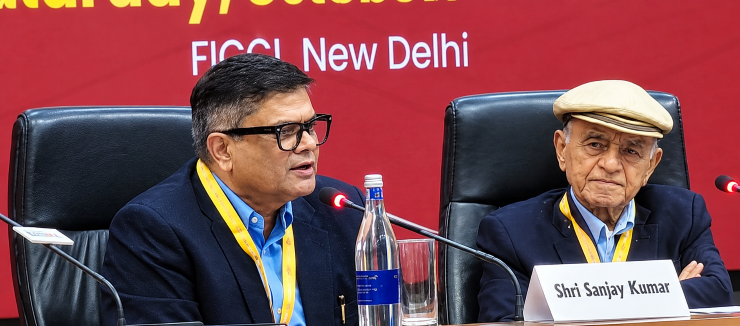
Sanjay Kumar, a former Secretary of the Department of School Education and Literacy who retired earlier this year, made three important observations about India’s school education system during a conversation with columnist- public intellectual Gurcharan Das at the National School Choice Conference organised by the Centre for Civil Society (CCS) in New Delhi on October 31. He highlighted three critical questions: What is the optimal size of a school? How much should be budgeted to run schools effectively? And what structural reforms are needed to address fragmentation in the system?
Kumar pointed to the Right to Education (RTE) Act’s distance norms, which led to the establishment of a large number of primary schools across the country. These account for about half of all schools, with a significant percentage of them having fewer than 200 students. He argued that the resulting fragmentation has deprived the school education sector of the benefits of economies of scale, unlike the healthcare sector, where the economics of service delivery are better understood.
Drawing a comparison with China, Kumar noted that India has approximately 14.7 million schools catering to 25 million children, while China has 29 million students studying in around 4.7 million schools. He also highlighted the existence of 18 different types of schools in India, describing this multiplicity as a structural problem that affects student retention.
Emphasising the need for more K-12 schools to ensure continuity in a child’s academic journey, Kumar observed that an Indian student typically goes through an average of three school admissions during the course of schooling. He cited Chandigarh as a model where schools have provided greater stability and continuity in this regard.
On the question of funding, Kumar challenged the commonly held argument that simply increasing expenditure on schools would necessarily improve learning outcomes. Citing this year’s PISA results, he referred to Luxembourg, which remains one of the highest-spending nations per student in the OECD (Over $31,000 USD PPP) annually per pupil), yet its mean scores lag behind several countries (it ranked 35th in 40 countries) with lower per-student investment. Several countries that spend considerably less have performed better.
His argument, however, was not against adequate funding. Rather, he stressed that expenditure should not fall below the optimal level required to ensure effective schooling.
Addressing the shift of students from government to private schools and the aspirations of parents, Kumar said that the preference for private education is often driven by the values and perceptions associated with these institutions. He said that some of this perceived value is already under challenge. He said as children study in both setting, governments are bound to look after them and issues of regulations.
He pointed out that more than 97% of schools in Japan and around 85% in the United States are government-run, and asked why the debate over the effectiveness of government schools remains so persistent in India.
“How come they can do it and we cannot? This is a question of introspection,” he said.
Kumar argued that government schools should set benchmarks for private institutions while addressing issues of equity and access. India already has successful examples in the form of Jawahar Navodaya Vidyalayas (JNVs) and Kendriya Vidyalayas (KVs), which have demonstrated that government-run schools can deliver quality education.
He also challenged the perception that government schools, because they provide free education, are somehow less accountable. Teachers in these institutions, he said, operate under a social contract that requires them to fulfil their responsibilities towards students and society.
Improving classroom transactions, strengthening teacher competence and motivation, and ensuring greater empowerment and accountability are all essential to making the school education system more effective.
Kumar noted that there is now evidence of improvements in foundational learning under NIPUN Bharat, the national initiative aimed at ensuring foundational literacy and numeracy among children. However, he expressed concern that learning outcomes tend to decline progressively as students advance through the school system.
This, he suggested, calls for greater attention to secondary education, where the gains made during the foundational years need to be sustained and strengthened.
He also emphasised the need to examine the larger political and cultural issues surrounding school education, arguing that these have a significant bearing on policy choices and can sometimes lead to unproductive decisions.

His observations brought the debate back to a fundamental question: Is India’s school education system structured to deliver quality, continuity and equitable learning outcomes for every child? Addressing this challenge, he suggested, requires more than incremental reforms. It calls for a fundamental rethink of how schools are organised, funded and held accountable.